Accounts Receivable Management: Process, Metrics, Tips

Accounts Receivable Management: Process, Metrics, Tips
Accounts receivable management is how you invoice customers, track what they owe and collect it on time. It covers everything from the credit decision before a job starts to the moment the money lands in your account. Done well, it keeps cash flowing and cuts the number of invoices that turn into write-offs. This guide walks through the process step by step, the metrics worth watching and the habits that get service businesses paid sooner.
TL;DR
- Accounts receivable (AR) management means checking credit, invoicing, tracking payments, collecting and resolving disputes. It starts before the sale, not after the invoice.
- Invoice the day the work is done. The payment clock does not start until the customer has the invoice.
- Review an aging report weekly and escalate overdue invoices on a fixed schedule, from friendly reminder to formal notice.
- Track a few numbers consistently: days sales outstanding (DSO), collection effectiveness, bad debt and aging buckets.
- For field service teams, linking work orders, invoices and payments in one system removes most manual follow-up.
Table of Contents
- 📋 What accounts receivable management means
- 🔁 The accounts receivable process, step by step
- 📊 Metrics that show whether it is working
- ⚙️ Using software to keep receivables moving
- 💬 Our perspective
- 🚀 Put it into practice with Firmanager
- ✅ A checklist to start this week
- FAQ
- Sources
📋 What accounts receivable management means
When you complete a job and send an invoice instead of taking payment on the spot, you create a receivable: money a customer owes you. Managing those receivables means tracking, invoicing and collecting payments from customers who buy on credit. The goal is on-time payment, fewer unpaid invoices and steady cash flow.
The finance textbook OpenStax Principles of Finance puts it plainly: for any business that sells on credit, receivables management is critical to cash flow, profitability planning and long-term viability. It also notes that the work begins before the sale, when credit approval, credit terms, cash discounts and credit limits have to be decided.
That last point matters for service companies. A cleaning contractor or HVAC firm often does the work first and bills afterward. Every day between the finished job and the cleared payment is money you have already spent on labor, parts and fuel.
Why it matters for results
The evidence supports treating this as a core function, not back-office housekeeping. An academic study of firms listed on the Nairobi Securities Exchange found a strong positive relationship between receivables management and financial performance (r = 0.723, p < 0.01). The authors conclude that efficient management speeds up cash inflows, reduces bad debts and improves liquidity. It is one market and one sample, but the direction matches what most owners see in their own books.
Payment delays are also a widespread problem. Intrum’s European Payment Report 2026 found that the average European business gives corporate customers 43 days to pay but is paid after 63 days, a 20-day gap that ties up working capital. Those figures describe Europe, and your own numbers will differ, which is exactly why measuring them matters.

🔁 The accounts receivable process, step by step
Guides slice the cycle differently. Some list five steps, others seven or nine. They all cover the same ground. For a service business, these are the stages that matter, in order.
1. Evaluate credit before you agree to terms
Decide who gets credit and how much. For new commercial customers, check a credit report or company registry entry, ask for trade references and set a credit limit. For existing customers, look at payment history. OpenStax notes that credit managers judge creditworthiness using financial statements, financial ratios and credit reports based on payment history, and that prior payment history with you counts when it exists.
A useful shortcut is the five Cs of credit: character, capacity, capital, collateral and conditions. Allianz Trade explains the five Cs as a way to judge the likelihood of default and the possible loss if you extend credit. In practice:
- Character: Does this customer have a record of paying vendors on time?
- Capacity: Does their cash flow support the size of the contract?
- Capital: How much financial cushion does the business hold?
- Collateral: Are there assets that could settle an unpaid invoice?
- Conditions: What is happening in their industry or the wider economy that could affect payment?
You do not need a formal scorecard for a $400 maintenance visit. You do want one for a $40,000 annual service contract.
2. Set clear payment terms
Put the terms in the quote, the contract and the invoice: the due date (a specific date, not just “net 30”), accepted payment methods and any late fee you have agreed. If a project is large, split the billing. Our guide to deposit invoices shows how to collect part of the amount up front so you are never carrying the whole cost of a job.
3. Invoice promptly and accurately
Send the invoice as soon as the work is complete. Every day you wait delays the due date by a day. A good invoice states the work completed, the amount due, the payment deadline and who to contact with questions. Errors invite disputes, and disputes stall payment.
For field teams, the delay usually comes from paperwork: a technician finishes at 3 p.m., the notes reach the office the next morning, and the invoice goes out the day after. Connecting the work order to the invoice closes that gap. If your technicians log hours, time tracking that closes billable gaps keeps unbilled labor from slipping through.

4. Track payments and apply cash
Once an invoice is out, you need to know its status at any moment: sent, viewed, partly paid, paid or overdue. Reconciliation is the matching of incoming payments to the right invoices, and it is the step that most often falls behind. If you accept card payments, our Stripe payment reconciliation guide shows how to match payouts to invoices so your ledger reflects reality.
Recurring customers are easier to manage when payment is automatic. How recurring payments work in practice explains the mechanics of charging customers on a schedule, which suits maintenance contracts and subscriptions.
5. Collect overdue balances on a schedule
Choose your collections sequence in advance and apply it to everyone. A typical ladder looks like this:
- A courtesy reminder a few days before the due date.
- A friendly note the day after the due date.
- A phone call at about 7 to 14 days overdue.
- A formal written notice at about 30 days overdue.
- A final demand, then a collection partner or legal advice for balances that remain unpaid.
The exact timing should fit your terms and customer base. What matters is consistency: customers learn quickly whether your due date is real.
6. Resolve disputes fast
Most late payments with good customers come from a question: the wrong PO number, a disagreement about scope, a missing signature. Assign one person to own each dispute, record the issue against the invoice and resolve the undisputed part of the balance separately when you can. Quick answers protect the relationship and the cash.
7. Handle bad debt
Some invoices will not be paid. Decide in advance when you stop work for a customer, when you escalate to a collection agency and when you write a balance off. Doing it by policy keeps decisions consistent and keeps emotion out of the call. For tax and accounting treatment of write-offs, talk to your accountant, because the rules depend on your jurisdiction and accounting method.
📊 Metrics that show whether it is working
You do not need a dozen dashboards. A handful of numbers, reviewed on a regular rhythm, tells you most of what you need.
| Metric | What it tells you | How to calculate it |
|---|---|---|
| Days sales outstanding (DSO) | Average days to collect after a sale | (Accounts receivable ÷ credit sales) × days in the period |
| Aging report | How much is current, 31 to 60, 61 to 90 and 90+ days late | Group open invoices by days past due |
| Collection effectiveness index (CEI) | Share of collectible receivables you actually collected | Collected ÷ collectible in the period |
| Bad debt ratio | Share of credit sales that never gets paid | Written-off debt ÷ credit sales |
| Invoice dispute rate | How often invoices are challenged | Disputed invoices ÷ invoices sent |
Paystand lists the same core set of AR measures: DSO, collection effectiveness, receivables turnover, bad debt ratio and the percentage of AR that is current. Treat published benchmark ranges as rough guides only, because healthy DSO differs a great deal between industries and contract types. Your best benchmark is your own trend over the last four quarters.
A simple review rhythm
- Daily: Check which payments arrived and apply them to invoices.
- Weekly: Read the aging report, call the largest overdue accounts and confirm that every finished job has an invoice.
- Monthly: Calculate DSO and bad debt, and compare them with the previous month.
- Quarterly: Review credit limits and terms for your biggest customers.
The aging report deserves the most attention. Collection becomes harder with age, and overdue balances are far more likely to go unpaid the longer they sit. Starting at the oldest and largest invoices gives you the most cash for the least effort.
⚙️ Using software to keep receivables moving
Spreadsheets work until the volume grows. Then the cracks show: invoices created from memory, payments matched by hand, reminders sent only when someone remembers. Software helps in three places:
- Faster invoicing. Electronic invoices arrive immediately, and templates reduce errors.
- Automatic reminders. Scheduled messages by email or SMS keep follow-up consistent without anyone having to chase.
- Real-time visibility. When payment status updates as it happens, you spot a late invoice before it becomes a collection problem.
If your accountants and office staff share documents, a clear document workflow plan for accounting keeps invoices, approvals and records from getting lost between people. And if you connect your sales records to your books, our piece on a CRM and accounting integration shows how to map the flow from customer record to invoice.
💬 Our perspective
Most receivables problems in service companies are not collection problems. They start in operations. A job is finished but nobody marks the work order complete. The invoice waits for someone to type it up. The customer record in the CRM does not match the billing contact. By the time the invoice goes out, the opportunity for fast payment has already passed.
That is why we built Firmanager as one platform instead of separate tools. Our design connects CRM, work orders, field service, time tracking, invoicing and reporting under one login, so the data that starts a job is the same data that bills it. When a technician closes a work order on the mobile portal, the information needed to invoice is already there.
We also believe managers should see receivables the way they see the schedule: in real time. A cloud-synced platform means the person in the office and the person on site look at the same numbers. Invoicing with Stripe integration supports online payment, and notifications by SMS and email support timely reminders.
Our advice is simple. Shorten the path from finished work to sent invoice, make payment easy, follow a collections schedule that you apply to everyone, and review your aging report every week. A platform should make that routine easier, and that is what we aim to deliver.
KaiosMedia
🚀 Put it into practice with Firmanager
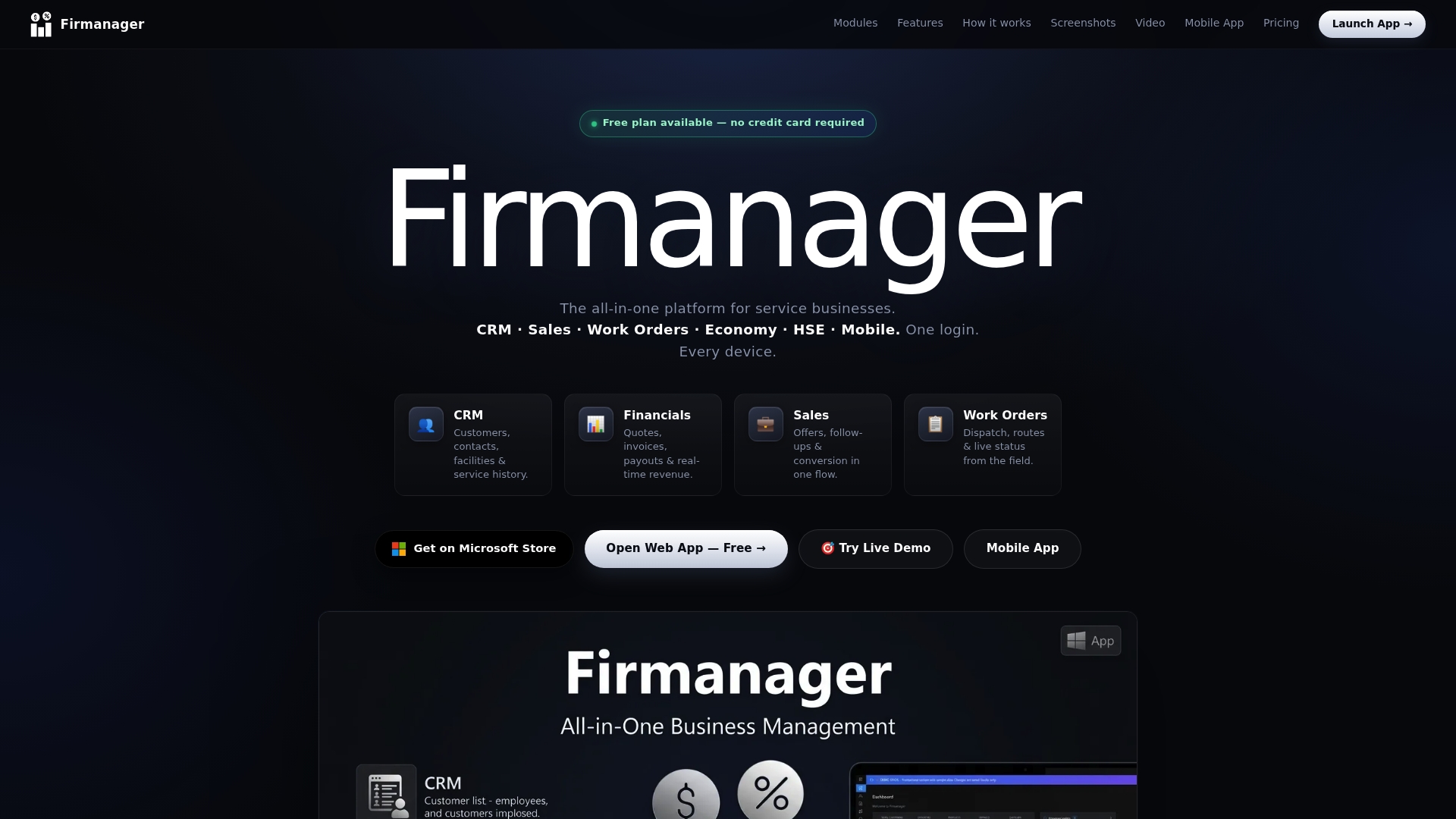
Firmanager is an all-in-one business management platform for service companies. It brings together customer management, work orders, quoting, invoicing with Stripe integration, time and leave tracking, route and dispatch, HSE compliance and real-time financial analytics, all accessible from any device.
Plans are published on our site:
- Free: $0
- Pro: $19 per month
- Business: $49 per month
See the Firmanager plans to compare what each includes, or log in to the app if you already have an account.
If you manage recurring maintenance visits, recurring task automation shows how scheduled work can feed straight into scheduled billing.
✅ A checklist to start this week
- Write down your standard payment terms and put them on every quote and invoice.
- Set a credit limit for each commercial customer, starting with your five largest.
- Make a rule that every completed job is invoiced the same day.
- Pull your aging report and call the three largest overdue accounts.
- Write your collections ladder, with timing and owner for each step.
- Calculate your DSO today so you have a baseline to improve on.
- Offer a simple online payment option on every invoice.
FAQ
What are the 5 Cs of accounts receivable management?
The five Cs are character, capacity, capital, collateral and conditions. Credit teams use them to judge how likely a customer is to pay and what loss is possible if they do not. Apply them most carefully to large or new commercial accounts.
What is the best way to manage accounts receivable?
Check credit before you extend terms, state the due date clearly and invoice immediately after the work is done. Then track payment status, review an aging report weekly and follow a fixed collections schedule. Software that links work orders to invoices makes each step faster.
What does accounts receivable management mean?
It is the set of processes a business uses to make sure it is paid for goods or services it has already delivered on credit. That includes invoicing, payment tracking, collections, reconciliation and dispute resolution. Dun & Bradstreet frames it as knowing what is owed, who owes it and when it will be paid.
How is AR management different from accounts payable?
Accounts receivable is money customers owe you. Accounts payable is money you owe suppliers. Both affect cash flow, but receivables management focuses on getting paid faster, while payables focus on paying on time and on the best terms.
Sources
- OpenStax: 19.4 Receivables Management, Principles of Finance 2e
- Accounts Receivables and Financial Performance of Listed Firms (Nairobi Securities Exchange study)
- Intrum: What is accounts receivable management and why does it matter
- Allianz Trade: Customer Creditworthiness
- Dun & Bradstreet: Accounts Receivable Management
Recommended
Run your whole business in one place
CRM, quotes, work orders, invoicing, expenses, HR and HSE — one login, every device. Free-forever plan.
Start free →