Pilot One Flow: Mapping First CRM Accounting Integration for IT

Pilot One Flow: Mapping First CRM Accounting Integration for IT
CRM accounting integration connects your sales records to your ledger so invoices generate automatically, payments post without manual entry, and cash gets reconciled faster. Most teams should start small: pilot one flow, typically Closed Won deals triggering invoices, before connecting everything else. The payoff shows up quickly once you see fewer manual entries and a shorter invoice-to-cash cycle.
TL;DR:
- Connecting CRM and accounting systems reduces manual data entry, shortens the invoice-to-cash cycle, and improves reconciliation accuracy.
- Prioritize real-time sync for payment, deal, and invoice data, while less critical information like pricing can update hourly or daily.
- Use native connectors or unified APIs for easier maintenance, but customize flow triggers for revenue-critical processes to ensure timely updates.
- Maintain strict idempotency rules and a clear mapping CSV to prevent duplicate records and facilitate troubleshooting during pilot phases.
- Continuous monitoring of success rates, latency, and exception queues helps catch issues early and keeps the integration aligned with business operations.
Table of Contents
- Why integrate CRM and accounting: benefits and use cases
- Priority data flows to synchronize (what to do first)
- Integration architectures and trade-offs (native connectors, iPaaS, unified API, custom)
- Field mapping, idempotency, and reconciliation rules
- Sync strategy: webhooks vs polling and recommended frequencies
- Implementation checklist and pilot plan
- Operating the integration: SLIs, common failures, and governance
- Why integration deserves a place on the product roadmap
- Firmanager: a direct option to reduce connectors and reconciliation scope
- Sources
- FAQ
Why integrate CRM and accounting: benefits and use cases
When your CRM and accounting platform work from the same data, your finance team stops re-typing deal terms into invoices and your sales team stops guessing whether a customer has paid. The connection removes duplicate entry, which is where most reconciliation errors start.
Service businesses that connect these systems typically see the invoice-to-cash cycle shrink, since invoices generate the moment a deal closes rather than after someone remembers to create one. Sales reps also gain visibility into accounts receivable directly inside the CRM, so they know which customers are current before they pitch an upsell.
Common use cases include:
- Automated invoice creation the moment a deal or work order closes.
- Payment posting that updates CRM records without a manual export step.
- Subscription revenue triggers that fire recurring invoices on schedule.
- A consolidated customer view that shows sales, service, and billing history in one place.
To know whether the integration is working, track a few KPIs: the auto-match rate for payments against invoices, the age of unresolved exceptions, and the lag between a deal closing and its invoice appearing. These three numbers tell you more about integration health than any dashboard summary.
Priority data flows to synchronize (what to do first)
Not every record needs real-time sync on day one. Rank your flows by business impact and start with the ones that touch cash directly.
- Contacts and accounts to customer records. Decide which system masters the customer profile, usually the CRM for sales-owned fields and accounting for tax and billing details, and match on a stable key like email domain plus company name.
- Deals or quotes to invoices. Trigger invoice creation the moment a deal reaches Closed Won, mapping deal terms directly into invoice line items.
- Payments to payment records or bank deposits. Use webhooks where the payment processor supports them, matching on
payment_idrather than amount alone. - Invoice status back to the CRM. Sales teams need to see paid, overdue, or disputed status without opening the accounting system.
- Products, items, and price lists. These change infrequently, so a nightly or hourly batch sync is usually sufficient.
Flows one through three touch revenue directly and deserve near-real-time treatment. Flow five can safely run on a schedule, since stale pricing for a few hours rarely causes harm.
Integration architectures and trade-offs (native connectors, iPaaS, unified API, custom)
Architecture is shifting away from custom point-to-point builds toward approaches that normalize provider differences for you, which cuts long-term maintenance work considerably according to analysis of accounting software integration.
- Native vendor connectors deploy fastest and require no code, but they limit how much you can customize field mapping or add business logic.
- iPaaS platforms like Make, Workato, or Celigo offer visual mapping and lower engineering effort than custom code, while still giving you control over transformation rules.
- Unified accounting APIs let you build once against a single interface that normalizes invoices, payments, and contacts across multiple accounting platforms, handling authentication and rate limits centrally, which Unified’s documentation describes as reducing ongoing maintenance to near zero for the consuming team.
- Custom integrations give you maximum control over edge cases but carry the highest long-term maintenance burden, since every provider API change becomes your problem to fix.
For most service businesses, the right starting point is whichever option gets a working pilot in front of finance fastest. You can always migrate to a more controlled architecture once you know which flows matter most.
Field mapping, idempotency, and reconciliation rules
Every write to the accounting system needs a canonical integration_id so re-running a sync never creates a duplicate invoice or payment. This single discipline prevents the majority of reconciliation headaches teams run into during rollout.
A basic field mapping might look like this:
| CRM field | Accounting field | Notes |
|---|---|---|
| deal_id | invoice.integration_id | Idempotency key for invoice creation |
| payment_id | payment.payment_id | Primary reconciliation key |
| customer_id | customer.external_id | Used for account mastering |
| amount | invoice.total | Validate currency before write |
Reconciliation should follow a priority order: match on payment_id first, fall back to invoice number plus amount, and only use customer plus amount plus a date window as a last resort. Edge cases like processor fees, partial payments, and currency conversions need explicit handling rules or they will silently break your match rate. A ready-made CRM-to-accounting mapping template gives you a CSV structure with these exact fields, which speeds up pilot setup considerably.
Pro Tip: Run your mapping CSV past both the sales ops lead and the controller before writing any code. Field names that make sense to one team rarely make sense to the other.

Sync strategy: webhooks vs polling and recommended frequencies
Webhooks and batch polling both have a place, and the right choice depends on how much the delay costs you if data goes stale.
- Use webhooks for payments and payment status, since a delayed payment update can lead a sales rep to chase a customer who already paid; secure these endpoints with signature verification.
- Sync closed-won-to-invoice flows near real time, aiming for a window of one to fifteen minutes rather than instant, which gives you room to batch validation checks.
- Batch sync catalogs, price lists, and reporting data on an hourly or daily schedule, since these rarely need to be current to the minute.
- Build polling fallbacks for systems without native webhooks, since webhook coverage varies widely across ERP and accounting platforms, and a hybrid approach that pings and pulls where events aren’t available keeps behavior consistent.
- Plan for rate limits and retries with exponential backoff, since a burst of activity after an outage can otherwise trigger a second outage on the receiving end.
Treat the webhook-versus-polling decision per flow, not as a single architecture-wide choice. Payments deserve urgency that a monthly product catalog update does not.
Implementation checklist and pilot plan
A successful rollout follows a specific order, and skipping steps tends to surface as reconciliation errors weeks later rather than immediate failures.
- Choose one pilot flow and define success metrics up front, such as auto-match rate and exception count.
- Assign a system of record for every entity and every contested field, so there’s never ambiguity about which system wins a conflict.
- Build the mapping CSV with transformation rules and confirm every write carries an idempotency key.
- Run a load test with realistic volume before connecting live data, catching failures that only appear under concurrent writes.
- Verify reconciliation against the actual bank feed, not just against the accounting system’s internal records.
- Set up monitoring, alerting, and a runbook with a named owner before the pilot goes live, not after something breaks.
Following a structured CRM-ERP integration checklist that starts with three to five high-value flows and layers in monitoring before scaling tends to catch the majority of mapping issues before they reach production. Teams that skip the dry-run step often discover their edge cases the hard way, during month-end close.
Operating the integration: SLIs, common failures, and governance
Once live, treat the integration as a service with its own uptime expectations, not a one-time project you can walk away from.
- Track success rate, p95 latency, and dead-letter-queue size as your core service-level indicators.
- Separate transient failures from permanent ones, since a rate-limit error deserves a retry while a mapping mismatch deserves a human.
- Set a reconciliation cadence, whether daily or weekly, and track exception aging so unresolved items don’t quietly pile up.
- Budget for ongoing maintenance, since provider API changes and edge cases tend to consume roughly 15 to 25% of the initial build cost each year as a rough planning figure.
Drift between systems is normal and expected. The goal isn’t zero drift, it’s catching it within your reconciliation window before it compounds.
Why integration deserves a place on the product roadmap
Integration work behaves like product work: it needs observability, ownership, and a maintenance budget, not a one-time build and a shrug. Service businesses running Firmanager’s combined CRM and invoicing modules reduce the number of connectors they need in the first place, since customer and billing data already share one system. Fewer connectors mean less reconciliation surface to monitor.
— KaiosMedia
Firmanager: a direct option to reduce connectors and reconciliation scope
Every connector you build is another thing that can break at 2 a.m. Firmanager takes a different route: CRM, invoicing, work orders, and financial reporting live in one platform, so the customer record that closes a deal is the same record that generates the invoice. There’s no mapping file to maintain because there’s no second system to map against.
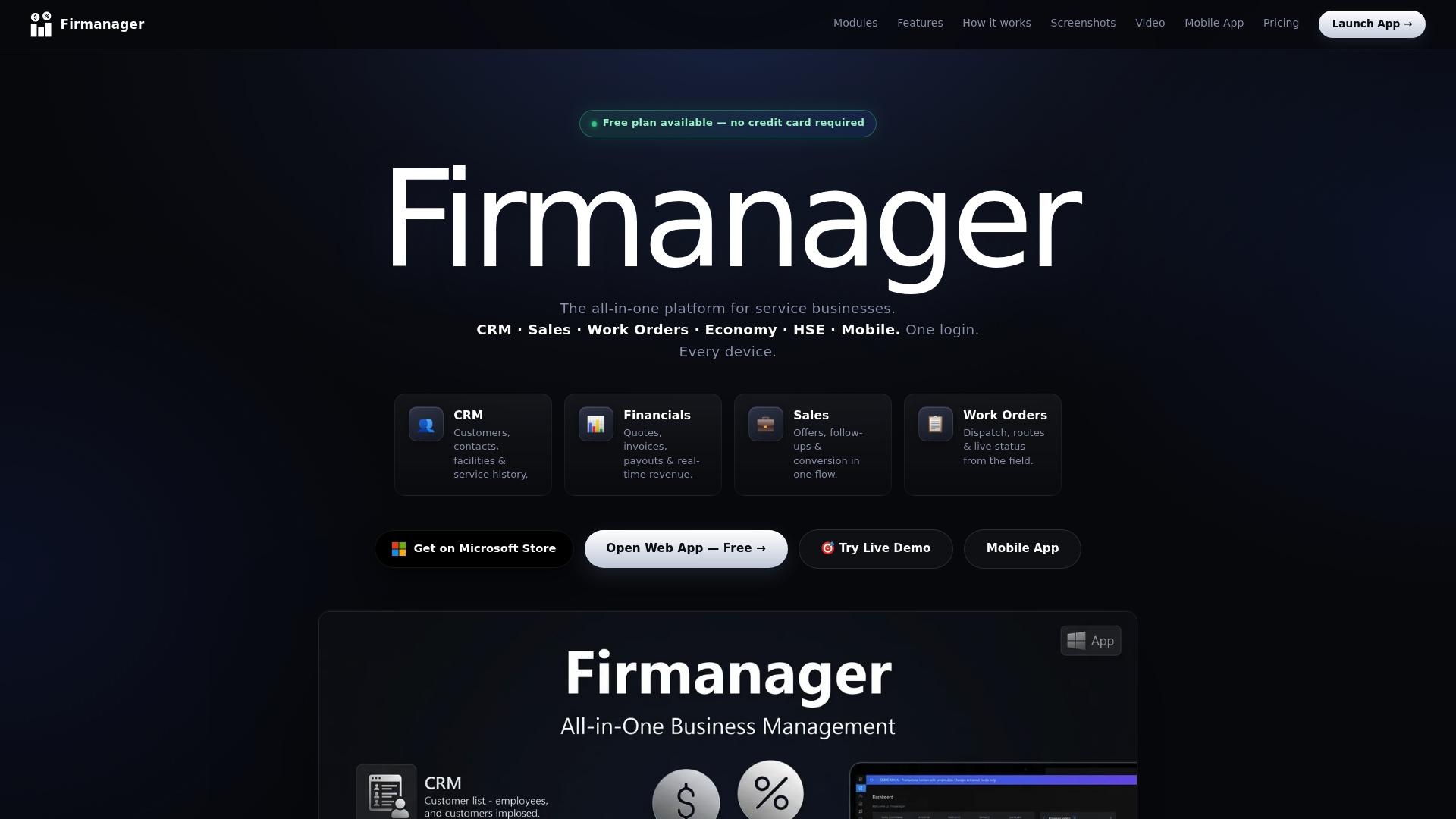
For service businesses, that means:
- Automated invoicing tied directly to work orders and deals, with no export or sync step.
- Real-time financial analytics that reflect the same data your sales team sees.
- One login across devices, so field staff, office managers, and finance all work from the same source of truth.
Firmanager offers multiple subscription plans, including a free option and paid tiers available monthly. If reconciliation overhead is eating your finance team’s week, start a free trial and see what a single connected system looks like for your business.
Sources
- Accounting software integration — Apideck
- Unified Accounting API overview — Unified
- CRM–ERP integration: architecture, data flows & mistakes — ERPImplementation
FAQ
What is CRM for accounting?
CRM for accounting refers to connecting customer relationship data with financial records so sales activity like closed deals automatically triggers billing events. It typically covers invoicing, payment status, and accounts receivable visibility inside the sales tool.
Is QuickBooks a CRM system?
QuickBooks is accounting software, not a CRM. It’s commonly connected to a separate CRM through native integrations, iPaaS platforms, or a unified accounting API to sync customer, invoice, and payment data between the two systems.
What is CRM integration?
CRM integration means connecting your CRM to another business system, such as accounting software, email, or a support platform, so data flows between them automatically instead of requiring manual entry. It typically involves defining a system of record for each field and setting sync rules for how often data updates.
What is a CRM accounting system?
There’s no single standardized product called a “CRM accounting system.” The term generally describes a platform, or a connected pair of platforms, that combines customer relationship management with financial functions like invoicing and payment tracking, often through integration rather than a single unified product.
How often should CRM and accounting data sync?
Payment and invoice status should sync in near real time, ideally through webhooks, since delays there affect cash visibility directly. Catalog and pricing data can sync on an hourly or daily batch schedule since it changes far less often.
Recommended
Run your whole business in one place
CRM, quotes, work orders, invoicing, expenses, HR and HSE — one login, every device. Free-forever plan.
Start free →