12 Touch Customer Communication Plan for Service Businesses With 5 Cs

12 Touch Customer Communication Plan for Service Businesses With 5 Cs
A customer communication plan is a documented schedule and messaging framework that tells your team what to say, when to say it, and through which channel. The fastest way to build one is to adopt a short framework like the 4Cs or 5Cs, then map a 12-month touch calendar for one key customer segment. Start today: pick your highest-value segment and draft the first twelve touches on a calendar.
TL;DR:
- Most businesses fail to maintain their customer communication schedule due to poor data hygiene and unclear ownership, leading to missed touches.
- A typical plan involves about 12 touches per year, with specific channels assigned for different message types, such as email for details and SMS for urgent reminders.
- Segmentation into high-value, active, or dormant tiers allows personalized cadences, prioritizing high-value accounts during onboarding and renewal periods.
- Measuring engagement and outcome metrics every 90 days helps identify effective adjustments, with a focus on open rates, satisfaction scores, and retention.
- Using an integrated platform like Firmanager ensures consistent messaging by unifying CRM, SMS, invoicing, and portals, especially during service disruptions or when automating outreach.
Table of Contents
- What are the core elements of a communication framework?
- How many times should you contact customers each year?
- Which channels fit which message, and when?
- How should you segment and personalize without burning resources?
- What should you measure, and how often should you test?
- How do you roll out a communication plan without stalling?
- How KaiosMedia and Firmanager approach this in practice
- How do you communicate during a service disruption?
- How do you train your team to send consistent messages?
- What most businesses get wrong about customer communication
- Putting the plan into action with Firmanager
- FAQ
- Sources
What are the core elements of a communication framework?
Every message you send should pass a quick test: does it serve context, continuity, content richness, consistency, and creativity? This is the 5 Cs framework, and it works because it forces you to ask why a customer should care before you hit send. Context and continuity matter most: a message tied to a real event in the customer’s lifecycle (a renewal date, a service milestone, a billing change) lands differently than a generic newsletter blast.
- Context: tie the message to something happening in the customer relationship right now.
- Continuity: reference past interactions so the customer feels tracked, not restarted.
- Content-rich: give useful information, not filler.
- Consistency: match tone and timing across every channel.
- Creativity: vary format so repeated touches do not feel robotic.
ISO’s auditing guidance for quality systems lists similar expectations: providing product and service information, handling enquiries and order changes, collecting feedback and complaints, and planning for contingency communication. A context-led message says “your filter replacement is due in 10 days.” A generic one says “check out our latest offers.” Only one of those earns a reply.
Pro Tip: When in doubt about sending a touch, skip it unless it serves a clear context: a milestone, a service update, a billing event, or a feedback request.
How many times should you contact customers each year?
A baseline of 12 touches per year gives most service businesses a predictable rhythm without overwhelming the inbox. Each touch should have a job: some are transactional, some educational, some relationship check-ins, and a few are offers or renewal nudges.
- Transactional touches (invoices, appointment confirmations, work order updates) happen as events occur, often four to six times a year per active customer.
- Educational touches (maintenance tips, seasonal reminders, how-to content) fill two or three slots and keep the brand useful between service visits.
- Check-in touches (satisfaction surveys, mid-contract reviews) cover two slots and catch problems before they become cancellations.
- Offer and renewal touches (upsells, contract renewals, loyalty perks) fill the remaining slots and should cluster near natural decision points.
Up-weight cadence during onboarding and renewal windows, when a missed message costs more than during a quiet month. Trigger extra touches on events like an SLA miss, a failed payment, or a completed milestone. These exception-based messages often matter more than the scheduled ones because they catch the customer at a moment of real need.
Which channels fit which message, and when?
Email handles detail and documentation, SMS handles urgency and reminders, phone handles anything emotional or complex, and a self-service portal handles ongoing visibility between conversations. Shopify’s guide to customer outreach notes that a simple follow-up can meaningfully lift response rates, which is why sequencing matters more than channel choice alone.
- Email carries invoices, service summaries, and educational content that benefits from formatting and links.
- SMS fits appointment reminders, SLA alerts, and anything time-sensitive that needs a fast glance.
- Phone earns its cost for renewal conversations, complaint resolution, or any message that could be misread in text.
- Customer portal gives customers a place to check work order status without waiting on a reply.
- In-person or technician touchpoints reinforce trust during service visits and catch issues a message would miss.
A practical sequence for a missed SLA might run: automated SMS alert, followed by a human phone call within the hour if there is no response. For U.S. businesses, SMS outreach carries real legal weight: TCPA compliance rules require documented consent and an easy opt-out, and a preference center keeps that consent current as customer habits change.
How should you segment and personalize without burning resources?
Segment customers into three or four tiers and set a different cadence for each one, because a flat communication plan either annoys your best accounts or neglects them. High-value or enterprise accounts typically need closer contact during onboarding and renewal; active small accounts do well on the 12-touch baseline; dormant accounts need fewer, more deliberate nudges rather than a steady drip.
- High-value tier: weekly or biweekly contact during onboarding, monthly check-ins afterward, and a dedicated renewal sequence.
- Active standard tier: the 12-touch baseline, adjusted slightly for service frequency.
- Dormant tier: quarterly re-engagement messages built around a clear reason to return, not a generic “we miss you.”
Personalization tactics worth building into templates include behavioral triggers (a message fires after a specific action, like a completed work order), dynamic fields pulled from CRM records, and a short preference center where customers set their preferred channel and frequency. When resources are tight, protect the high-value tier first and automate the rest.
Pro Tip: Nudge customers to update their communication preferences right after a major interaction, like a completed job or a renewal call, when they are most likely to respond.
What should you measure, and how often should you test?
Track engagement metrics alongside outcome metrics, because a high open rate means nothing if retention keeps slipping. Primary KPIs worth watching include open and reply rates, Customer Effort Score or Net Promoter Score, retention rate, and renewal rate.
- Engagement metrics (open rate, reply rate, click-through) show whether messages get seen at all.
- Effort and satisfaction metrics (CES, NPS) show whether the interaction felt easy and worthwhile.
- Outcome metrics (retention, renewal rate) show whether communication actually changes business results.
Run a 90-day test on one variable at a time: subject lines, send times, or channel order. Set a short-term target (a specific lift in reply rate or a measurable drop in missed renewals) before you start, so you know whether the change worked. A basic dashboard that pulls SLA data and feedback loops together lets you spot which touches are earning replies and which ones are just noise.
How do you roll out a communication plan without stalling?
Audit your existing customer data before you write a single template, because a plan built on outdated contact information fails before it starts. Clean records are the foundation everything else depends on.
- Days 1 to 30: audit and clean your CRM data, removing duplicates and fixing missing fields through a data hygiene framework, then define your two or three core segments.
- Days 31 to 90: map the 12-touch calendar per segment, draft templates for each touch type, and set up automation for transactional and trigger-based messages.
- Days 91 to 180: assign ownership for each touch type, set a measurement cadence (monthly review, quarterly deep dive), and start the first 90-day test on one variable.
Assign a single owner per channel so no message falls through a gap between departments. Keep the templates simple enough that any team member can send one correctly without rewriting it from scratch.
How KaiosMedia and Firmanager approach this in practice
Operational readiness decides whether a plan survives contact with a real week. Clean CRM data, consented SMS lists, and a shared template library are prerequisites, not nice-to-haves. Without them, even a well-designed 12-touch calendar collapses into missed sends and duplicate messages.
- Route time-sensitive touches like SLA alerts and appointment reminders through two-way SMS with documented consent.
- Give customers a self-service portal so routine status checks do not need a phone call.
An integrated platform that connects CRM, SMS, invoicing, and the service portal removes the handoff friction that breaks consistency, because the same customer record feeds every channel instead of living in three separate tools.
How do you communicate during a service disruption?
Speed and honesty matter more than polish when something goes wrong. The moment you know about an outage, a missed appointment window, or a supply delay, send a short notice through the fastest channel available, usually SMS or a push alert through the portal, before customers start asking.
State what happened in plain terms, what you are doing about it, and when they can expect an update, even if the update is “we will follow up by end of day.” Silence during a disruption does more damage than the disruption itself, because customers fill the gap with their own assumptions.
Route crisis messages through a single owner so customers do not receive conflicting updates from different team members. Follow the ISO guidance’s contingency communication expectations by having a pre-written template ready for common disruption types (weather delays, staffing shortages, supply issues) so you are not drafting from scratch under pressure.
Once the disruption resolves, send a short close-out message confirming the fix and thanking the customer for their patience. This final touch often matters more to retention than the apology itself, because it shows the issue was tracked through to completion rather than quietly dropped.

How do you train your team to send consistent messages?
Give every team member the same template library and the same rules for tone, so a message from one technician reads the same way as a message from another. Inconsistency usually comes from individual improvisation, not bad intent, and a shared library fixes most of it.
Run a short onboarding session for new hires covering the communication framework (the 4Cs or 5Cs), the 12-touch calendar, and where templates live. Pair this with a quick reference card listing which channel to use for which situation, so decisions do not require guesswork mid-shift.
Review a sample of outgoing messages monthly, not to police tone but to catch drift before it becomes a pattern. When a team member finds a better way to phrase a common message, fold it back into the shared template rather than letting it stay personal to them.

What most businesses get wrong about customer communication
Most communication plans fail from inconsistency, not from a bad framework. Teams draft a solid 12-touch calendar, then let it slide the first busy month, and it never recovers. Poor data hygiene and unclear ownership cause more missed touches than any strategic error. One quick win that outperforms expectations: pairing an SMS reminder with a short human follow-up call, since the combination catches both the customers who respond to a quick nudge and the ones who need a real conversation. Adapt the checklist to your team’s size rather than copying it wholesale.
— KaiosMedia
Putting the plan into action with Firmanager
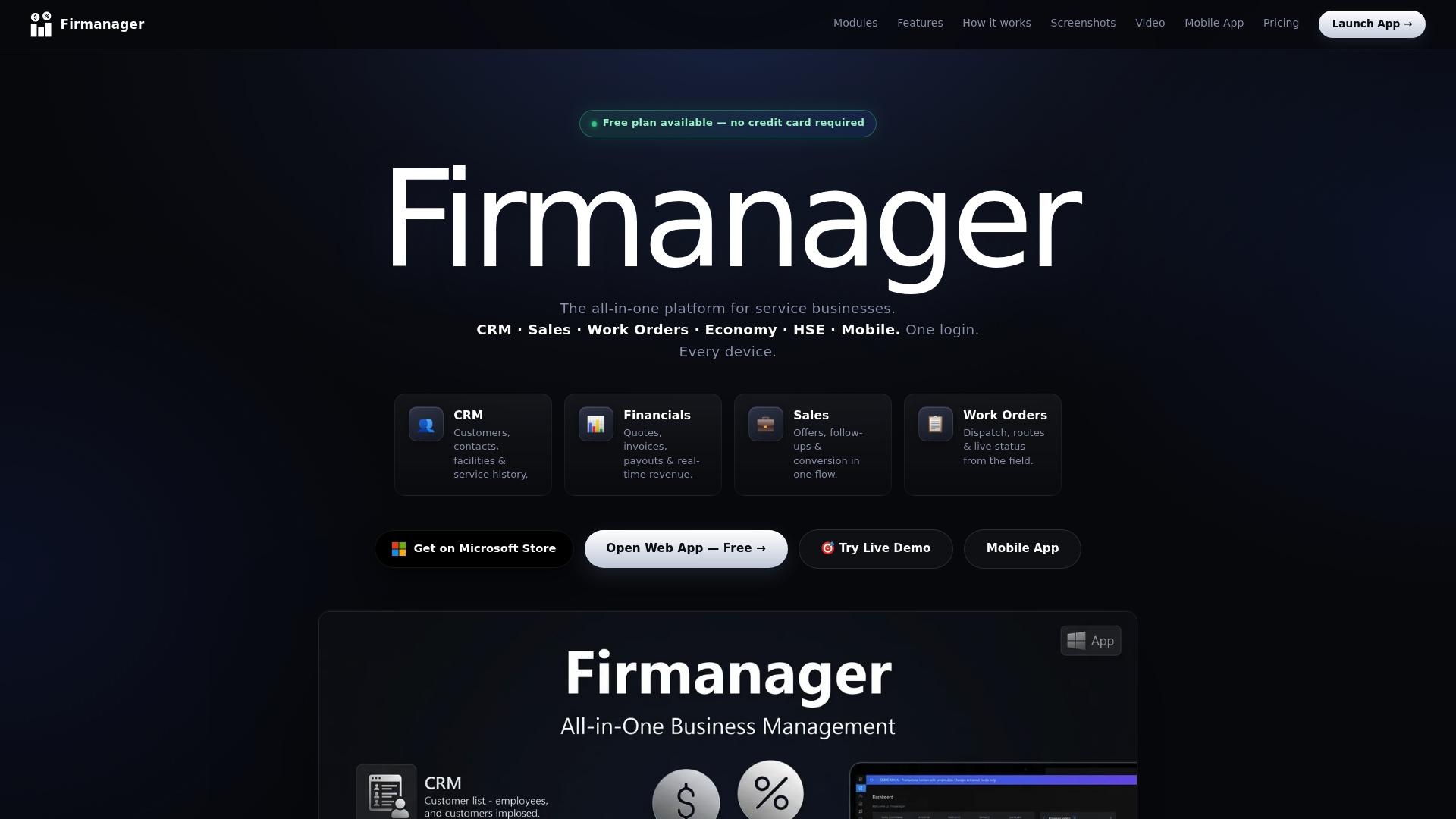
Executing a 12-touch calendar by hand across spreadsheets and separate texting apps is where most plans quietly fall apart. Firmanager keeps CRM records, SMS, invoicing, and the customer portal under a single login, so the same customer data feeds every touch instead of living in disconnected tools.
That matters most in a few specific situations:
- Sending automated appointment reminders and SLA alerts without a separate texting tool.
- Keeping CRM segments accurate as customers move between service tiers.
- Giving customers portal access to check work order status without a phone call.
Firmanager offers a Free plan to start, with Pro at $19 per month and Business at $49 per month for teams that need broader automation and reporting. Check the plan details and get started on the Firmanager landing page.
FAQ
What are the 5 C’s of communication?
The 5 Cs, as outlined in Broadridge’s framework, are context, continuity, content-rich, consistency, and creativity. Context and continuity are considered the most important because they tie a message to the customer’s actual history and current situation rather than treating every send as a cold outreach.
Can you provide an example of a communications plan?
A simple example: a service business builds a 12-touch annual calendar for its active customer segment, mixing four transactional updates, three educational tips, two satisfaction check-ins, and three renewal or offer messages. Each touch is assigned a channel (email, SMS, or phone) and an owner, with automation handling the transactional and trigger-based sends.
Can you give me an example of a communication goal?
A measurable goal might be increasing survey reply rates or reducing missed renewals over a defined test period, tracked against a baseline you set before changing anything. Goals should tie to one KPI at a time, such as reply rate or retention rate, so a 90-day test produces a clear result.
What should a good communication plan include?
A solid plan includes a chosen framework (like the 4Cs or 5Cs), a documented touch calendar, defined customer segments, channel rules, and a measurement cadence. It should also include ISO-aligned provisions for handling feedback, complaints, and contingency communication during disruptions.
Does Firmanager help manage customer communication directly?
Firmanager connects CRM data, SMS, invoicing, and a customer portal under one login, which keeps touch calendars and customer records synced across the team. Plans are available through the Firmanager landing page, starting with a free option and scaling to paid tiers as needs grow.
Sources
- The 5 Cs of Customer Communications — Broadridge
- Customer communication — ISO auditing practices group
- Customer outreach: Meaning, channels, and strategies — Shopify
Recommended
Run your whole business in one place
CRM, quotes, work orders, invoicing, expenses, HR and HSE — one login, every device. Free-forever plan.
Start free →