Field Data Accuracy for Ops: One Control to Make Records Audit Ready

Field Data Accuracy for Ops: One Control to Make Records Audit Ready
Field data accuracy means capturing complete, timestamped, geo-tagged, and signed job records at the point of service, covering everything from labor hours to invoice-ready line items. The single best control is structured mobile capture with required-field validation and automatic timestamps and geotags, because it stops incomplete records before they ever leave the job site. Everything else in your data collection precision effort, from QC audits to backup policy, builds on that one habit.
TL;DR:
- Field records must include timestamps, geolocation, signatures, photos, parts, and labor details to withstand billing disputes and audits.
- Using mobile apps with offline capability, mandatory proof actions, and real-time validation significantly reduces errors and incomplete records.
- Conducting baseline audits, pilot programs, and ongoing QC checks helps measure improvements and maintain data integrity over time.
- Integrating capture with invoicing and dispatch through a unified platform minimizes transcription errors and streamlines data flow.
- Cutting unnecessary fields and focusing proof requirements on high-value jobs enhances compliance and reduces rework within one to three months.
Table of Contents
- What Does an Accurate Field Record Actually Include?
- Five Practical Controls Managers Can Implement This Month
- How Do You Roll Out Better Field Data Practices?
- Quality Control, Backups, and Audit Readiness
- How a Unified Platform Applies These Controls in Practice
- What Actually Breaks Field Data Rollouts
- Start Your Own Field Data Pilot
- Sources
- FAQ
What Does an Accurate Field Record Actually Include?
An accurate field record isn’t a vague notion of “good notes.” It’s a defined set of elements that billing, dispatch, and compliance teams can each pull from without calling the technician back. Miss one, and you get a billing dispute, a scheduling conflict, or a failed audit.
At minimum, a complete record needs:
- Job ID and work order number tying the record to a specific customer and contract
- Timestamp for arrival, key milestones, and departure
- Geolocation confirming the technician was actually on site
- Technician identity for accountability and labor tracking
- Customer sign-off or signature confirming work performed
- Before, during, and after photos documenting condition and completion
- Parts and serial numbers used or replaced
- Labor hours logged against the job
- Invoice-ready fields (materials, quantities, rates) that flow directly into billing
The FAA’s AC 120-78B guidance on electronic records sets a useful benchmark here, even outside aviation: every electronic record should capture the event type, date and time, location, participants, and a verified signature. Field service businesses that build to that same standard end up with records that hold up in a billing dispute or a compliance review, not just a filed report.
Five Practical Controls Managers Can Implement This Month
You don’t need a six-month rollout to see improvement. Most of the accuracy gains come from a handful of specific changes, and you can pilot all five inside a single billing cycle.
- Standardize your templates and add conditional logic. A universal 40-field form for every job type guarantees blank fields and frustrated techs. Build shorter, job-specific templates that only surface the questions relevant to that task.
- Move to a mobile-first app with offline capability. Techs in basements, rural routes, or dead zones still need to capture data. Offline sync with automatic timestamps and geotagging removes the “I’ll fill it in later” excuse that causes most data entry errors in the first place.
- Make proof actions mandatory, not optional. Require a minimum photo set, a signature, and a barcode or QR scan on parts before the job can close. Configurable proof requirements that block completion until conditions are met are one of the more effective mechanisms available in modern field apps.
- Add real-time validation and range checks. If a labor entry says 47 hours on a two-hour job, the system should flag it before submission, not after invoicing. Auto-populate fields from existing asset and customer records instead of asking techs to retype information that already exists.
- Integrate capture directly with invoicing and dispatch. Disconnected systems mean someone retypes field notes into billing software, and that’s where transcription errors creep in. A unified data foundation also happens to be what makes automation and AI-assisted scheduling viable down the line.
Pro Tip: Start mandatory proof requirements on your highest-dollar job types first. A plumbing company that requires photo proof only on jobs over $500 sees most of the same dispute reduction as one that requires it on every job, with far less pushback from technicians.
Structured, validated capture consistently reduces rework and errors compared with paper forms or unstructured note-taking, largely because the system catches problems at the point of entry instead of during a reconciliation headache three weeks later.
How Do You Roll Out Better Field Data Practices?
Improving field data reliability works best as a phased rollout, not a company-wide mandate rolled out overnight.
Phase 0: Baseline audit. Pull a sample of 30 to 50 recent job records and measure your starting point. Track the missing signature rate, the percentage of blank critical fields, and how many jobs required a rework visit due to incomplete information.
Field service operations that skip the baseline audit typically can’t prove their pilot worked, because they have nothing to compare it against.
Phase 1: Pilot. Choose two or three job types, build templates for them, turn on validation rules, and train a single crew. Measure the first-time-complete rate, meaning the percentage of jobs closed with zero missing fields on the first submission.
Phase 2: Scale. Once the pilot shows improvement, integrate the templates with your CRM and invoicing system, schedule recurring QC audits, and define escalation rules for exceptions.
- Assign a form owner responsible for template updates
- Assign a QC auditor who reviews samples on a set schedule
- Assign an IT or backup owner for system issues and data recovery
- Set clear supervisor sign-off rules for exceptions and edge cases
Track first-time-complete rate, time to invoice, dispute rate, and rework visits monthly. Those four numbers tell you whether the rollout is working faster than any anecdote from the field.
Quality Control, Backups, and Audit Readiness
Good data capture at the point of entry solves half the problem. The other half is making sure those records stay accurate, traceable, and recoverable months later, when a customer disputes an invoice or a regulator asks for evidence.
Run QC audits on a fixed cadence, either quarterly or semiannually depending on your job volume, and check the same things every time:
- Timestamp integrity, confirming entries weren’t backdated or edited after the fact
- Photo standards, verifying before/during/after shots exist and are legible
- Edit history, reviewing who changed what and when
Revision control matters more than most managers assume. FAA guidance on electronic recordkeeping requires visible revision dates and preserved prior versions, not just a silent overwrite. Applying that same discipline to your own field service document control process, even without a regulator requiring it, builds a paper trail that protects you in a dispute.
Back up records to a separate archive, not just the primary system, and test restores periodically rather than assuming the backup works. Immutable evidence, meaning timestamps, edit logs, and signed approvals that can’t be quietly altered, shortens dispute resolution because there’s no argument about what happened and when.

How a Unified Platform Applies These Controls in Practice
The controls above sound straightforward until you try running them across five spreadsheets, a paper form, and a separate invoicing tool. That’s where a modular platform earns its place.
- Templates and conditional logic replace one-size-fits-all forms with job-specific capture
- Offline mobile capture logs timestamps and geotags automatically, even without signal
- Photo annotation attaches evidence directly to the record instead of a separate camera roll
- Mandatory proof actions block job completion until signatures and required fields are present
- Audit logs preserve edit history for QC review
- Invoicing integration pushes field data straight to billing without re-entry
Firmanager applies this same logic across CRM, work orders, and invoicing under one login, and KaiosMedia’s own operational guides on equipment service history and CRM data cleanup offer reusable frameworks for teams building their first templates.
What Actually Breaks Field Data Rollouts
Most failed rollouts share the same three problems: forms too long for a tech to finish in the field, no offline support for rural routes, and nobody assigned to own QC once the excitement fades. Cut fields ruthlessly, force proof only where dollars are highest, and run a focused 30 to 90 day pilot. Teams that do this typically see rework drop and invoicing speed up within one to three months.
— KaiosMedia
Start Your Own Field Data Pilot
A modular, cloud-synced platform built around this workflow includes templates and conditional logic on the front end, offline mobile capture with timestamps and geotags in the field, and audit logs and invoicing integration on the back end, all accessible under one login instead of using multiple disconnected tools.
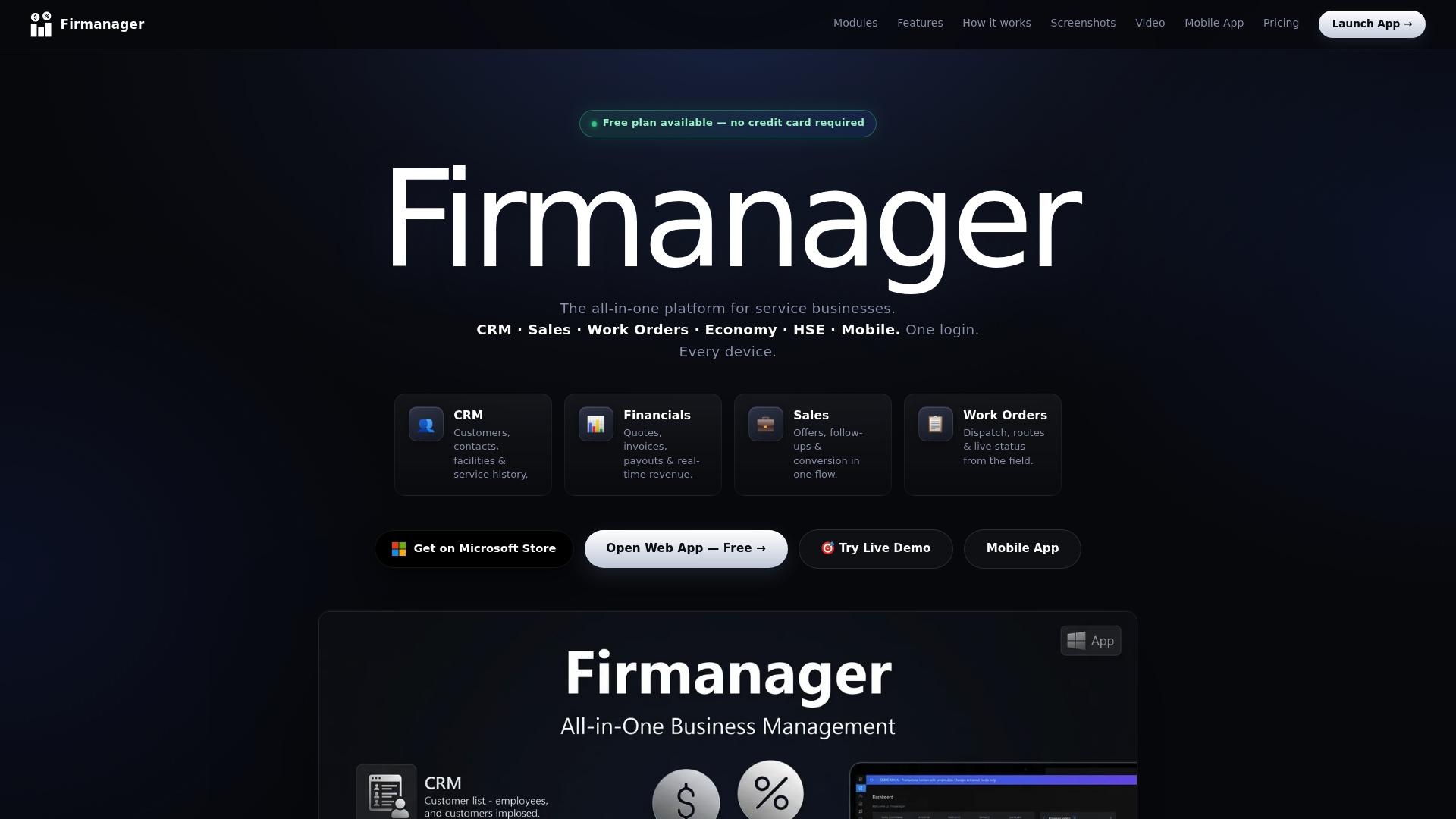
If you’ve been patching accuracy problems with spreadsheets and reminder texts, a pilot is the faster way to find out what a unified system actually fixes. The provider offers a Free plan as a starting option, with paid plans available as your team size and job volume increase; current prices can be found on the pricing page. Run your baseline audit, build two or three templates for your highest-dispute job types, and try Firmanager to see whether first-time-complete rates move within your first billing cycle.
Sources
- FAA AC 120-78B: Electronic Records, Signatures, and Manuals
- How Is AI Changing Data Collection For Field Services | TrueContext
- Field service guide (Salesforce) — on unified data foundations and AI-readiness
FAQ
What Is Field Data Accuracy in Field Service Operations?
Field data accuracy refers to how completely and correctly a technician’s on-site record captures timestamps, signatures, photos, inventory, and invoice details. Accurate records are complete enough to bill from, dispatch from, and audit without a callback to the field.
How Do You Verify Field Data Is Accurate?
Verify field data through a QC audit that checks timestamp integrity, confirms required fields aren’t blank, and reviews the edit history for unexplained changes. Comparing a sample of job records against your first-time-complete rate each month is the fastest way to catch drift early.
What Causes the Most Common Data Accuracy Challenges in the Field?
The biggest data accuracy challenges come from forms that are too long, no offline capture for low-signal areas, and duplicate data entry between field notes and invoicing systems. Fragmented systems that force manual re-entry are consistently the biggest source of transcription errors.
Does Firmanager Support Improving Field Data Accuracy?
Firmanager supports structured templates, offline mobile capture with automatic timestamps and geotags, mandatory proof actions, and audit logs, all synced directly to invoicing. Plans start with a Free option, with Pro at $19 per month and Business at $49 per month.
How Often Should Field Data Be Audited for Quality Control?
Most field service operations run QC audits quarterly or semiannually, depending on job volume and dispute frequency. Higher-volume or higher-risk operations often benefit from a tighter, quarterly cadence to catch errors before they compound across a billing cycle.
Recommended
Run your whole business in one place
CRM, quotes, work orders, invoicing, expenses, HR and HSE — one login, every device. Free-forever plan.
Start free →