Budget $50–$100/User: Field Service Software Year One Costs for SMBs

Budget $50–$100/User: Field Service Software Year One Costs for SMBs
Most field service software falls into three bands: entry-level plans under $100 per month, mid-market plans between roughly $100 and $450 per month, and premium suites above that. You’ll see pricing built around per-user fees, per-job charges, or flat seat-based plans. For most small and mid-sized teams, the smart move is to start with a self-serve tier and budget separately for onboarding and integrations rather than jumping straight to an enterprise contract.
TL;DR:
- Entry-level plans typically cost under $100 per month, but costs rise quickly with added features and larger teams, often exceeding $450 for premium suites.
- Monthly billing is generally more flexible, but annual plans offer significant discounts, making long-term commitments cost-efficient for steady growth.
- Costs increase with per-user, per-job, or add-on charges, especially once your team surpasses about 15 to 20 users, where flat-rate enterprise licenses become more economical.
- Budgeting for onboarding, migration, training, and hardware is crucial, as these one-time costs often exceed subscription expenses during the first year.
- Comparing comprehensive costs requires calculating per-technician monthly expenses including all add-ons, support, and setup fees to avoid misleading price comparisons.
Table of Contents
- How vendors typically package and price field service software
- Detailed breakdown of pricing models and how they affect your bill
- The major levers that move price: features, integrations, users, and services
- Sample monthly and first-year budgets by technician team size
- Onboarding, migration, training, and other one-time costs to budget
- Firmanager as an example: mapping modular plans to SMB needs
- Discounts, promotions, and negotiation opportunities
- How to evaluate and compare pricing plans effectively
- Author perspective: prioritizing fit over the lowest sticker price
- Firmanager plans and how to start a trial
- FAQ
- Sources
How vendors typically package and price field service software
Field service platforms almost always bill monthly or annually, and annual billing usually knocks a meaningful chunk off the per-month rate since vendors trade a longer commitment for lower effective pricing. If your team is still testing a workflow, monthly billing costs more per month but keeps you out of a long-term contract while you figure out what you actually need.
Most vendors also offer a free or low-cost starter tier. These usually cap the number of users, limit payment processing, or remove features like advanced reporting and integrations, so they work for solo operators and very small teams but get restrictive fast once you add technicians or want to accept online payments.
Category pricing data gives a useful reference point: entry-level field service plans commonly start under $100 per month, while premium, fully customized suites tend to run $450 or more per month. That spread reflects the difference between a basic scheduling and dispatch tool and a platform handling CRM, invoicing, HR, and compliance under one roof.
Plan names follow a predictable pattern across the category:
- Starter or Free tiers cover basic scheduling, a limited number of users, and few integrations.
- Pro or Growth tiers add invoicing, more users, and mobile app access.
- Business or Premium tiers unlock advanced reporting, HR modules, and priority support.
- Enterprise tiers bring custom contracts, dedicated onboarding, and negotiated pricing.
Knowing where a vendor’s naming convention lands helps you skip the marketing language and compare actual capability instead.
Detailed breakdown of pricing models and how they affect your bill
The pricing model matters as much as the sticker price, since two plans with similar headline numbers can produce very different bills once your team scales.
- Per-user or per-technician pricing charges you for every seat, whether that’s an office admin or a technician in the field. Count every person who needs a login, not just the technicians doing the work, since admin and dispatcher seats often carry their own fee.
- Per-job or per-transaction fees charge based on usage rather than headcount. These suit businesses with unpredictable job volume but can get expensive fast during a busy season.
- Add-on charges for payment processing, SMS notifications, or GPS tracking often sit outside the base subscription. A platform that looks cheap at checkout can cost noticeably more once you turn on the features your team actually uses daily.
- Flat fees or enterprise licensing cover unlimited users under one price. These become cost-effective once your team grows past roughly 15 to 20 seats, since per-user pricing starts to outpace a flat rate at that size. Enterprise SaaS agreements typically bundle custom terms, dedicated support, and negotiated seat minimums rather than published per-user rates.
- Role-based pricing charges differently for admin accounts versus mobile-only technician accounts. This can lower your bill if most of your team only needs the mobile app, but it adds a layer of complexity when you’re comparing quotes across vendors.
Before signing anything, map out exactly how many people need full access versus mobile-only access. That single exercise often reveals that a per-user plan costs less than it first appears once you separate admin seats from field seats.
The major levers that move price: features, integrations, users, and services
A handful of choices drive most of the difference between a cheap plan and an expensive one.
- Payment processing adds a transaction fee or a flat monthly charge on top of your base subscription.
- Inventory and parts tracking often sits behind a higher tier or carries its own add-on fee.
- Payroll and HR modules (time tracking, leave management, compliance) usually require stepping up from a basic plan.
- Third-party integrations and API access can carry setup fees or ongoing per-connection charges, especially for accounting or inventory systems outside the platform.
- Support tiers range from community forums on free plans to dedicated account managers on premium ones, and faster response times usually cost extra.
- SMS notifications, payment gateways, and document storage frequently show up as metered add-ons once you exceed a included allowance.
Pro Tip: Ask every vendor for a full add-on price sheet before you compare base prices. The base subscription rarely tells the whole story.
Integration costs deserve particular attention. Connecting your field service platform to QuickBooks, a payroll provider, or a parts supplier’s API can mean a one-time setup fee, a recurring per-integration charge, or both. Custom integration work tends to cost more the deeper it reaches into your existing systems, so a simple one-way data sync costs far less than a two-way integration handling inventory and invoicing simultaneously.
Support and onboarding fees also scale with how hands-off you want the setup to be. A DIY onboarding with self-serve guides costs nothing extra, but a managed onboarding with a dedicated specialist walking your team through setup can add a meaningful one-time fee, particularly if your business runs multiple locations or complex recurring workflows.
Sample monthly and first-year budgets by technician team size
Translating pricing models into real numbers makes the decision easier. Here’s how costs typically scale.
- 1 to 3 technicians: Expect a subscription in the $0 to $100 per month range, often on a free or entry-level plan. Add-ons like payment processing or SMS might add a modest amount monthly. Onboarding is usually self-serve, so your first-year cost is close to 12 times your monthly subscription with minimal extra spend.
- 4 to 10 technicians: Per-user pricing starts to matter here. If each seat costs between $15 and $30 per month, a 7-person team could land in the $100 to $250 per month range before add-ons. This is also the size where managed onboarding starts to pay off, since a specialist setting up recurring job templates and integrations correctly the first time saves hours of trial and error later.
- 11 to 50 technicians: At this size, you’re typically budgeting for advanced reporting, deeper integrations, and SLA-backed support, which push many businesses toward Business or Enterprise tiers. Monthly costs commonly range from $450 upward depending on the feature set and seat count, consistent with premium suite pricing seen across the category.
To calculate your own per-technician monthly total cost of ownership, add your base subscription, all add-ons, and any amortized onboarding fee (spread over 12 months), then divide by your technician count. A 10-person team paying $200 per month in subscription fees plus a one-time $600 onboarding fee works out to roughly $25 per technician per month in year one, dropping to about $20 per technician per month in year two once onboarding is paid off.
Onboarding, migration, training, and other one-time costs to budget
The subscription price is rarely the full story. First-year budgets need to account for several one-time or front-loaded costs.
- Onboarding timelines range from a few days for a self-serve setup to several weeks for a managed implementation with data migration and custom workflows.
- Data migration gets more expensive the messier your existing records are. Moving clean customer and job data from a spreadsheet costs far less than migrating years of history from a legacy system with inconsistent formatting.
- Training for your team (and any device provisioning, like tablets or rugged phones for technicians) adds a cost that’s easy to forget when comparing subscription prices alone.
- Connectivity and hardware matter if your technicians work in areas with poor signal, since offline-capable apps and reliable devices become a real line item rather than a nice-to-have.
More than half of buyers (51%) budget $50 to $100 per user per month for field service software, according to Capterra’s category data, while 75% of products in the category start under $50 per month. That gap between what buyers expect to pay and what most products actually charge at entry level suggests many SMBs are budgeting for mid-tier features even when a cheaper plan would cover their immediate needs.
To estimate your real first-year total cost of ownership, add 12 months of subscription fees to every one-time cost (onboarding, migration, training, hardware) rather than comparing the monthly price alone. TCO analyses consistently show that implementation and operational costs, not the subscription line, cause the biggest gap between expected and actual spend.
Firmanager as an example: mapping modular plans to SMB needs
We built Firmanager around three tiers: Free, Pro, and Business, so a buyer evaluating pricing across the category has a concrete reference point for how modular plans typically scale.
Our Free plan covers fundamental features suitable for a very small team testing the platform. Pro adds more depth across invoicing, project management, and field service workflows for teams ready to consolidate tools. Business brings in a full set of modules for businesses running multiple crews or locations that need comprehensive features.
What typically moves a business from one tier to the next is less about user count and more about how many separate tools they’re trying to replace. A team juggling a CRM, a separate invoicing tool, and a spreadsheet for HR usually finds more value jumping to a higher tier than one that only needs scheduling and basic job tracking.
Before committing to any vendor, including us, it’s worth checking:
- How often data syncs across devices, and whether updates are real-time or batched.
- Whether invoicing and payment processing are built in or require a separate integration.
- What HR and compliance tracking actually covers (time, leave, safety documentation).
- Whether the mobile app has user limits or feature restrictions compared to the desktop version.
Asking these questions of every vendor you evaluate, not just one, is what actually protects your budget.
Discounts, promotions, and negotiation opportunities
Most field service software vendors offer some form of discount for annual billing, typically a lower effective monthly rate in exchange for a 12-month commitment. Seasonal promotions, like discounts tied to a new product launch or a slow sales quarter, show up periodically but aren’t guaranteed, so timing a purchase around a sale isn’t a reliable budgeting strategy.
Volume discounts are more consistent. If you’re adding 10 or more seats at once, many vendors will negotiate a lower per-seat rate rather than lose the deal, particularly on per-user pricing models where the vendor has more margin to work with at scale.
It’s also worth asking directly about fee waivers for onboarding or setup, especially if you’re switching from a competing platform. Vendors sometimes waive migration fees to win a contract away from a competitor, but this almost never happens unless you ask.
Before negotiating, get a clear picture of what you actually need over the next 12 to 24 months. Vendors are far more willing to discount a plan when you can commit to a seat count or usage level in writing, since that reduces their own forecasting risk. A short list of your required features and expected growth gives you real leverage in a sales conversation, rather than just asking for “a better price” with no context.
How to evaluate and compare pricing plans effectively
The most reliable way to compare plans is to convert every quote into a per-technician monthly cost, including add-ons, rather than comparing base subscription prices side by side. A plan advertised at $80 per month with mandatory payment processing fees can cost more in practice than a $120 per month plan with everything included.
Build a simple comparison sheet with columns for base subscription, per-user cost, mandatory add-ons, optional add-ons you’d actually use, and one-time onboarding fees. Fill it out identically for every vendor you’re considering, including ours, so you’re comparing like for like rather than relying on marketing pages that highlight different features.

Request a trial or demo before committing, and test the specific workflows your team uses daily, not just the features that look impressive in a sales call. A platform that handles complex recurring jobs beautifully but has a clunky mobile app will frustrate technicians in the field regardless of price.
Finally, ask about contract terms directly: whether you can downgrade mid-contract, what happens to your data if you cancel, and whether there’s a cancellation fee. These terms rarely appear prominently on pricing pages but matter just as much as the monthly rate once you’re locked in.
Author perspective: prioritizing fit over the lowest sticker price
The cheapest plan on paper is often the most expensive one in practice. A $20 per month tier that lacks automated invoicing or real-time sync forces your team back into manual work, and that lost time costs more than the $30 difference to the next tier up.
Our stance: pilot any platform with a limited scope first. Pick one crew or one workflow, run it for a month, and measure whether it actually reduces admin time before rolling it out company-wide. Staged adoption catches mismatches early, when switching costs are low.
Managed onboarding earns its cost once your workflows get complex: multiple locations, recurring compliance requirements, or integrations with existing accounting systems. Below that complexity, a DIY setup with good documentation is usually the better use of your budget.
— KaiosMedia
Firmanager plans and how to start a trial
We built Firmanager as an integrated platform for CRM, invoicing, work orders, and HR, designed to reduce duplicate data entry across systems.
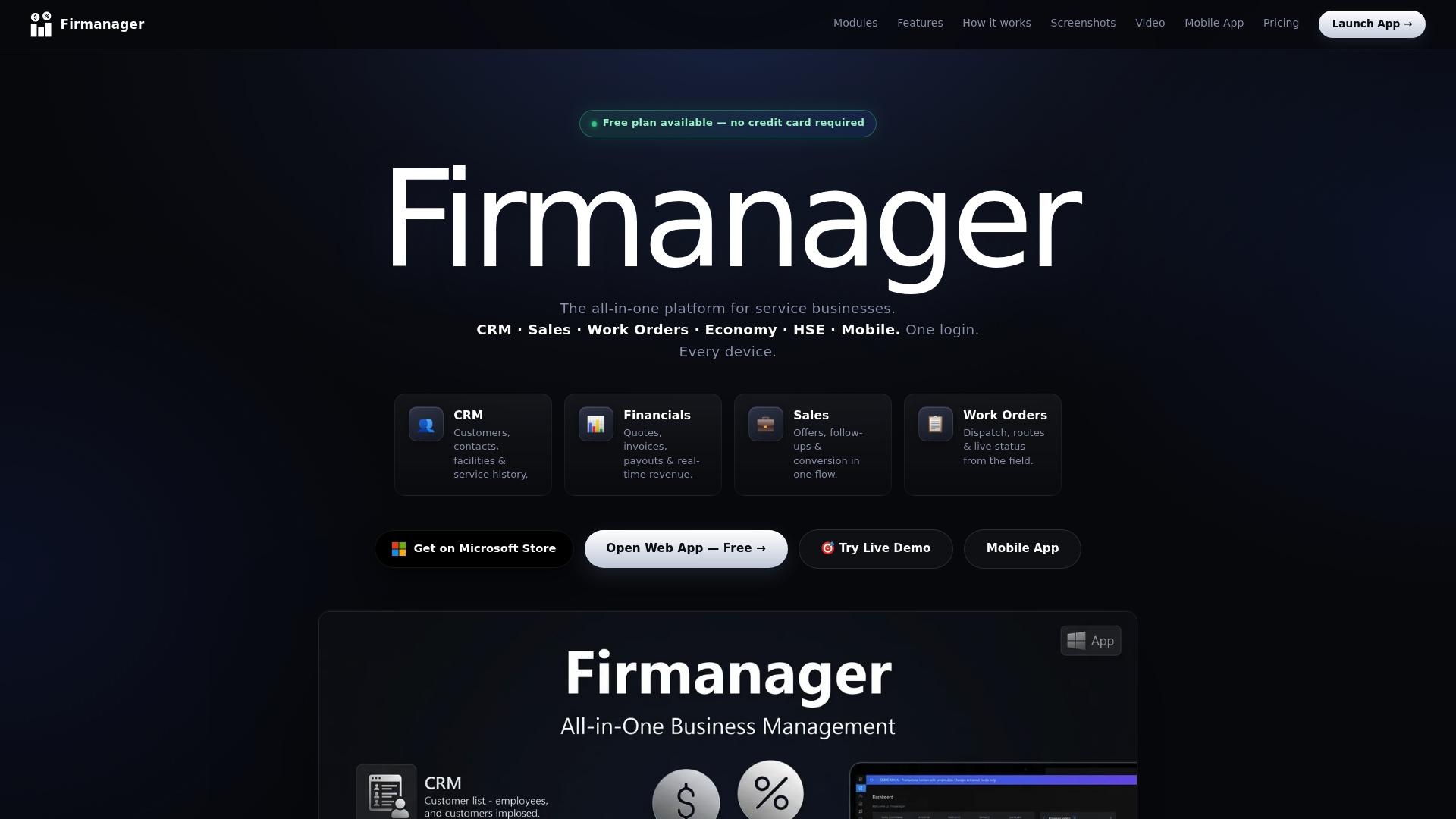
Our lineup keeps things simple:
- Free plan for teams testing basic CRM and work order features.
- Pro plan adding invoicing, project management, and advanced field service tools.
- Business plan with HR, compliance tracking, and financial reporting features.
If you’re comparing us against other field service platforms, the difference isn’t a longer feature list. It’s that every module shares the same data, so a job logged in the field shows up instantly in invoicing and reporting without a separate sync step. Start on Firmanager’s plans page to pick a tier and get your team set up today.
FAQ
Is there a free app for field service management?
Yes, several field service platforms offer a free tier, typically limited to a small number of users and basic scheduling or work order features. Our own Free plan follows this pattern, covering core CRM and work order tracking before you need to upgrade for invoicing or HR tools.
What is the best field service software?
The best choice depends on your team size and which workflows you need to consolidate, whether that’s scheduling, invoicing, HR, or all three under one login. Buyers typically compare entry-level plans under $100 per month against mid-market and premium suites based on how many modules they need.
How much does HR software typically cost?
HR features within field service platforms are usually bundled into mid-tier or premium plans rather than sold separately, with pricing varying by how many employees and compliance features are included. Standalone HR software pricing isn’t publicly standardized across vendors, so it’s best confirmed directly with each provider.
How much does field service software like FieldEdge cost?
Pricing for individual field service vendors like FieldEdge isn’t published as a standard public rate and typically requires a custom quote based on team size and modules. Category-wide data shows entry-level field service plans commonly starting under $100 per month, which gives a useful reference point when requesting quotes.
Recommended
Run your whole business in one place
CRM, quotes, work orders, invoicing, expenses, HR and HSE — one login, every device. Free-forever plan.
Start free →