How to Improve Customer Retention in a Service Business

How to Improve Customer Retention in a Service Business
To improve customer retention, do four things in order: measure retention and churn every month, find out why customers leave, fix the moments where service breaks down (late arrivals, missed follow-ups, billing errors), and stay in touch before problems turn into cancellations. For field service companies, most of this comes down to reliable scheduling, clear communication and fast issue resolution. All three depend on having customer, job and invoice data in one place.
This guide walks through each step with formulas, worked examples and a simple 90-day plan you can run with a small team.
TL;DR
- Measure first: retention rate, churn rate and revenue churn, tracked monthly on the same definition.
- Ask leavers why they left, and look at individual accounts, not only averages.
- Most preventable churn comes from service quality, communication gaps, billing friction and unclear value.
- Proactive contact (reminders, follow-ups, check-ins) beats reacting to complaints.
- Keep customer history, jobs, quotes and invoices in one system so your team can act on what it sees.
Table of Contents
- Why retention matters to a service business
- Step 1: Measure retention and churn
- Step 2: Find out why customers leave
- Step 3: Fix the moments that cause cancellations
- Step 4: Communicate before they have to ask
- Frameworks worth knowing
- Perspective: retention is an operations problem
- Step 5: Check whether it is working
- A simple 90-day retention plan
- Put your customer data in one place
- FAQ
- Sources
Why retention matters to a service business
Retention is the share of customers who keep buying from you over a period. Churn is the share who stop. They are two sides of one number: if 90% stay, 10% churned.
For a cleaning, maintenance or technical services company, recurring contracts are the backbone of predictable revenue. Every lost account has to be replaced by a new one, and that means more marketing, more quotes and more onboarding. Retention is also a stated priority across the industry: a 2025 Sutherland research report found that more than 65% of respondents call customer retention a top objective for their customer care operations.
The good news for service businesses is that your product is largely your reliability. You control whether the technician arrives on time, whether the customer knows when, and whether the invoice is right. These are operational details, and operations can be improved.

Step 1: Measure retention and churn
You cannot improve what you track loosely. Pick a period (a month or a quarter) and use the same definition every time.
Customer retention rate
The standard formula, as Zendesk’s guide to calculating retention rate gives it: take the number of customers at the end of the period, subtract the new customers added during the period, divide by the number of customers at the start, and multiply by 100.
Worked example for a janitorial company:
- Customers at the start of the quarter: 200
- Customers at the end: 210
- New customers added: 30
- Retention rate: (210 − 30) ÷ 200 × 100 = 90%
- Churn rate: 100% − 90% = 10%
The new-customer subtraction matters. Without it, a growing business can look healthy while quietly losing its older accounts.
Revenue churn
Customer counts hide differences in account size. Losing one large facility contract hurts more than losing three one-off clients. Revenue churn fixes that. According to Zendesk’s retention guide, it is monthly recurring revenue (MRR) lost in the period divided by MRR at the start, times 100. It is especially useful when you have tiered pricing, varied contract values, or customers who downgrade rather than leave.
Example: you start the month with $10,000 in recurring revenue and lose $400 through cancellations and reduced service plans. Revenue churn is 4%.
Supporting metrics
A single rate tells you what happened, not why. Stripe’s overview of retention and churn lists customer lifetime value, customer acquisition cost, net promoter score (NPS), engagement, support tickets and revenue churn as useful companions. For a service company, a practical starter set looks like this:
| Metric | What it tells you | Where service teams find it |
|---|---|---|
| Retention rate | Share of customers who stayed | Customer list by period |
| Revenue churn | Dollar impact of losses and downgrades | Recurring invoices |
| Repeat job rate | Whether one-time clients come back | Work order history |
| Complaint or reopen rate | Service quality problems | Support tickets, rework jobs |
| NPS or satisfaction score | Sentiment before it becomes cancellation | Short surveys after jobs |
If you want a broader view of financial tracking, this overview of SaaS metrics to track explains how recurring-revenue measures fit together.
Step 2: Find out why customers leave
Numbers show the size of the leak. Conversations show where it is.
The common reasons
Research from the consultancy Anova Consulting Group groups preventable churn into five categories: product-fit gaps, service quality and issue resolution, communication and expectation management, pricing and value perception, and executive alignment. Translated for a field service business:
- Fit gaps: the customer needed a service you do not offer well, such as after-hours coverage or a specific certification.
- Service quality: missed visits, repeat call-backs, jobs that were not finished properly, slow resolution.
- Communication: no arrival window, no update when a technician is delayed, no answer to a quote request.
- Price and value: the customer cannot see what they are getting for the monthly fee.
- Relationship: the person who chose you left the company, and nobody new knows you.
Avoidable billing problems belong here too. Failed card payments and invoice errors can end a relationship that was otherwise fine.
Ask directly
For your largest accounts, a short exit conversation is worth more than a hundred survey scores. The same Anova white paper suggests interviewing departed customers about 7 to 14 days after they leave, and framing the call as a request for feedback rather than a win-back attempt, so people speak candidly.
Two practical rules:
- Ask open questions: “What was the moment you started considering a change?”
- Write down the answer in the customer record, tagged by reason, so patterns show up after ten or twenty conversations.
If your team handles these conversations by phone, CRM phone integration helps keep call notes attached to the customer instead of lost in someone’s memory.
Look at accounts, not averages
Churn happens one customer at a time. That is why looking only at company-wide totals falls short, and why a Voice of the Customer approach, collecting what individual customers say in their own words, is useful for explaining the numbers behind them. Compare customers by start month (cohorts) as well: if everyone who signed in spring leaves by autumn, something in your onboarding or seasonal service is off.
Step 3: Fix the moments that cause cancellations
Once you know the reasons, work on the operational moments that matter most. In field service, they are predictable.
Make the first 90 days smooth
Many cancellations are seeded early: a messy handover, unclear scope, or a first visit that goes badly. Write down what a new customer should experience in the first month: a welcome message, a confirmed schedule, a named contact, a first-visit follow-up. If you are setting up new software for this, our guide to a 90-day field service implementation shows how to roll it out without a second project.
Be on time, and say so
Showing up when promised is the baseline. Telling the customer in advance is what they notice. Automated reminders reduce missed appointments and give customers a chance to reschedule instead of ghosting. We cover the approach in our post on SMS appointment reminders.
Never let recurring work slip
Recurring clients expect routine visits to simply happen: monthly inspections, weekly cleaning, quarterly servicing. A missed one signals that you are not paying attention. Automating the schedule removes the dependence on someone remembering. See how recurring rules work in our guide to recurring task automation.
Get billing right
Invoice errors, late invoices and unclear line items create friction that has nothing to do with your service quality. Generate invoices from completed work orders so the amount matches the job, and offer online card payment so customers do not have to chase a paper process.
Close the loop on issues
When a customer reports a problem, record it, assign an owner, set a due date and tell the customer what will happen. Then confirm it was resolved. Most customers forgive a mistake handled well far more readily than silence.
Step 4: Communicate before they have to ask
Proactive contact is the cheapest retention tool you have.
A McKinsey article on AI-powered “next best experience” describes a shift from pushing offers to proactively addressing customer needs, such as resolving a billing error or providing relevant education, which can raise loyalty and reduce inbound calls. You do not need AI to apply the principle. A service business can do it with simple rules:
- Send a confirmation when a job is booked and a reminder before it.
- Message the customer when a technician is on the way or delayed.
- Follow up one to three days after a job to ask if everything is working.
- Contact recurring clients a month before a contract renewal to review the service.
- Flag an account when no job has been logged for longer than its normal interval.
Writing these messages from scratch every time is slow and inconsistent. We put together 9 customer communication templates for service teams that you can paste and adapt.
Personalize with the data you already have
Personalization means using customer data to tailor communication, offers and service to individual preferences. TechTarget notes that consumers are more likely to become repeat buyers after a personalized experience. In a service business, that can be as simple as:
- Remembering access instructions, site contacts and equipment details.
- Proposing a maintenance plan based on the equipment in the customer’s facility.
- Sending the invoice to the right person, in the format their accounts team prefers.
The more of this lives in the customer record rather than in a technician’s head, the less it depends on who happens to be on the job.
Frameworks worth knowing
Readers often ask about the “three R’s” and “8 C’s” of retention. They are mental checklists, not laws.
- The 3 R’s: Reward, Relevance and Recognition, a framework attributed to Paulo Claussen in this loyalty overview. In practice: reward long-term customers (a loyalty discount or priority scheduling), keep offers relevant to what they use, and recognize them by name and history.
- The 8 C’s: Customer Experience, Communication, Convenience, Consistency, Community, Customization, Care and Commitment, described as a progression from transactional buyers to loyal advocates in this breakdown. For a service company, consistency and communication carry the most weight.
If you want a general overview of retention strategies built around these ideas, this piece on how to increase customer retention is a good starting point.
Perspective: retention is an operations problem
We build Firmanager for service companies, and what we see again and again is that customers rarely leave over one dramatic failure. They leave after a series of small ones: a missed visit, a quote nobody answered, an invoice that did not match the job.
That is why we designed the platform around one login and one shared record. CRM, work orders, task tracking, invoicing and HR sit in modules that exchange data, so the person who answers the phone sees the same job history the technician sees. Real-time sync means a rescheduled visit, a finished job or a new note is visible to everyone straight away.
Our view is simple: if your team can see the whole customer relationship in one place, they can act on it. Recurring tasks happen on schedule, notifications go out by SMS and email without someone remembering to send them, and invoices come from the work that was actually done. Retention follows from that kind of reliability.
KaiosMedia
Step 5: Check whether it is working
Track leading and lagging indicators together.
- Lagging: retention rate, churn rate and revenue churn, reviewed monthly or quarterly.
- Leading: satisfaction or NPS scores after jobs, survey response rates, complaint volumes, time to resolve issues, and the share of feedback items you actually acted on.
One published benchmark suggests aiming for response rates of 40 to 60% on relationship surveys and 30 to 40% on transactional surveys, with at least 80% of feedback items acted on. Treat these as rough targets, not guarantees, and compare against your own history first.
The real test is correlation: do customers who score you low leave more often? If yes, your survey is a useful early warning. If no, change the questions.
A simple 90-day retention plan
- Days 1 to 15: Calculate your current retention rate, churn rate and revenue churn for the last two quarters. List every lost account and its likely reason.
- Days 16 to 30: Call your five largest lost or at-risk accounts. Tag reasons in the customer record.
- Days 31 to 60: Fix the top two causes. Typical choices: automate reminders and recurring visits, and standardize your post-job follow-up.
- Days 61 to 90: Start a short survey after each completed job. Review scores weekly and assign owners to every low score.
- Day 90: Recalculate your metrics and compare them with the baseline. Keep what worked, and drop what did not.
Put your customer data in one place
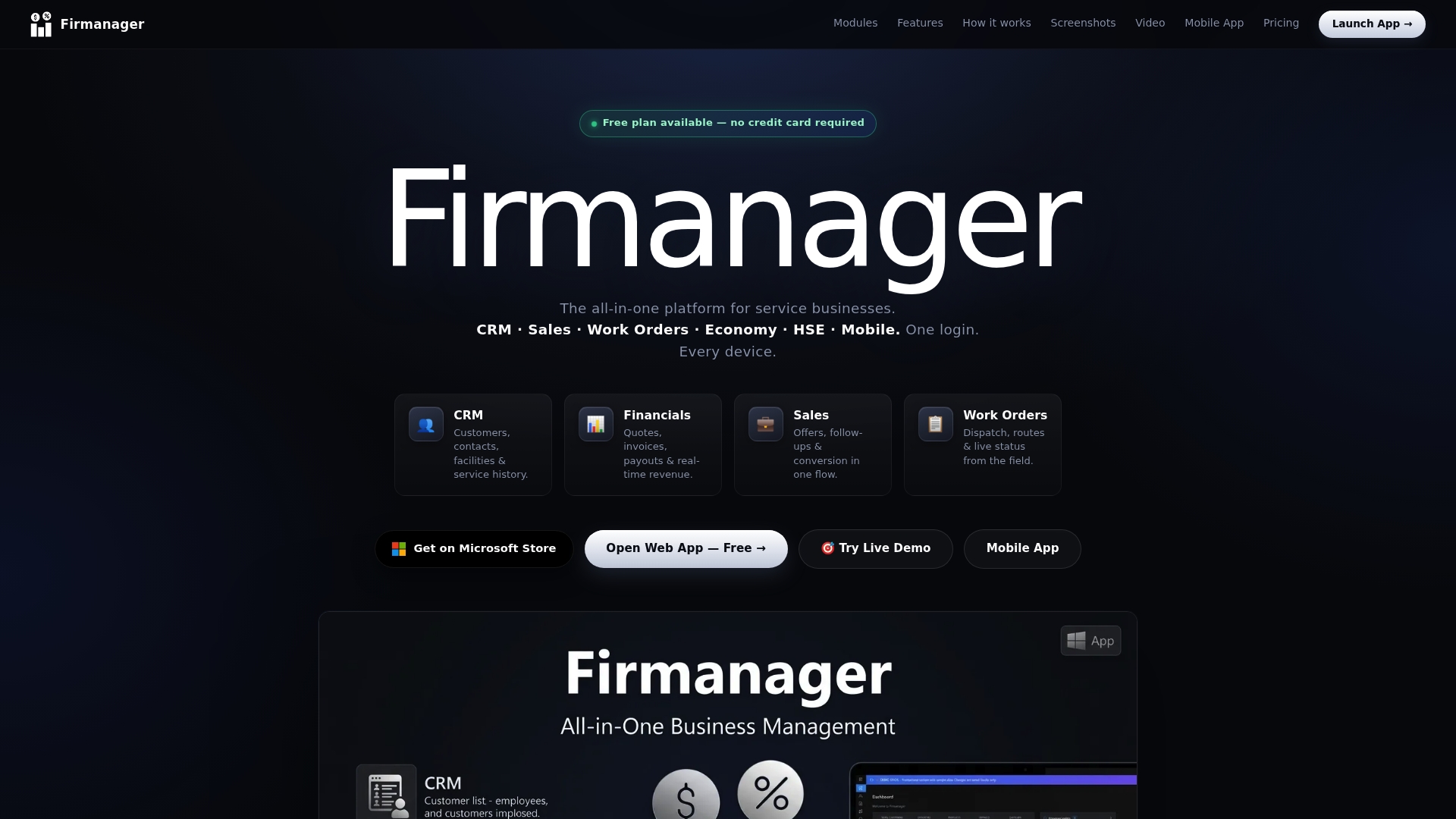
Retention work fails when information is scattered across spreadsheets, inboxes and memory. Firmanager brings CRM, customer and facility records, work orders, recurring tasks, quoting, invoicing with Stripe integration, time tracking and SMS or email notifications together under one login, on any device. Your technicians get a mobile self-service portal for job details, and managers get real-time reporting.
You can start on the Free plan at $0, move to Pro at $19 per month, or choose Business at $49 per month when your team grows. Pricing is published on the Firmanager site, where you can compare plans and sign up.
If you already have an account, sign in to Firmanager and set up your first recurring task and customer reminder this week. For more practical guides, browse the Firmanager blog. If your retention problem starts earlier in the funnel, our guide to sales pipeline stages shows how to qualify customers who are likely to stay.
FAQ
What is the best way to improve customer retention?
Start by measuring churn and finding out why customers leave, then fix the operational causes. For service businesses, the biggest gains usually come from reliable scheduling, proactive communication and accurate billing. Strategies that do not address the reason customers actually leave rarely move the numbers.
How do you reduce customer churn quickly?
Contact your highest-value at-risk accounts first, and ask what would make them stay. Then fix the most common complaint, whether that is missed visits, silent delays or invoice errors. Quick wins often come from automating reminders and follow-ups so nothing depends on memory.
How do you calculate customer retention rate?
Subtract new customers added during the period from your end-of-period customer count, divide by your start-of-period count, and multiply by 100. If you began with 200 customers, ended with 210 and added 30, your retention rate is 90%. Stripe explains the formula alongside churn rate.
What are the three R’s of customer retention?
They are Reward, Relevance and Recognition, a framework attributed to Paulo Claussen. Reward loyal customers, make offers and communication relevant to them, and recognize their history with you. They work best as a checklist for your customer communication.
Sources
- Don’t Let AI Break Your Customer, Sutherland research report, Fall 2025
- Customer retention rate + formula: A guide for 2026, Zendesk
- Retention rate vs. churn rate, Stripe
- Customer Churn Analysis White Paper, Anova Consulting Group
- 10 tips to improve customer retention, TechTarget
- AI-powered next best experience for customer retention, McKinsey
- Customer loyalty: Definition, challenges and strategies, Dinmo
- The 8 C’s of customer retention, Subscribfy
- Client Feedback Systems, Rework
Recommended
Run your whole business in one place
CRM, quotes, work orders, invoicing, expenses, HR and HSE — one login, every device. Free-forever plan.
Start free →