How to Improve Employee Communication in Field Teams
Employee communication improves when every update lives where the work lives. For a service business, that means job details, schedules, changes and approvals sit in one shared record your crew can open on a phone, not in scattered texts, calls and whiteboards. Firmanager puts work orders, field service management, notifications and an employee self-service mobile portal behind a single login, so the message and the job travel together.
TL;DR
- Leaders and frontline staff rate communication very differently: in one 2022 survey, 65% of leaders called theirs effective, versus 35% of frontline workers.
- Fix the channel first: put job details, changes and approvals in one record that field staff can open on their phones.
- Match the medium to the message: routine updates in text, difficult conversations by voice or in person.
- Close the loop: ask for input, then act on it or say why you can’t.
- Measure understanding and behavior change, not just whether a message was sent.
Table of Contents
- Why leaders and crews hear different things
- Build the routine in six steps
- Habits for managers that make the system work
- Measure whether it is working
- Our perspective
- Put the routine into one platform
- FAQ
- Sources
Why leaders and crews hear different things
Most communication advice assumes an office, where everyone sits at a screen. Field teams work differently. Technicians, cleaners and maintenance crews are on the road or on a client site, often with no desk and no company inbox.
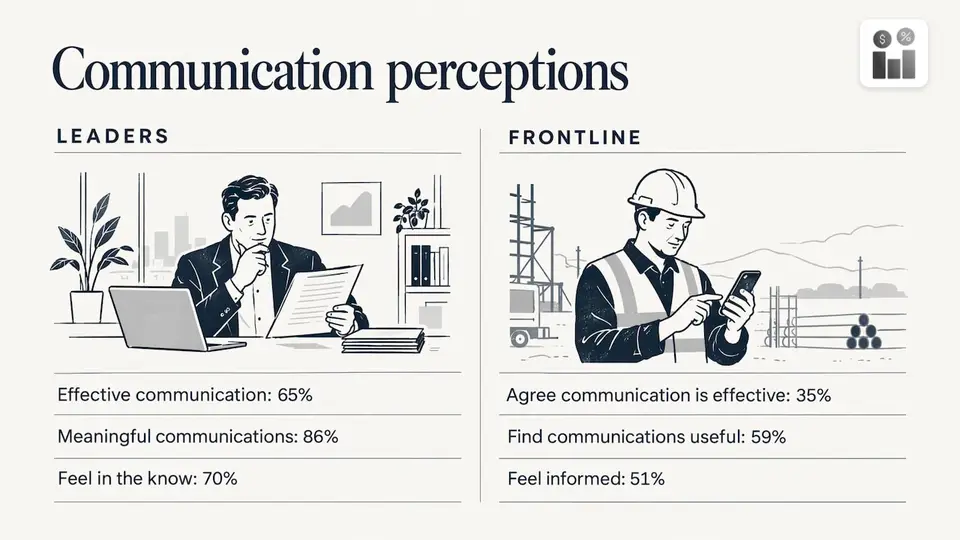
The gap shows up in the numbers. The 2022 Deskless report, cited in a case study by a facilities management company, found that 65% of corporate leaders think their communication is effective while only 35% of frontline workers agree. It also found that 86% of leaders believe they send meaningful communications, against 59% of workers who find them useful. And 70% of managers feel in the know, compared with 51% of hourly workers.
The same case study describes a “game of telephone”: decisions pass from owner to manager to supervisor to crew, and the people doing the work hear last. If you run a service business, this is the problem to solve. Better speeches or more meetings will not close that gap. A shorter path from decision to the person holding the tool will.
Build the routine in six steps
1. Decide what must reach every person
Start by listing the messages your crew cannot miss. For most service companies the list is short:
- Which jobs they are on today, where, and in what order
- What changed since yesterday (time, address, scope, access)
- Safety requirements for the site
- Leave approvals and schedule changes that affect them
- Company news that changes how they work
Everything else is secondary. Harvard’s continuing education team advises defining your goal and audience before you write, and keeping messages clear and brief. Apply that to each item: who needs it, what should they do, and by when.
2. Put job information in one record, not in chat threads
The most common failure in field teams is not a lack of messages but too many places to look. A change arrives by text, a note is on a whiteboard, a customer call is remembered by one dispatcher. By Thursday nobody agrees what was said.
The fix is to make the work order the single source of truth. In Firmanager, work orders, customer and facility records, tasks and recurring workflows, documents and route and dispatch management all sit in one platform, cloud-synced so what the office sees is what the technician sees. When the schedule changes, you change it once, in the job, and the crew reads it from there. Our guide to mobile job management for field teams walks through how that looks day to day.
This is also where a single login helps. Staff do not need to remember which tool holds which information, because CRM, work orders, invoicing and HR records are part of the same system.
3. Push important updates to the phone
A record only works if people know it changed. Real-time notifications by SMS and email in Firmanager are there for this: a change to a job reaches the person assigned, instead of waiting for them to check in.
Keep the notification rules simple:
- Notify on changes to time, location or scope, not on every edit.
- Send the update to the person who must act, not the whole company.
- Keep the text to what changed and what they need to do.
The facilities company in the case study above moved to a mobile-first approach for hourly, deskless staff. Even with app adoption peaking at 40% in the first year, voluntary turnover of hourly personnel decreased. The lesson is that reaching the frontline on their phones is worth doing even before everyone uses it.
4. Match the medium to the message
Not every message belongs in text. MIT Sloan Management Review researchers advise using lean text-based media for routine, one-directional information, and richer channels for complex problems, and avoiding contentious interpersonal issues over email or chat. Australia’s workplace safety regulator Comcare makes a similar point: phone helps you read emotions in difficult conversations, and email is the least effective option, best kept for simple tasks such as confirming agreements.
In practice:
| Message | Best medium |
|---|---|
| Today’s job list, address changes, access codes | Job record plus SMS or email notification |
| Safety requirements for a site | Job record and compliance checklist |
| Leave request status | Approval workflow in the system |
| Performance concern or conflict | Phone call or in-person conversation |
| Company-wide change | Short written message, then a team conversation |
The routine stays in the system, which leaves your phone calls and face time for the conversations that need a human voice.
5. Make the answer to “when will I hear back?” predictable
Silence is a communication failure too. Staff asking for leave or time corrections want a decision, not a guess. A defined path with a deadline removes the follow-up messages. See our guide to a leave approval workflow that gets decisions within two days for a practical model. Firmanager covers time and leave tracking, and the employee self-service mobile portal gives staff a place to see their own information.
The same idea applies to hours. When technicians record time on the job, there is less chasing at the end of the week. Our pieces on technician time tracking and time and attendance options for field teams cover this in more depth.
6. Keep a two-way channel and use it
Communication that only flows down is the cause of the gap in the first place. Gallup advises leaders to create opportunities for employees to ask questions and give input, while actively listening and checking understanding instead of assuming a message was clear. Comcare recommends asking staff how they would like to be communicated with, which it says promotes a sense of control and engagement.
So ask. A two-minute question at the start of a team meeting works: “What did you find out about a job this week that the office should have told you?” Write the answers down and sort them into things you can fix now and things you can’t.
Habits for managers that make the system work
Tools carry the routine, but a manager’s habits decide whether people trust it.
Explain the reason. Gallup’s guidance includes explaining the reasoning behind decisions and setting clear expectations. A crew that knows why a route changed is more likely to follow it.
Listen without interrupting. Harvard Business School Online recommends active listening, and open-ended prompts built on a simple acronym: tell me more, explain what you mean, define that term. These work well on a job-site walk-through, where the details of a problem matter.
Close the loop. The same Harvard piece stresses that collecting feedback is only half the job. Leaders must implement changes or be transparent about what they cannot act on, or employees lose faith that anything will happen. If a technician flags a recurring access problem, tell them what you did about it.
Give specific, regular feedback. A Forbes contributor, Dr. Samantha Madhosingh, advises specific, regular constructive feedback balanced with recognition, for example a weekly note of thanks. A completed job is a natural moment for it.
Keep it inclusive. Comcare recommends clear language without jargon and communication that is culturally appropriate. In a mixed crew, a short plain-language job note beats a long technical one.
If you have staff who work remotely or in hybrid setups alongside the field team, these hybrid work communication practices are a useful companion to the routine above.
Measure whether it is working
Sending messages is easy to count. Understanding is harder, and it is what matters.
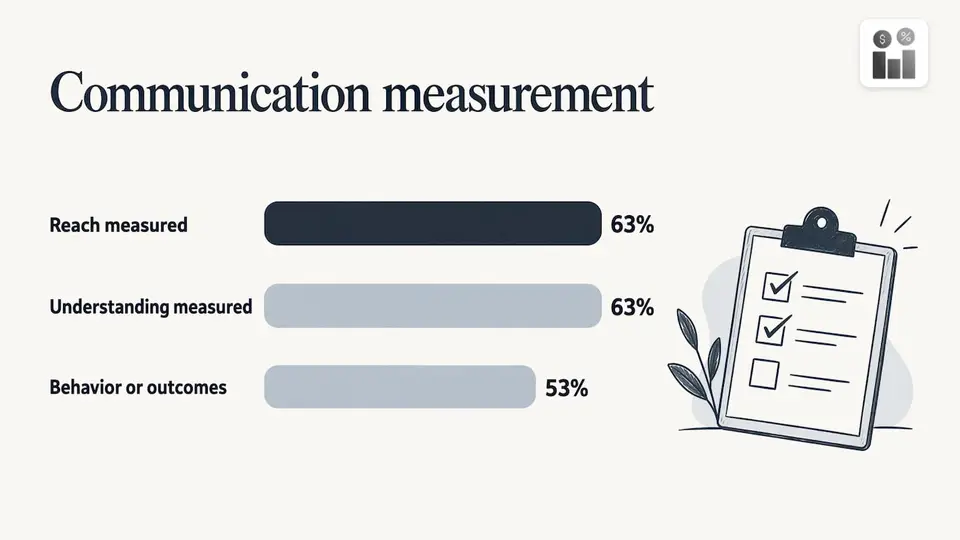
Gallagher’s State of the Sector 2022/23 report found that 63% of surveyed organizations measured communication reach and 63% measured employee understanding, while 53% measured behavior change or business outcomes. The takeaway is to look beyond whether a message went out.
A simple version for a service business:
- Baseline. Ask your crew three questions: did you know about last week’s schedule changes before you arrived, do you know where to find job details, do you hear about company decisions from us first?
- Reach. Check that updates arrive and are read by the person assigned.
- Understanding. Ask a few people to say back what they were told to do.
- Outcomes. Look at the things bad communication causes: missed appointments, repeat visits, late arrivals, corrections to time records, staff turnover.
- Repeat. Run the same questions every quarter and compare.
The researchers behind the MIT Sloan study found that for every 10% a team outscored others on five virtual communication behaviors, it outscored them by 13% on overall performance. Those behaviors include being responsive, making intentions clear and staying in sync. Better communication and better results move together.
Our perspective
Most advice on employee communication is written for people who sit at desks. Your technicians don’t. They need the right job, at the right place, with the latest changes, in the one place they already look.
That is why we built Firmanager as one platform. CRM, work orders, invoicing, HR and field service management share one login and one set of data, synced in the cloud. When the office updates a job, the field sees it. When a technician finishes, the office sees it. There is no second system to reconcile and no message to forward.
Our approach is to treat communication as a by-product of well-run work, not as an extra task. Clear work orders, recurring workflows, SMS and email notifications and a mobile portal for employees let managers say less and be understood more.
KaiosMedia
Put the routine into one platform
If your crew currently gets job details through a mix of calls, texts and paper, Firmanager gives you one place to start. It combines work orders, route and dispatch, task tracking, time and leave, HSE compliance, document handling and invoicing, with notifications by SMS and email and a mobile portal for employees.
There are three plans: Free at $0, Pro at $19 per month and Business at $49 per month. You can see what each includes on the Firmanager plans page.
FAQ
What is the quickest way to improve communication with field employees?
Move job details and changes into one shared record that staff can open on their phones, and send a short notification when something changes. That removes most of the missed updates caused by texts, calls and paper notes. Then add a regular two-way check-in so people can raise problems.
Which channel should I use for what?
Use text-based channels for routine, one-way information such as schedules and job details. Use a phone call or an in-person conversation for complex problems, conflict or sensitive feedback. MIT Sloan researchers and Comcare both advise matching the medium to the task in this way.
How do I know if my team understands my messages?
Ask people to say back what they are meant to do, and compare what happens on jobs with what you intended. Gallup advises checking understanding instead of assuming a message was clear. Track outcomes such as missed appointments and time corrections alongside simple reach numbers.
How often should I ask employees for feedback?
Make it a routine, for example a short question at each team meeting and a fuller check each quarter. What matters more than frequency is that you act on what you hear, or explain why you can’t. Harvard Business School Online notes that employees lose faith when feedback goes nowhere.
Can a small service business do this without a big budget?
Yes. The routine is mostly habits: a short list of must-know messages, one record per job, a defined response time and a regular question to the crew. Firmanager has a Free plan at $0 and paid plans from $19 per month, so the structure can grow with the team.
Sources
- Reaching the unreachable workforce: adopting a mobile-first approach (ESFM, CREJ, 2023)
- Five Ways to Improve Communication in Virtual Teams (MIT Sloan Management Review)
- Effective communication (Comcare)
- How to Improve Leadership Communication (Gallup)
- 8 Essential Leadership Communication Skills (Harvard Business School Online)
- 8 Ways You Can Improve Your Communication Skills (Harvard DCE)
- 6 Steps To Improve Communication With Employees (Forbes)
- State of the Sector 2022/23 (Gallagher)
Recommended
Run your whole business in one place
CRM, quotes, work orders, invoicing, expenses, HR and HSE — one login, every device. Free-forever plan.
Start free →