Field Ops Managers: 9 Step Incident Reporting Process That Works

Field Ops Managers: 9 Step Incident Reporting Process That Works
An incident reporting process is a short, defined sequence that secures the scene, captures factual data, triggers a root-cause investigation, assigns corrective actions, and verifies closure. The first moves are always the same: make the area safe, notify the right people, and get a factual report filed while details are fresh. Everything else, from investigation to recordkeeping, builds on those three actions.
TL;DR:
- Nearly all incident reports should be filed within the same shift to ensure details and witness accounts remain accurate and complete.
- Near misses should be logged as rigorously as injuries because they reveal underlying hazards before someone gets hurt.
- A small investigation team, including someone close to the work, produces more accurate root cause analysis than management alone.
- Corrective actions must have a designated owner and verification process to confirm they effectively eliminate risks.
- Regularly reviewing key KPIs like report volume, investigation completion, and corrective-action verification prevents recurring incidents.
Table of Contents
- What counts as an incident: types and examples
- Step-by-step incident reporting process from response to record retention
- Conducting investigations and root-cause analysis
- Near-miss reporting: triage, prioritization, and sustaining participation
- Regulatory reporting and recordkeeping: what managers must know
- Designing a workflow and choosing tools to close the loop
- An implementation example using Firmanager
- Measuring effectiveness: KPIs and a balanced set of indicators
- Common pitfalls, red flags, and a starter checklist
- Why treating incident reports as data changes outcomes
- Putting the process into practice with Firmanager
- Sources
- FAQ
What counts as an incident: types and examples
Most teams under-report because they only think of “incident” as an injury. A workable process defines the categories up front so employees know what to log, and near misses get the same attention as actual harm.
- Injury or illness: a technician cuts a hand on a metal panel edge, or a cleaner develops a skin reaction to a chemical.
- Near miss: a ladder slips but the worker catches their balance, or a vehicle brake fails during a pre-trip check instead of on the road.
- Hazardous condition: exposed wiring in a client’s utility room, or a blocked fire exit at a job site.
- Equipment failure: a lift malfunctions mid-use, or a generator overheats and shuts down during a service call.
- Security incident: unauthorized access to a client facility, or a stolen company laptop containing client data.
Field service work generates all five categories regularly because crews move between unfamiliar sites, work with vehicles and tools, and often operate alone. A near miss deserves the same reporting discipline as an injury because it points to the same underlying hazard before someone gets hurt. OSHA’s near-miss template makes this explicit: a report should capture who witnessed the event, the date and time, location, incident type, a factual description, the potential outcome, any unsafe acts or conditions, immediate actions taken, and recommended prevention steps, whether or not anyone was hurt.
Treating near misses as free data is one of the cheapest risk-reduction moves available to a manager. A ladder slip that gets logged and investigated can prevent the fall that would have generated a workers’ compensation claim and a lost workday. Ignore that same slip and the hazard stays in place until it eventually connects with someone who does not catch their balance.
Step-by-step incident reporting process from response to record retention
Once a category is clear, the sequence itself should not require improvisation. Build it once, print it, post it, and train every crew lead to run it from memory.
- Respond and control the scene. Provide first aid or call emergency services if needed, then stop further exposure: shut down equipment, cordon the area, or remove people from danger.
- Notify the chain of command. Alert the direct supervisor and the designated report recipient immediately, with a named backup in case the primary contact is unavailable.
- Submit a factual report. File the report within the same shift, capturing who was involved, what happened, when and where it occurred, how it happened, any witnesses, and the immediate actions taken.
- Preserve evidence. Photograph the scene, sketch positions if useful, note timestamps, and secure any damaged equipment before it gets moved or repaired.
- Launch the investigation. Assign an investigator or small team within 24 to 48 hours, pull the preserved evidence, and interview those involved separately.
- Determine root causes. Push past the first explanation and identify the systemic factors: a process gap, a training shortfall, or a maintenance failure.
- Assign corrective actions. Give each action a named owner and a deadline, whether that is a repaired guardrail, a revised procedure, or additional training.
- Verify closure. Confirm the corrective action was completed and actually works, not just that a box got checked.
- Retain the record. Keep the report, investigation notes, and corrective-action history for the period your recordkeeping policy requires, and make it searchable for future audits.
The minimum fields for step 3 matter more than most managers assume. A report missing witness names or a precise timestamp turns a straightforward investigation into a guessing exercise days later. OSHA’s employer investigation guide frames the whole sequence as a four-step systems approach: preserve and document the scene, collect information, determine root causes, and implement corrective actions, in that order, so evidence never gets lost to a rushed cleanup.
Evidence preservation is where many otherwise solid processes fall apart. A supervisor eager to get equipment back in service will move or repair something before it is photographed, and once that happens, the investigation is working from memory instead of facts. A simple rule helps: nothing gets touched until it is documented, unless leaving it in place creates further danger.
Investigation team composition should include someone close to the work, not just management. A crew member who does the job daily will spot a workaround or shortcut that an outside investigator would miss entirely. Keep the team small, usually two to three people, and give them a firm timeline so the investigation does not stall for weeks while memories fade.
Corrective actions fail most often at the ownership and verification stage. An action with no named owner drifts. An action marked “complete” without verification might not have solved anything. Build both steps into the workflow as hard requirements, not optional follow-up.
Pro Tip: Set a rule that no corrective action gets marked closed without a dated verification note, even a one-line confirmation that someone checked the fix in place.
Retention periods vary by record type and jurisdiction, so check your own recordkeeping policy against applicable rules. As a baseline, most organizations keep incident reports, investigation notes, and corrective-action histories for several years so they are available for audits, insurance claims, or repeat-incident analysis.
Conducting investigations and root-cause analysis
An investigation exists to find what let the incident happen, not who to blame. OSHA’s incident-investigation guidance is direct about this: investigations should include both managers and employees, and they should be blame-free, seeking systemic causes rather than stopping at “carelessness.”
That last point deserves attention because it is where most investigations go wrong. “The worker wasn’t paying attention” is rarely a root cause. It is a symptom of something else: poor lighting, an unrealistic schedule, unclear instructions, or a tool that made the safe way to do the job harder than the risky way.
- Preserve first, always. Photograph, tag, and secure the scene before anything gets cleaned up or repaired.
- Interview separately. Talk to witnesses and the affected worker one at a time so accounts are not shaped by what someone else already said.
- Ask open questions. “Walk me through what happened” surfaces more detail than “did you follow the procedure.”
- Use a structured root-cause method. The 5 Whys or a fishbone diagram forces the investigation past the first, easy answer.
- Look for systemic patterns. A single equipment failure might be a fluke, but three similar failures point at a maintenance schedule that is too thin.
The 5 Whys works well for straightforward incidents: ask “why” repeatedly until the answer points at a process, training, or equipment fix rather than a person’s judgment call. A fishbone diagram helps with more complex events by sorting potential causes into categories such as equipment, people, methods, and environment, which keeps an investigation team from fixating on one theory too early.
Common systemic causes include inadequate training that never covered the specific hazard, equipment that was overdue for maintenance, a procedure that assumed conditions that were not actually present on site, and staffing levels that left one person doing a job meant for two. None of these get fixed by writing someone up. They get fixed by changing the equipment, the schedule, the procedure, or the training.

An OSHA fact sheet on root cause investigations makes the point plainly: investigations that stop at “carelessness” miss the equipment, process, training, or management-system failures underneath, so the same incident tends to recur under a different name. Converting a root-cause finding into a corrective action means asking what would prevent this exact failure mode, not just this exact incident, from happening again.
Near-miss reporting: triage, prioritization, and sustaining participation
Near misses are the cheapest source of prevention data a business has, but only if the reporting system is simple enough that people actually use it. A near-miss form with a dozen required fields and no anonymity option will get ignored after the first few submissions.
Keep the intake form short: what happened, where, when, who was involved or witnessed it, and what could have gone wrong. An optional anonymity setting removes the fear that reporting a near miss reflects badly on the person who caused it. Route every submission to one named recipient with a designated backup, so a report never sits unread because the usual person is on leave. A same-day acknowledgment, even a brief one, signals the report was received and matters.
- Named recipient plus backup: every near miss goes to a specific person, never a general inbox that no one owns.
- Same-day triage: someone reviews the submission within 24 hours to judge urgency.
- Severity and likelihood scoring: a near miss that could have caused a fatality gets investigated before one that could have caused a scraped elbow.
- Visible follow-up: the reporter hears back on what action, if any, was taken.
Prioritization works best with a simple scoring matrix that combines potential severity against likelihood, so a rare but catastrophic scenario gets the same urgency as a frequent but minor one, according to guidance on managing near misses. A near miss scored high on both axes jumps the queue ahead of a lower-severity report even if it arrived later.
Participation depends entirely on the feedback loop. If reporters never hear what happened to their submission, they stop submitting, reasoning correctly that it goes nowhere. A short update, even “we’ve flagged this ladder for replacement,” keeps the channel alive far more effectively than any poster campaign or reminder email.

Pro Tip: Publish a monthly near-miss summary to the whole team, showing what was reported and what changed as a result, without naming individuals.
Regulatory reporting and recordkeeping: what managers must know
External reporting deadlines exist on top of, not instead of, your internal process. A manager who treats a regulatory report as the finish line has stopped one step short of actually fixing anything.
Under OSHA’s recordkeeping and reporting rules, employers must report a work-related fatality within 8 hours of learning about it, and an in-patient hospitalization, amputation, or loss of an eye within 24 hours. Missing either window can trigger its own compliance problem on top of the incident itself.
Recordkeeping basics rest on OSHA Forms 300, 300A, and 301, which track a running log of recordable incidents, an annual summary, and detailed incident reports respectively.
The 8-hour and 24-hour windows are external notification deadlines, not investigation deadlines. OSHA’s recordkeeping rules require the report itself, but the root-cause work and corrective actions still need their own timeline behind it.
Filing the regulatory report satisfies a legal obligation. It does nothing to prevent the next incident unless it triggers the same internal investigation and corrective-action sequence you would run for any other event.
Designing a workflow and choosing tools to close the loop
A process only works if every step has an owner and a deadline. Vague responsibility is where good intentions go to die, so assign four roles before you write a single form field.
- Receiver: the person who gets the initial report and confirms it was logged.
- Investigator: the person or small team who runs the root-cause analysis.
- Action owner: the person responsible for completing each corrective action.
- Verifier: a separate person who confirms the action actually worked, ideally not the same person who implemented it.
Sample service-level targets keep the process from stalling: triage within 24 hours of submission, investigation kickoff within 48 hours for anything beyond a minor near miss, corrective-action deadlines set at the time of assignment rather than left open-ended, and verification scheduled at 30, 60, or 90 days depending on the complexity of the fix.
A frictionless intake form asks for the minimum: incident type, date and time, location, a factual description, witnesses, and immediate actions taken. Anything beyond that slows submission down without adding much value at the intake stage. Deeper detail belongs in the investigation phase, not the initial report.
Embedding the process into existing operations means it should not feel like a separate system bolted onto daily work. Handoffs between the receiver, investigator, and action owner need automatic notifications so nothing waits on someone remembering to forward an email. Periodic audits, comparing closed corrective actions against what was actually verified in the field, catch the gap between “marked complete” and “actually fixed.” Teams building this from scratch sometimes look at broader examples of streamlined workflows for ideas on how automation and clear handoffs reduce the friction that kills reporting programs. A detailed workflow guide walks through how to structure these handoffs so a report never sits unassigned.
An implementation example using Firmanager
A manager building this process from scratch does not need custom software to make it work, but a platform built for field service operations removes a lot of the manual tracking that causes steps to get skipped. Firmanager’s modular structure maps onto the reporting sequence in a fairly direct way.
- Intake: a report submitted through the mobile portal creates a record immediately, with fields for who, what, when, and where, timestamped automatically.
- Task creation: the work order module turns an investigation or corrective action into an assigned task with a deadline, visible to the owner and their supervisor.
- Corrective-action tracking: HSE compliance features keep a running record of what was assigned, who owns it, and whether it has been verified closed.
- Recurring checks: automated notifications flag overdue corrective actions before they become the reason the same incident happens again.
- Record retention: because the platform is cloud-synced, past reports and investigation histories stay searchable across devices instead of sitting in a filing cabinet or a scattered set of spreadsheets.
The value here is not that the software runs the investigation for you. It is that the receiver, investigator, action owner, and verifier all work off the same record instead of chasing updates through email threads, which is usually where corrective actions quietly stall. For a manager running several crews across different sites, that shared visibility often matters more than any single feature.
Measuring effectiveness: KPIs and a balanced set of indicators
A reporting process without measurement is a guess dressed up as a system. Managers need a small set of numbers that tell them whether the process is catching problems before they become injuries.
- Report volume: total reports filed per period, tracked as a trend rather than a single number.
- Near-miss ratio: near misses reported relative to actual incidents, where a healthy program sees far more near misses logged than injuries.
- Response time: how long between an incident and the initial report reaching the receiver.
- Investigation completion rate: the share of investigations finished within the target timeline.
- Corrective-action closure rate: the share of assigned actions verified complete, not just marked complete.
- Repeat events: whether the same root cause shows up again after a corrective action was supposedly implemented.
NIOSH guidance on evaluating safety practices recommends pairing leading indicators, such as near-miss trends and audit completion, with lagging indicators like injury and illness outcomes, so a manager is not just reacting to harm that already happened but also watching for the warning signs that precede it.
Verification percentage is the metric most programs skip, and it is the one that matters most. Tracking what share of corrective actions are confirmed effective at 30, 60, or 90 days after implementation, per NIOSH’s guidance, separates a program that fixes things from one that just closes tickets.
A monthly dashboard covering these six figures gives a manager enough signal to spot a slipping process before it produces a serious incident. Reviewing them quarterly against the previous period shows whether the underlying trend is improving or just holding steady.
Common pitfalls, red flags, and a starter checklist
Most reporting programs do not fail because employees do not care. They fail because the system around them makes reporting feel pointless, risky, or slow.
- Blame culture: if a report leads to discipline, reports stop coming in, and near misses go completely dark.
- Overly complex forms: a report that takes fifteen minutes to fill out gets skipped when the crew is already behind schedule.
- No feedback loop: reporters who never hear what happened to their submission stop submitting.
- Premature closure: marking an investigation complete before corrective actions are verified creates a false sense that the risk is handled.
Watch for a sudden drop in report volume with no corresponding drop in actual incidents, which usually signals a fear or fatigue problem rather than an improvement. Repeated corrective actions tied to the same root cause that never actually close are another red flag worth investigating on their own.
Pro Tip: If report volume drops two months in a row, ask crews directly why, before assuming the drop means fewer problems.
A 30 to 90 day starter checklist for a manager building this from scratch: define the incident categories and near-miss criteria in week one, assign the receiver and backup role in week two, build the minimum intake form fields by week four, train crews and communicate the blame-free investigation policy by day 45, run the first monthly KPI review by day 60, and audit corrective-action verification for the first time by day 90.
Why treating incident reports as data changes outcomes
The instinct in most workplaces is to treat an incident report as paperwork that follows an event, something to file and move past. That instinct is backward. A report is data about a hazard that still exists in your operation, and every report you receive is cheaper than the injury it might prevent.
The organizations that get real prevention value out of reporting are the ones that stop asking “whose fault was this” and start asking “what let this happen.” That shift changes everything downstream: how forms are worded, how investigations are run, and whether employees bother reporting the next near miss at all.
If there is one place to start, it is the feedback loop. Close it, and reporting becomes a habit. Leave it open, and no amount of policy will keep the reports coming.
— KaiosMedia
Putting the process into practice with Firmanager
Building this workflow with spreadsheets and email threads is possible, but it puts the burden of tracking deadlines and verification on whoever remembers to check. Firmanager keeps the intake, investigation tasks, corrective-action ownership, and record retention in one system that every role in the process can see.
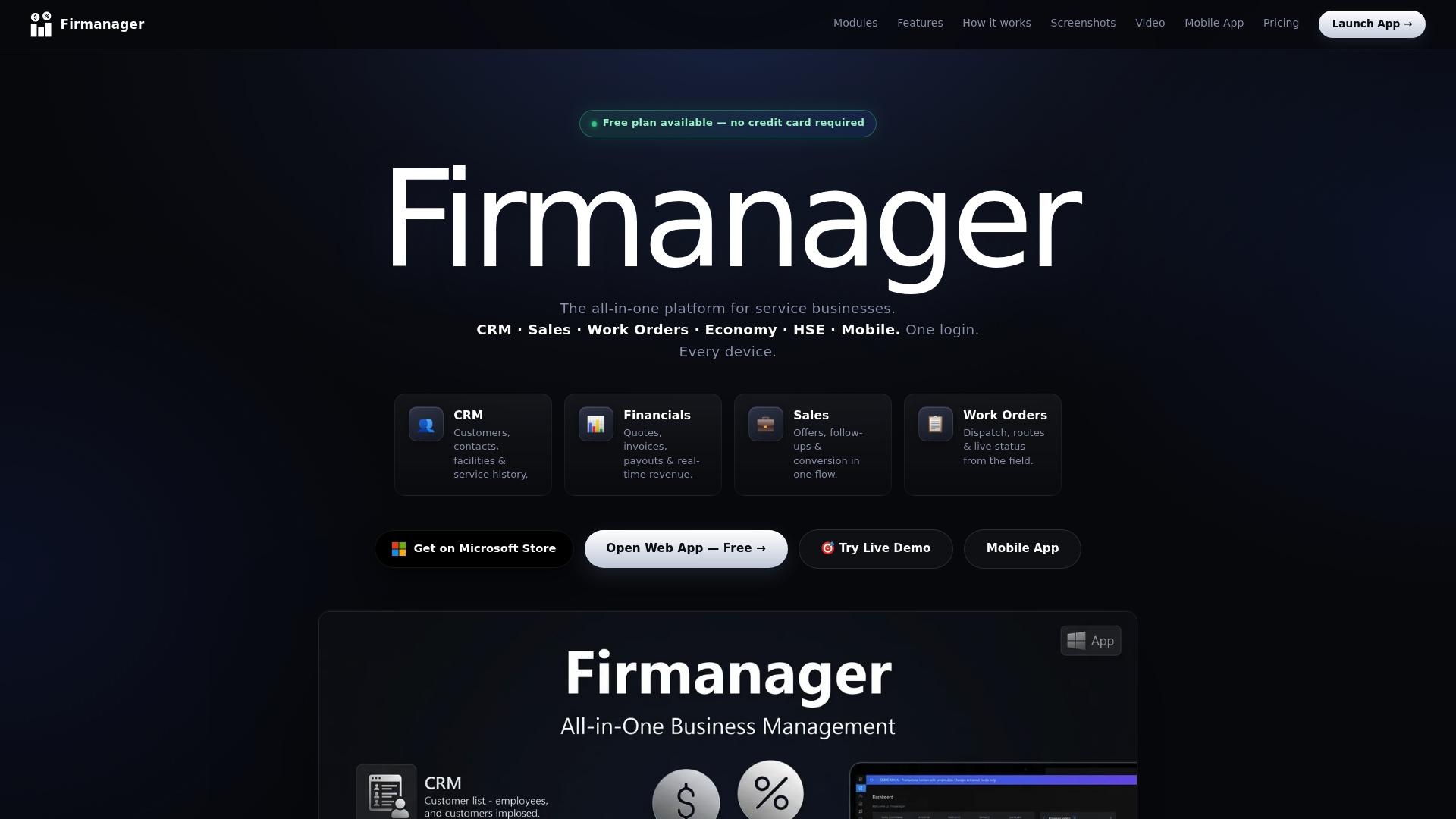
A crew lead files the initial report from the mobile portal, a supervisor gets notified automatically, the investigator’s tasks and deadlines live in the work order module, and the HSE compliance features keep the corrective-action history in one searchable place instead of scattered across devices and inboxes.
- Free plan for teams starting to formalize a reporting process without upfront cost.
- Pro plan for teams ready to add task automation and notifications to the workflow.
- Business plan for organizations running compliance tracking and reporting across multiple crews or sites.
If your current process depends on someone remembering to follow up, explore Firmanager’s plans and see which tier fits the size of your team.
Sources
Every step in this guide draws on public guidance built for employers, not theory. Keep these on hand as references or as templates to adapt directly.
- Template for Near Miss Reporting Policy (OSHA)
- OSHA recordkeeping and reporting (OSHA/OBIS)
- Evaluating safety practices and indicators (NIOSH/CDC)
FAQ
What are the 5 rules of incident reporting?
There is no single universal list, but most guidance converges on the same core rules: report every incident and near miss, act fast to secure the scene and preserve evidence, capture factual details rather than assumptions, investigate for root causes without assigning blame, and verify that corrective actions actually close the risk. OSHA’s incident-investigation guidance anchors the blame-free and root-cause principles behind these rules.
How soon should an incident be reported after it happens?
An internal report should be filed the same shift, while details and witness accounts are still fresh. Separately, OSHA’s recordkeeping rules require external notification within 8 hours for a work-related fatality and within 24 hours for an in-patient hospitalization, amputation, or loss of an eye.
What is the difference between a near miss and an incident?
An incident results in actual harm, damage, or loss, while a near miss is an event that could have caused harm but did not. OSHA’s near-miss guidance recommends reporting near misses with the same rigor as incidents, since they point at the same underlying hazard.
Who should investigate a workplace incident?
A small team that includes both a manager and someone close to the actual work produces better results than a manager working alone. OSHA’s guidance recommends including employees in investigations specifically because they can spot systemic causes that an outside investigator might miss.
How long should incident records be kept?
Retention periods depend on the record type and applicable recordkeeping rules, so check your specific obligations rather than assuming a single universal period. As a general practice, keeping incident reports, investigation notes, and corrective-action histories for several years supports audits and helps identify repeat root causes over time.
Recommended
Run your whole business in one place
CRM, quotes, work orders, invoicing, expenses, HR and HSE — one login, every device. Free-forever plan.
Start free →