5 Step Pre Field Checklist for Reliable Offline Data Capture
5 Step Pre Field Checklist for Reliable Offline Data Capture
Offline data capture is the practice of collecting information on a device without an active internet connection, then syncing it to a server once one is available. The core discipline behind it isn’t complicated: build offline-first workflows, preload every form and reference dataset before you leave connectivity, show a clear pending-sync state, and use resumable sync with server acknowledgement before treating any record as complete.
TL;DR:
- Confirm that the offline tool supports full form logic, media capture, and reference data preloading before disconnecting from signals.
- Ensure the solution provides clear pending-sync indicators, resumable uploads, and role-based data access controls for reliable operation in spotty networks.
- Test the complete offline workflow, including conflict handling and recovery options, in real-world conditions before deploying to avoid data loss and delays.
- Use conflict detection with versioning or operation IDs to prevent silent overwrites and establish explicit conflict resolution policies for critical data types.
- Encrypt local databases with FIPS-validated tools and control device access to protect sensitive data stored on offline devices.
Table of Contents
- How Offline Data Capture Works Behind the Scenes
- What to Require From an Offline-Capable Solution
- Preparing an Offline-First Workflow Before You Leave the Office
- Synchronization Patterns and How Conflicts Get Resolved
- Security and Data Protection for Offline Records
- Testing Before You Trust the Workflow in the Field
- When Offline-First Actually Pays Off
- Firmanager for Teams Running Offline Field Work
- Sources
- FAQ
How Offline Data Capture Works Behind the Scenes
Not all “offline” tools work the same way, and the difference matters more than most teams realize. A browser-based form that relies on cached pages behaves very differently from a native app storing records in a local database like SQLite or IndexedDB. The KoboToolbox documentation on data collection tools distinguishes web forms, which depend on pre-caching, from dedicated collectors like KoboCollect, which download forms and store drafts directly on the device. That distinction affects everything downstream, including how a device recovers data if it’s lost or damaged before syncing.
Once a record is captured, it typically moves through three stages:
- Draft: the entry exists locally and can still be edited.
- Finalized: the user locks the record, often after attaching photos, signatures, or GPS coordinates.
- Queued for upload: the record waits in a resumable transfer queue until connectivity returns.
Here’s the detail teams often miss: a finalized record isn’t safely synced the moment the upload starts. KoboToolbox’s own guidance is explicit that a record leaves the upload queue only after the server confirms receipt. If the transfer drops mid upload, the record stays queued and retries. That’s the entire point of a resumable queue instead of a one-shot upload.
What to Require From an Offline-Capable Solution
Picking a tool based on “it works offline” is like picking a car based on “it has wheels.” The real question is what happens when a form has 40 fields, three photos, a signature, and a spotty connection.
At minimum, require these capabilities:
- Offline form logic and media capture. Full support for photos, signatures, barcode scans, and GPS tagging without a live connection, not just text fields.
- Preloading of forms and reference data. Lookup lists, customer records, and prior job history need to load onto the device before the team disconnects. SurveyCTO’s advanced offline features go further, supporting offline dataset publishing and case transfers so devices can share data with each other without touching a server.
- Visible pending-sync status. Field staff need to see, at a glance, which records are still queued and which have been acknowledged by the server.
- Resumable retry behavior. A dropped connection mid-upload shouldn’t force a full re-upload; the transfer should pick up where it left off.
- Role-based access and export controls. Not everyone on a team needs to see every record, and every device needs a defined recovery path if it’s lost.
Pro Tip: Don’t assume a form that displays offline is fully offline-capable. Test the entire chain, creation, edits, media attachment, finalization, and sync, because a form that renders without a connection can still fail silently on submission.
Preparing an Offline-First Workflow Before You Leave the Office
Most offline data failures trace back to preparation, not technology. The fix is a short pre-field runbook, not a new platform.
- Map the disconnected workflow. Define exactly which fields are mandatory, which are optional, and what “complete” looks like for a record captured with zero connectivity.
- Preload everything while you still have signal. Forms, maps, customer or asset records, and any required reference datasets need to be on the device before the team leaves the building, per KoboToolbox’s pre-caching guidance.
- Provision the devices. Check battery life, confirm available storage for photo and signature attachments, and verify camera and microphone permissions are granted, not just installed.
- Train on the failure states, not just the happy path. Staff should know what a pending-sync icon means and what to do if a device never reconnects.
- Run a sync verification step after first reconnection. Confirm that every record shows server acknowledgement, not just “upload started.”
A field workflow built this way avoids the classic failure mode: paper backups, duplicate entries, and reports that arrive days late because someone forgot a form wasn’t preloaded. That kind of practical field-record checklist is worth building once and reusing on every deployment.
Synchronization Patterns and How Conflicts Get Resolved
Two technicians editing the same customer record while both are offline is not a rare edge case. It happens constantly in field service and research operations, and it’s the scenario that separates a well-designed sync engine from a fragile one.

Blind last-write-wins sync, where whichever device syncs last simply overwrites the other, is the riskiest default a team can accept for anything that matters. OutSystems documents a conflict-detection pattern instead: non-conflicting updates sync through automatically, while conflicting edits get registered and flagged for human or rule-based resolution.
Good conflict handling generally relies on:
- Versioning or operation IDs attached to every local edit, so the sync engine can tell which change happened first.
- Surfaced, unresolved conflicts that sit in a review queue rather than resolving themselves silently.
- Per-object conflict policy, decided before rollout rather than improvised after data loss. ObjectBox’s guidance on conflict resolution makes the case that failing to define this policy per business object is a common, quiet cause of lost data.
Not every record type deserves the same treatment. Approvals, inventory counts, and financial records need human review when conflicts appear. Simpler records, like a status note or a non-critical tag, can often accept an automated merge without much risk.
Security and Data Protection for Offline Records
A device sitting in a truck or a backpack for a week is a different security problem than a browser tab. Encryption has to happen locally, not just in transit.
- Encrypt the local database. SQLCipher offers full database encryption and carries FIPS-validated status through NIST’s Cryptographic Module Validation Program, making it a solid option for teams with regulatory encryption requirements.
- Control the device lifecycle. Passcodes, remote wipe capability, and role-based access limit exposure if a device is lost or stolen in the field.
- Use encrypted-form workflows for sensitive submissions. KoboToolbox and ODK’s encryption model encrypts finalized submissions on the device using a public key, and decryption requires the matching private key, typically through a tool like ODK Briefcase. That protects the data in transit and at rest, but it also means encrypted content can’t be mapped or exported directly on the server until someone runs it through decryption.
Testing Before You Trust the Workflow in the Field
A form that works in the office on Wi-Fi tells you almost nothing about how it’ll behave 40 miles from cell coverage. Run the full test before deployment, not after the first bad sync.
- Simulate a complete offline cycle. Create a new record, attach a photo and signature, finalize it, put the device in airplane mode, then reconnect and confirm the server acknowledged receipt before it drops from the queue.
- Force a conflict on purpose. Edit the same record on two devices offline, then reconnect both and verify the conflict gets flagged rather than silently overwritten.
- Test the no-reconnection scenario. Confirm there’s a working export or recovery path, such as a USB transfer or a briefcase-style extraction tool, for devices that never get signal again.
Pro Tip: Run the conflict test with two low-stakes records before you ever trust the system with financial or compliance data. It’s far cheaper to find a sync bug on a test record than on an invoice.
When Offline-First Actually Pays Off
Full offline-first architecture is overkill for a form someone fills out once a month with decent Wi-Fi nearby. It earns its complexity when teams work in basements, rural routes, disaster zones, or anywhere connectivity is genuinely unpredictable, not just occasionally spotty. Lighter browser caching handles the in-between cases fine.
The real cost of offline-first isn’t the software. It’s the support burden: someone has to own conflict review, device provisioning, and recovery paths. An integrated platform that already ties field records to the same customer and job data eliminates a layer of duplicate entry that standalone offline form tools can’t touch.
— KaiosMedia
Firmanager for Teams Running Offline Field Work
Firmanager gives field teams one login across various business functions instead of stitching together separate offline form tools, scheduling apps, and invoicing systems that require manual reconciliation later. That matters most for maintenance, cleaning, and technical service teams where a technician’s field notes, a customer’s job history, and the invoice all need to line up without anyone retyping the same job three times.
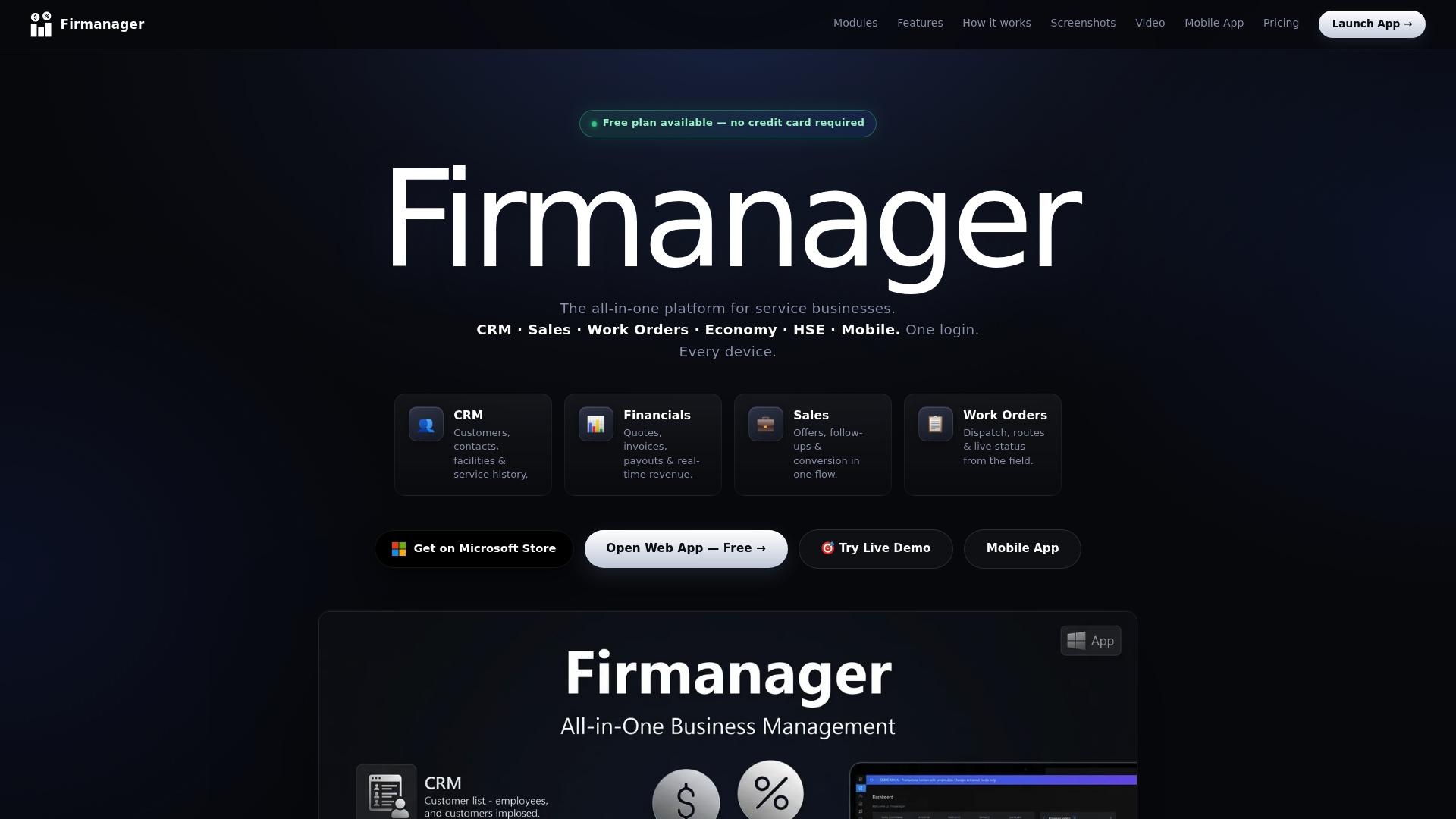
If your crews are filling out paper forms in areas with weak signal, or your dispatchers are chasing down job updates that arrived late because of a bad sync, an integrated mobile job workflow closes that gap by keeping field data, scheduling, and invoicing under one system instead of three. Teams evaluating whether to build a custom app or adopt an off-the-shelf platform can also compare notes with this overview of mobile app builders before deciding. Firmanager offers multiple subscription plans, including a free option; current pricing details are available on their website at Firmanager. Start on the free plan to test your own offline field workflow before committing to a paid tier.
Sources
- Data collection tools — KoboToolbox documentation
- Read/write data with conflict detection synchronization pattern — OutSystems
- Cryptographic Module Validation Program — NIST / CSRC (SQLCipher module)
FAQ
What Does “Offline Data” Mean?
Offline data refers to information captured and stored on a device without an active internet connection, then transmitted to a server once connectivity returns. It typically sits in a local database or drafts folder until a resumable sync process uploads it and receives server acknowledgement.
Can REDCap Collect Data Offline?
REDCap supports offline data collection through its mobile app, which caches forms locally and syncs records once the device reconnects. Like most offline tools, it relies on preloading project forms before disconnection, the same principle behind KoboToolbox’s pre-caching approach.
Can Survey Apps Be Used Offline?
Yes, most dedicated survey and field-data apps support offline use, though the mechanism varies. Native collectors download forms and store drafts on the device, while browser-based tools depend on pre-caching, and that distinction affects how reliably a form behaves with zero signal.
What Is the Best App for Data Collection?
There’s no single best tool, since requirements shift based on media capture needs, team size, and whether you need conflict-aware sync for shared records. Teams already managing field jobs, invoicing, and customer records often prefer a platform like Firmanager that keeps offline-captured field data connected to the same system running schedules and billing, rather than syncing into a disconnected form tool.
How Do Conflicts Get Resolved When Two Devices Edit the Same Record Offline?
A well-designed sync engine detects conflicting edits, lets non-conflicting changes sync automatically, and flags the conflicting ones for review instead of overwriting data silently. OutSystems’ conflict-detection pattern is a widely referenced example of this approach for records where accuracy matters, like financial data or inventory counts.
Recommended
Run your whole business in one place
CRM, quotes, work orders, invoicing, expenses, HR and HSE — one login, every device. Free-forever plan.
Start free →