Preventive Maintenance Schedules: A Playbook for Planners
Preventive Maintenance Schedules: A Playbook for Planners
A preventive maintenance schedule is a planned sequence of inspection, service, and replacement tasks performed on a fixed trigger (time, usage, or condition) to catch failures before they happen. Done right, it cuts unplanned downtime and extends the working life of your equipment.
The single best first action: export your asset list and pick 10 to 20 critical assets for a pilot schedule. Don’t try to schedule everything at once. A peer-reviewed review of maintenance program effectiveness found that systematic preventive maintenance reduces failure rates most reliably when paired with data-driven interval tuning, not blanket frequency assignments.
Pro Tip: Before you write a single task, pull your asset registry and tag each item as A, B, or C criticality. You’ll build the rest of the schedule around that ranking, so do it first.
Three numbers should anchor your plan from day one:
- Uptime and failure-rate gains depend on tuning intervals with real data, not guessing at OEM defaults.
- Structured templates with defensible starting frequencies reduce unplanned breakdowns compared with ad-hoc scheduling.
- Firmanager customers use the same criticality-first approach, running PM schedules and work orders from one login instead of juggling spreadsheets and paper checklists.
Key Takeaways
Preventive maintenance schedules cut downtime and extend asset life when planners start with a small, criticality-ranked pilot and tune intervals using real failure data instead of static defaults.
| Point | Details |
|---|---|
| Start with a pilot | Pick 10 to 20 critical assets before scheduling your entire facility or fleet. |
| Match trigger to asset | Use time, floating, meter, or condition-based scheduling depending on how the asset actually wears. |
| Write checklists with tolerances | Include pass/fail criteria, labor estimates, part numbers, and skill level on every task. |
| Track four KPIs | Monitor PM compliance rate, planned versus unplanned ratio, MTBF trend, and emergency rate monthly. |
| Automate to scale | Firmanager links schedules, checklists, and parts into one system so work orders and compliance dashboards update automatically. |
Table of Contents
- Types of Preventive Maintenance Schedules and When to Use Each
- How Do You Build a Preventive Maintenance Schedule From Scratch?
- What Fields Belong in a PM Checklist and Template?
- How Does Automation Change Preventive Maintenance Scheduling?
- Which Metrics Prove a PM Schedule Is Working?
- How Should You Roll Out and Sustain a New PM Program?
- How Do Safety and Regulatory Requirements Shape a PM Schedule?
- What Does a Preventive Maintenance Program Cost to Run?
- How Do Environmental Conditions Affect Maintenance Scheduling?
- What Planners Get Wrong About Preventive Maintenance
- Run Your PM Schedule Without the Spreadsheet Chaos
- Frequently Asked Questions
- Sources
Types of Preventive Maintenance Schedules and When to Use Each
Not every asset needs the same trigger. Picking the wrong one is how planners end up either over-servicing healthy equipment or missing failures on critical systems.
Time-based (calendar) scheduling triggers a task on a fixed date, like every 30, 90, or 365 days. It’s simple to plan and easy to staff around, but it ignores actual usage, so you can end up servicing a rarely-used pump on the same clock as one running 24/7.

Floating scheduling sets the next task a fixed interval after the previous one completes, rather than on a calendar date. This absorbs delays gracefully; if a technician finishes a task two weeks late, the next one doesn’t stack on top of the missed window.
Meter or usage-based scheduling triggers on a measurable unit: engine hours, mileage, cycles, or gallons pumped. Fleet vehicles and production equipment fit this model well because wear tracks usage far more closely than the calendar.
Condition-based scheduling triggers on measured degradation: vibration analysis, oil sample results, thermal imaging readings, or sensor thresholds. It’s the most precise trigger and the hardest to run without instrumentation or a connected system to flag out-of-range readings.
Here’s how these map to common asset categories:
- Fleet vehicles: meter-based on mileage or engine hours, with a time-based fallback for vehicles that sit idle.
- HVAC systems: time-based for filter changes, condition-based for compressor and refrigerant checks.
- Safety-critical systems (fire suppression, emergency generators): time-based per code requirements, layered with condition-based testing.
Standby generators are the clearest case for a hybrid approach. You run a monthly time-based load test to satisfy code, and add condition-based oil and coolant analysis to catch degradation the calendar alone would miss.
How Do You Build a Preventive Maintenance Schedule From Scratch?
Building a schedule that survives contact with a real shift is a sequence, not a document. Skip a step and the schedule either falls apart in month two or buries your team in low-value tasks. Here’s the six-step version that holds up.
1. Build the asset inventory. Every asset needs a unique ID, location, manufacturer, model, serial number, install date, and current meter reading if applicable. Export this from your existing CMMS, spreadsheet, or facility drawings; if none exists, a walkthrough with a tablet is faster than most planners expect.
2. Score criticality. Rank each asset across four dimensions: safety impact, production impact, downtime cost, and replacement lead time. A simple 1 to 3 scale per dimension, summed into a total score, is enough to sort assets into A, B, and C tiers without turning this into a spreadsheet project of its own.

3. Set starting intervals from OEM data and failure history. Pull the manufacturer’s recommended service interval as your baseline, then check it against your own failure history if you have any. CMMS-based guidance suggests setting the initial interval at roughly 80 to 90% of the calculated mean time between failures (MTBF) where that data exists, then adjusting after 12 months of reliable work-order history.
4. Write checklists with pass/fail criteria. A task description like “inspect belt” isn’t a checklist item; “inspect belt tension against 1/2 inch deflection spec, replace if cracked or glazed” is. Every line should specify the tolerance or the pass/fail condition, the estimated labor time, and the part number if a replacement might be needed.
5. Formalize assignments and parts stocking. Assign each task to a skill level (operator, technician, licensed trade), a completion window, and a named or role-based owner. Cross-reference the parts list against your stockroom so a scheduled task never stalls because nobody ordered the filter. Firmanager’s parts inventory tracking ties directly to work orders so this step doesn’t require a second system.
6. Launch the pilot, train, and measure. Run the schedule on your A-tier assets first. Train operators and technicians on where to find the checklist and how to log completion, then track compliance weekly for the first 90 days.
- Keep the pilot list under 20 assets so early wins are visible fast.
- Log every missed or late task with a reason code, not just a blank.
- Revisit every interval quarterly using the compliance and failure data you’ve collected.
Pro Tip: If two technicians disagree on how to complete the same task, that’s a checklist problem, not a training problem. Rewrite the step until it’s unambiguous.
What Fields Belong in a PM Checklist and Template?
A preventive maintenance checklist is only as useful as its weakest field. Vague entries create vague compliance, and vague compliance is what turns a promising schedule into a spreadsheet nobody trusts.
Every scheduled PM entry needs these fields, according to ProjectManager’s maintenance-schedule guidance:
- Asset ID matching your inventory record exactly.
- Task description with pass/fail criteria, not a vague verb.
- Trigger and interval (calendar date, meter reading, or condition threshold).
- Estimated labor time, used later for workforce planning.
- Parts required, with part numbers, not descriptions.
- Assigned skill level (operator, technician, licensed trade).
- Completion window, the grace period before a task counts as late.
- Checklist link or attachment, the actual step-by-step document.
Frequency defaults vary by equipment class, and the starting points below come from OxMaint’s facility equipment frequency guidance. Treat these as a defensible starting point, not a fixed rule; your OEM manuals and failure history should adjust them over time.
| Equipment class | Typical starting interval |
|---|---|
| HVAC filters and coils | Monthly to quarterly |
| Chillers | Quarterly, annual major service |
| Pumps | Monthly inspection, annual overhaul |
| Electrical switchgear | Annual thermal scan and inspection |
| Standby generators | Monthly load test, annual full service |
| Light-duty fleet | Meter-based on mileage or engine hours |
Once the template is populated, each row converts directly into a recurring work order: the interval sets the schedule, the checklist attaches automatically, and the parts field triggers a stock check before the technician even walks up to the asset.
How Does Automation Change Preventive Maintenance Scheduling?
A spreadsheet can hold a schedule. It can’t remind anyone that a task is overdue, and it can’t calculate compliance without someone manually counting rows. That’s the gap a computerized maintenance management system (CMMS) closes.
The capabilities that move the needle:
- Auto-generated recurring work orders tied to the schedule’s trigger, so nothing depends on someone remembering to open a spreadsheet.
- Mobile checklists technicians complete on the asset, with photo and signature capture for compliance records.
- Parts linked directly to tasks, flagging shortages before the work order is even dispatched.
- Overdue escalation that alerts a supervisor automatically rather than waiting for a monthly report.
- Dashboards showing compliance rate, MTBF trends, and planned versus unplanned work in real time.
Certain scale signals mean it’s time to move off spreadsheets: more than 50 active PMs, operations spread across multiple sites, or a compliance rate that’s stuck below a target you can’t explain. CMMS-focused guidance recommends linking the schedule, checklist, and work order in one system specifically so compliance and MTBF calculate themselves instead of living in someone’s head.
Teams that make this switch typically see compliance climb, in part because moving a schedule into an automated system surfaces the completion data planners need to tune intervals with confidence, rather than guessing at the next revision.
Which Metrics Prove a PM Schedule Is Working?
You need a handful of numbers, checked on a fixed cadence, not a dashboard full of vanity metrics nobody reviews.
- PM compliance rate: the percentage of scheduled tasks completed within their window. Below roughly 80%, reduce scheduled scope or fix visibility problems before adding more tasks.
- Planned versus unplanned work ratio: healthy programs skew heavily toward planned work; a rising unplanned share signals intervals are too loose or assets were misclassified.
- MTBF trend: rising mean time between failures on an asset means your interval is working; a flat or falling trend means it’s time to tighten the schedule.
- Emergency work order rate: a spike here usually traces back to a specific asset class whose PM tasks aren’t catching the real failure mode.
Review these metrics regularly, at least monthly for performance and quarterly for interval decisions. CMMS platforms calculate all four automatically once work orders and checklists are linked to the schedule, which is the whole point of moving off a spreadsheet in the first place.
How Should You Roll Out and Sustain a New PM Program?
- Select your A-class critical assets and set a specific compliance target, such as 90% completion within the assigned window, before the pilot starts.
- Run the pilot for 90 days and track compliance weekly, not just at the end.
- Post the schedule where operators see it daily, whether that’s a physical board or a mobile alert, so nobody discovers a missed task after the fact.
- Build a short feedback loop where technicians can flag a checklist step that doesn’t match reality.
- Review every interval quarterly, retiring any PM task that hasn’t caught a real problem in a year.
Pro Tip: Ask technicians directly which PM tasks feel pointless. If three people independently name the same task, it’s probably a candidate for retirement, not a training gap.
How Do Safety and Regulatory Requirements Shape a PM Schedule?
Safety-critical assets don’t get to follow the same interval logic as everything else. Fire suppression systems, emergency generators, elevators, and pressure vessels typically carry mandated inspection frequencies set by code, insurance requirements, or OSHA-adjacent standards, and those frequencies override whatever your MTBF data might suggest.
Build compliance-driven tasks as a separate, non-negotiable layer inside your schedule rather than blending them with discretionary maintenance. Flag each one with its governing requirement, whether that’s a local fire code, a state elevator inspection rule, or a manufacturer’s certification requirement, so nobody accidentally reschedules a legally mandated inspection to “next quarter” because the shop got busy.
Checklists for these tasks need documentation fields that go beyond pass/fail: inspector name or license number, date, and a record retention period, since many jurisdictions require these records on file for a set number of years. A job hazard analysis built into the checklist also protects technicians on tasks involving lockout/tagout, confined spaces, or energized equipment, and gives you a defensible record if an incident ever gets reviewed.
Treat these tasks as your highest-priority tier, above even your A-class production assets. A missed production PM costs you downtime. A missed life-safety inspection can cost a lot more, and it’s the one category of PM bloat you’re never allowed to trim for the sake of compliance numbers.
What Does a Preventive Maintenance Program Cost to Run?
Budgeting for preventive maintenance means accounting for three separate cost lines: labor hours, parts and consumables, and the tooling or software that runs the schedule.
Labor is usually the largest line item, and it scales with how many assets you schedule and how detailed each checklist is. This is exactly why criticality ranking matters for your budget, not just your risk profile: scheduling every asset at the same frequency inflates labor costs without a proportional drop in failures.
Parts and consumables costs are more predictable once your checklist fields include part numbers, because you can forecast consumption instead of reacting to it. Track parts against your inventory system rather than ordering reactively; a stockout that delays a scheduled task often costs more in downtime than the part itself.
The software or CMMS line is usually the smallest cost relative to the labor and parts it touches, and it’s the one budget line with the clearest payback: a system that automates work orders and tracks compliance typically pays for itself through reduced emergency labor and fewer expedited parts orders. Budget for the pilot phase separately from the full rollout, since a 20-asset pilot costs a fraction of a facility-wide program and gives you real compliance data to justify the larger spend.
How Do Environmental Conditions Affect Maintenance Scheduling?
Temperature, humidity, dust, vibration, and duty cycle all shift how fast an asset wears, which means the same equipment model can need very different intervals depending on where it operates.
A rooftop HVAC unit in a coastal climate corrodes faster than the same unit inland, and its filter change interval in a dusty industrial environment might need to be half the manufacturer’s default. Fleet vehicles running in stop-and-go urban routes wear brakes and transmissions faster than highway-heavy routes covering the same mileage, which is one reason meter-based scheduling beats pure calendar scheduling for vehicles.
Seasonal patterns matter just as much as geography. Generators need heavier pre-winter testing in cold climates where a failed cold start during an outage is the actual failure mode you’re trying to prevent, while HVAC systems need condenser and coil attention before peak cooling season rather than after. Aviation maintenance tracking programs handle this by layering environmental exposure data on top of usage meters, a model that translates well to any fleet or facility operating across variable conditions.
When you set your starting intervals in step three of the build process, adjust the OEM baseline for your specific environment before you lock it in. An asset running in a clean, climate-controlled facility can often extend past the manufacturer default; one running in a harsh environment usually needs to come in tighter than the label suggests.
What Planners Get Wrong About Preventive Maintenance
The most common mistake isn’t under-scheduling, it’s over-scheduling. Practical guidance consistently warns against PM bloat: assigning aggressive frequencies across every asset at once, which quietly tanks compliance because technicians can’t keep up and start skipping tasks silently. Starting small on your highest-criticality assets and proving out high compliance before expanding protects both your data and your technicians’ trust in the schedule.
Run Your PM Schedule Without the Spreadsheet Chaos
Every step in this playbook, from criticality scoring to interval tuning, depends on data that a spreadsheet can’t generate on its own. Firmanager turns your PM schedule into recurring work orders automatically, embeds the checklist and parts list on every task, and reports compliance and MTBF trends on a dashboard your team actually checks.
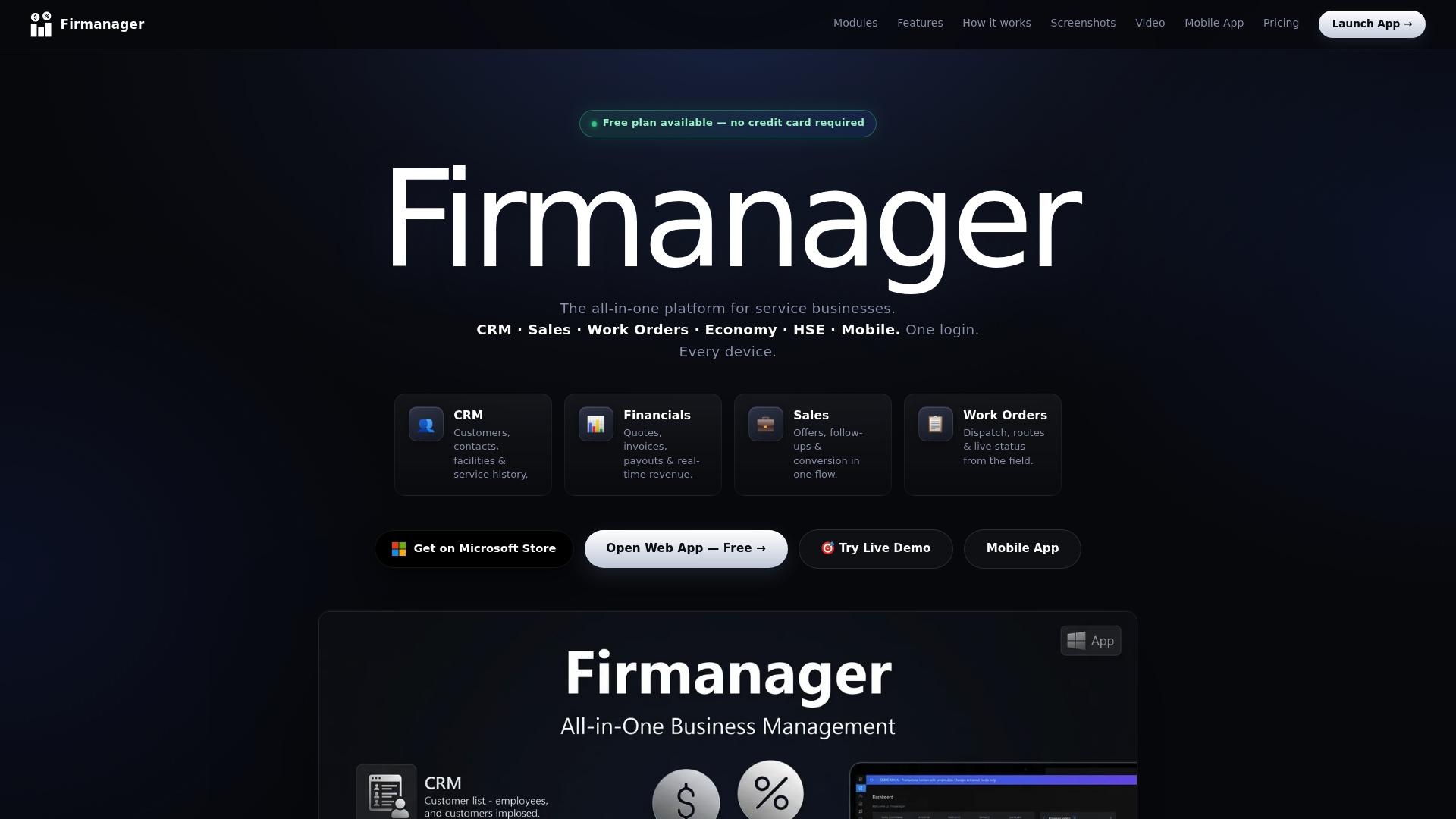
Technicians complete checklists from a mobile portal, parts link straight to your inventory so a missing filter doesn’t stall a work order, and supervisors see overdue tasks the moment they slip past the completion window instead of finding out a month later. Because CRM, work orders, and financial tracking all run through the same login, a missed PM never gets lost between systems the way it can when scheduling and inventory live in separate tools.
Start with your A-tier assets and see your real compliance number within the first pilot cycle at Firmanager.
Frequently Asked Questions
How often should I review a preventive maintenance schedule? Review compliance data monthly and revisit intervals quarterly. Most CMMS guidance recommends waiting for about 12 months of reliable work-order history before making major interval changes, since that gives you enough MTBF data to trust the adjustment.
What’s a reasonable PM compliance target to start with? If your pilot falls below that, the problem is usually visibility or task volume, not technician effort.
Can I run a preventive maintenance schedule on a spreadsheet? Yes, for a small pilot. Once you pass roughly 50 active PM tasks or operate across multiple sites, a spreadsheet stops scaling and a CMMS becomes the more reliable way to track compliance and generate work orders automatically.
Should safety-critical inspections follow the same interval logic as production equipment? No. Safety and regulatory inspections follow mandated frequencies set by code or insurance requirements, and those override MTBF-based tuning. Treat them as a fixed, non-negotiable layer in the schedule.
What’s the fastest way to get from a static schedule to automated work orders? Populate a template with asset ID, task, trigger, labor estimate, parts, and skill level, then load it into a system that converts each row into a recurring work order with the checklist attached automatically.
Sources
Recommended
Run your whole business in one place
CRM, quotes, work orders, invoicing, expenses, HR and HSE — one login, every device. Free-forever plan.
Start free →