Field Service: Recurring Task Automation with RFC 5545 Recipes

Field Service: Recurring Task Automation with RFC 5545 Recipes
Recurring task automation generates scheduled instances of work automatically, so no one has to rebuild the same task, meeting, invoice, or service visit by hand every cycle. The recommended setup: define a recurrence rule (many platforms use the RFC 5545 standard behind RRULE), attach a reusable template, build in exception handling for skipped or modified instances, and turn on monitoring so silent failures don’t slip through. Get those four pieces right and the rest of this guide is refinement, not survival.
TL;DR:
- Supporting complex recurrence patterns such as “last business day of the month” or “second Tuesday” requires adherence to RFC 5545 standards and explicit time zone management to prevent drift.
- Building a well-structured recurrence pattern and comprehensive template before activating automation reduces errors, missed notifications, and the need for manual intervention.
- Ensuring idempotency and clear overlap policies, along with daylight saving time considerations, is vital for maintaining reliable, repeatable scheduled tasks at scale.
- Monitoring automation through heartbeat signals, exception queues, and traceable run IDs helps detect silent failures and keeps recurring work trustworthy.
- Using an integrated platform like Firmanager simplifies coordination of scheduling, assignment, and invoicing, enabling pilot testing of recurring service recipes with minimal manual rework.
Table of Contents
- Why Automate Recurring Tasks in the First Place?
- What Scheduling Models Should Your Automation Support?
- How Do You Set Up a Recurring Task Step by Step?
- How Do You Keep Recurring Automations Reliable at Scale?
- How Do You Monitor and Troubleshoot Recurring Automations?
- What Does a Copy-Ready Recurring-Service Recipe Look Like?
- How Does an Integrated Platform Handle Recurring Work?
- A Practitioner’s Checklist for Rolling Out Recurring Automation
- Try Firmanager for Your Recurring Service Recipes
- Key Standards and Docs Worth Bookmarking
- Sources
- FAQ
Why Automate Recurring Tasks in the First Place?
Manual rebooking is where recurring work quietly bleeds time. A service manager who rebuilds a maintenance visit from scratch every month, or a coordinator who recreates the same status-report task every Friday, isn’t doing skilled work. They’re doing data entry disguised as planning.
Automating that pattern removes two costs at once: the minutes spent recreating the task, and the errors that creep in when a human retypes details under time pressure (wrong date, missing checklist item, forgotten customer notification). Neither cost is dramatic on its own. Multiplied across 50 recurring accounts or 200 weekly checklist items, they add up to a real drag on a team’s calendar.
Common use cases where automation earns its keep:
- Recurring meetings and reports: weekly status updates, monthly board packets, quarterly compliance filings.
- Billing cycles: subscription invoices, retainer billing, usage-based statements generated on a fixed date.
- Preventive maintenance: HVAC checks, equipment servicing, safety inspections tied to a calendar or usage threshold.
- Recurring service visits: lawn care, pest control, janitorial contracts, and any field service booked on a standing schedule.
One design decision matters more than people expect: whether to duplicate a task fresh each cycle or roll forward a single persistent record. Duplication works well when each cycle needs its own audit trail (a new invoice, a new inspection report). Rolling updates fit better when the task is really one ongoing commitment with a shifting due date, like a recurring checklist that just needs its status reset. Mixing the two models on the same workflow is the most common design mistake teams make when they first automate recurring work.
What Scheduling Models Should Your Automation Support?
Recurrence sounds simple until you hit the edge cases: “the last business day of the month,” “every second Tuesday,” “quarterly, except in December.” Supporting only basic daily or weekly intervals will eventually leave someone rebuilding a schedule by hand anyway.
The RFC 5545 iCalendar specification is the reference point most scheduling engines build on, because it defines RRULE syntax for exactly these patterns and mandates a TZID (time zone identifier) on every recurring event to stop it from drifting as it crosses daylight saving boundaries. Libraries like Python’s dateutil rrule module implement this same logic for developers who need to compute recurrence instances programmatically, including Nth-weekday and last-day-of-month rules that trip up naive date math.
| Pattern | Example rule | Typical use case |
|---|---|---|
| Daily | Every weekday at 9:00 AM | Status check-ins, log reviews |
| Weekly | Every Monday and Thursday | Route-based service visits |
| Monthly (fixed date) | 1st of every month | Rent invoices, subscription billing |
| Monthly (Nth weekday) | Second Tuesday of every month | Board meetings, review cycles |
| Monthly (last day) | Last business day of the month | Closing reports, payroll cutoffs |
| Yearly | Every March | License renewals, annual inspections |
| Custom/skip rule | Weekly, except the last week of December | Seasonal service pauses |
Most platforms expose this either as a cron-like expression (0 9 * * 1,4 for Monday and Thursday at 9 AM) or as a natural-language builder. Power Automate’s scheduled cloud flows, for instance, let you pick frequency and time zone through a form, and now support Copilot prompts that translate a plain-English request into the underlying schedule. Whichever format your tool uses, confirm it stores the time zone explicitly rather than assuming server local time. That one detail decides whether your 9 AM task still fires at 9 AM after the clocks change.
How Do You Set Up a Recurring Task Step by Step?
Setting up a recurring task well takes five deliberate steps, not one. Skipping straight to “pick a frequency and save” is how teams end up with tasks that fire correctly but produce garbage output because the template underneath was never finished.
- Define the pattern first, separate from the content. Decide whether it’s daily, weekly, monthly, or a custom rule like “every 90 days from install date” before you touch the task template. Recurrence and content are two different problems.
- Build the template. This is the reusable shell: task name, description, checklist items, assigned fields, and any customer-facing notice. A recurring task is only as good as the template it stamps out every cycle.
- Configure the cadence and start conditions. Set the recurrence rule (cron expression, RRULE, or natural-language equivalent), the time zone, and whether the series starts immediately or on a future date.
- Assign ownership and notifications. Every instance needs a clear owner and a notification path. If no one is pinged when a new instance generates, the automation is really just an unread queue.
- Run a dry-run before going live. Generate the next two or three instances without executing side effects like invoicing or dispatch, and confirm the dates, assignees, and template fields all look right.
A few concrete config examples make the abstraction real:
- Cron-style:
0 8 1 * *runs on the first day of every month at 8:00 AM. - RRULE-style:
FREQ=MONTHLY;BYDAY=2TUfires on the second Tuesday of every month, per the RFC 5545 syntax. - Natural language: “every 2 weeks on Friday” — the format ChatGPT’s scheduled tasks feature uses, with plan-dependent limits on how many active recurring tasks you can run at once.
Before flipping any recurring workflow to live, run this pre-flight checklist:
- ID fields: does each generated instance carry a unique identifier separate from the series ID, so you can trace one occurrence without confusing it with the next?
- Template completeness: are all required fields populated, or does the template silently leave a blank the assignee has to notice and fill manually?
- Exception rules: what happens on a holiday, a skipped week, or a canceled customer contract? If you haven’t defined this, the automation will define it for you, badly.
- Permissions: can the automation actually write to the calendar, CRM, or invoicing system it needs to touch, under the account it’s running as?
Pro Tip: Run your dry-run at least one full cycle ahead of go-live, not the day before. A monthly task tested three days before its first fire date gives you zero room to fix a bad template before it reaches a customer.
How Do You Keep Recurring Automations Reliable at Scale?
Reliability problems in recurring automation rarely show up in week one. They show up in month three, when a schedule quietly overlaps itself, a server clock shifts for daylight saving, or two instances of the same job both try to bill the same invoice.
Idempotency is the foundation. Every recurring job should be safe to run twice without creating duplicate side effects. That usually means a unique key per scheduled instance (date plus task ID, for example) and database upserts instead of blind inserts, so a retried run updates the existing record rather than creating a second invoice or dispatch ticket. Cron best practices treat idempotency as non-negotiable for exactly this reason.
Overlap policy needs a deliberate choice, not a default. Three common patterns:
- Skip if running: the next instance waits if the previous one hasn’t finished. Good for batch jobs where order matters.
- Cancel and restart: the new instance replaces the old one. Fits configuration refreshes where only the latest state matters.
- Always start independently: instances run in parallel regardless of overlap. Works for audit windows that don’t depend on each other.
Distributed systems need lease-based coordination. When more than one server or worker could theoretically pick up the same scheduled job, lease and fencing patterns prevent two workers from executing the same instance simultaneously. The practical takeaway from that architecture: design for at-least-once execution with idempotent handlers, rather than chasing exactly-once delivery that clock drift and network retries will eventually break anyway.
Daylight saving time deserves its own line item. NIST notes that jobs scheduled around 1:30 to 2:00 AM local time frequently run twice, get skipped, or drift by an hour during the transition. The fix is structural: schedule in UTC on the server side, store each tenant’s time zone separately, and display local times in the interface. Never let the scheduler’s execution logic depend on a wall-clock time that changes twice a year.
How Do You Monitor and Troubleshoot Recurring Automations?
The failure mode that hurts most isn’t a task that errors loudly. It’s a task that silently stops firing, and nobody notices until a customer asks why their monthly invoice never arrived.
A few operational habits close that gap:
- Heartbeat pings. A dead-man’s-switch monitor expects a signal every cycle; if the signal doesn’t arrive on schedule, it alerts a human instead of waiting for someone to notice a gap.
- Retry and backoff limits. Set a maximum retry count with increasing delay between attempts, and stop after a defined ceiling rather than retrying indefinitely into a broken dependency.
- An exception queue with escalation timing. When an instance can’t complete automatically, route it to a queue rather than failing silently, and escalate anything unconfirmed after a set window, commonly 48 hours, to a human owner.
- Observability fields on every run. Capture a
run_idand aschedule_bucket(the specific date/time slot the instance belongs to) so you can trace exactly which occurrence failed, retried, or duplicated, without guessing from a generic log line.
None of this needs to be complicated to be effective. A weekly ten-minute review of the exception queue catches most problems before they become customer complaints, and it’s far cheaper than rebuilding trust after a missed recurring service visit.
What Does a Copy-Ready Recurring-Service Recipe Look Like?
Field service teams running recurring contracts, lawn care, pest control, HVAC maintenance, or janitorial work, tend to converge on the same five-step recipe once they move past manual rebooking:
- Detect the trigger. A recurrence rule fires (date-based or usage-based, like “every 5,000 miles” or “every 90 days since last visit”).
- Generate the visit. A new work order populates from a template: expected duration, parts likely needed, and a service checklist.
- Assign by skill and route. The system matches the visit to a technician based on territory, certification, and existing route load.
- Confirm with the customer. An automated notice, commonly SMS, confirms the appointment window and gives the customer a chance to reschedule.
- Escalate exceptions. Anything unconfirmed, declined, or requiring a parts substitution routes to a human dispatcher instead of silently failing.
Your template should carry, at minimum: estimated duration, parts or materials list, the service checklist itself, and the customer notice text. Skip any of these and the “automated” visit still needs a human to fill the gap before the technician shows up.
One caution worth stating plainly: a simple Zapier-style trigger chain handles the happy path fine for a handful of recurring accounts. Past a certain volume, orchestration layers that manage assignment, confirmation, and retry logic hold up far better than a chain of point-to-point triggers that has no coordinated way to handle a dispatcher being out sick or a technician’s route changing mid-week.

Pro Tip: Build the escalation step before you build the happy path. Teams that automate detection and assignment first, then bolt on exception handling later, spend months firefighting exactly the cases they should have designed for from day one.
How Does an Integrated Platform Handle Recurring Work?
Recurring automation gets fragile when it’s stitched together across five disconnected tools: one for scheduling, another for invoicing, a third for customer notifications. An integrated field-service platform centralizes CRM, work orders, scheduling, and invoicing under one login, so a recurring visit’s status update flows straight into the customer record and the invoice draft without a manual handoff.
Firmanager applies this to recurring service work directly. Route-aware technician scheduling has cut travel time by roughly 10% for teams managing recurring routes, and automated SMS appointment reminders have reduced no-shows by 30 to 40 percent for recurring visit programs. Recurring invoices draft within a one-hour window after a visit closes, and preventive maintenance scheduling ties directly to the same work order history used for compliance tracking.
- Centralized CRM and work order data eliminate the handoff gap between scheduling and billing.
- Route-aware scheduling supports recurring service territories without manual rebooking.
- SMS confirmations close the loop with customers automatically.
- Recurring invoice drafts generate close to real time after visit completion.
Piloting a recurring recipe, like a single preventive maintenance route, is a low-risk way to see whether the platform’s default templates and exception handling fit before scaling to a full book of accounts.
A Practitioner’s Checklist for Rolling Out Recurring Automation
Get the recurrence pattern and exception rules right before anything else. Everything downstream, notifications, invoicing, dispatch, depends on that foundation being solid. Pilot with a small book of accounts, instrument monitoring from day one, and only scale once you’ve measured actual time saved against the exception load the automation generates. If exceptions outpace the time you’re saving, the pattern needs rework, not more volume.
— KaiosMedia
Try Firmanager for Your Recurring Service Recipes
Firmanager gives service businesses one login for the pieces recurring work usually scatters across separate tools: scheduling, technician assignment, SMS confirmations, and invoice drafting all stay connected to the same customer and work order record. That means a recurring maintenance contract or a weekly route doesn’t need a Zapier chain stitched between four apps to function.
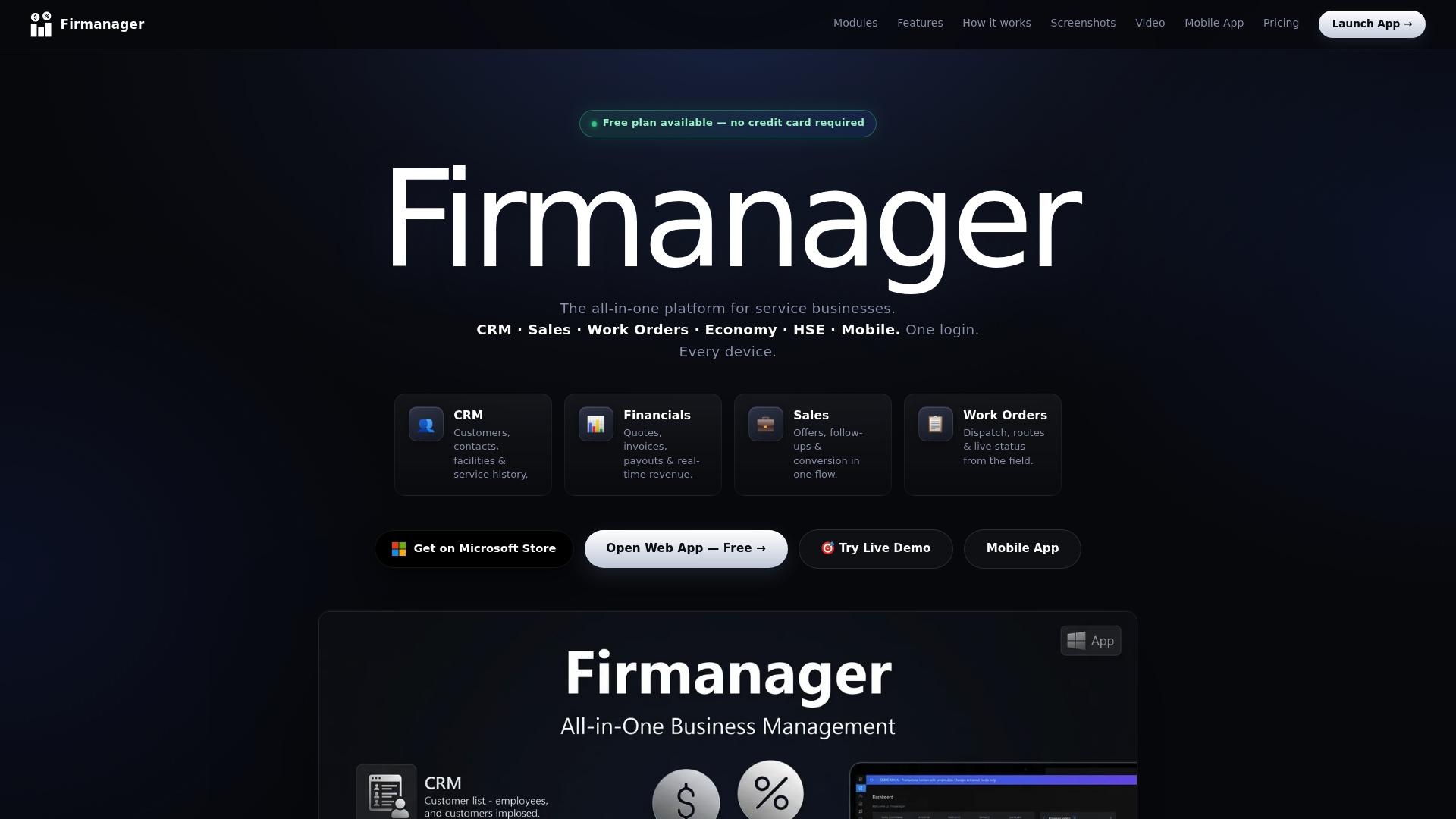
If you’re running preventive maintenance, recurring cleaning contracts, or any standing service schedule by hand or across disconnected software, piloting one recurring recipe inside Firmanager is a fast way to see the difference. Start with the Free plan to test recurrence templates and scheduling against a small book of accounts, or move straight to Pro at $19 per month for fuller automation and invoicing features once you know the pattern fits. For teams managing larger recurring portfolios, Business at $49 per month adds the scale to match. Set up your first recurring template today and see how many manual rebookings it removes from your week.
Key Standards and Docs Worth Bookmarking
For implementation details beyond this guide, consult the RFC 5545 RRULE specification, Power Automate’s scheduling documentation, the dateutil rrule reference, NIST’s daylight saving time guidance, and cron production best practices. Teams building recurring publishing workflows outside field service can also review WordPress publishing automation patterns for a useful parallel.
Sources
- Run a cloud flow on a schedule - Power Automate | Microsoft Learn
- dateutil rrule documentation
- Cron job best practices — CronWizard
FAQ
What Is Recurring Task Automation?
Recurring task automation generates scheduled task instances automatically based on a defined rule, like weekly, monthly, or a custom pattern, instead of requiring someone to recreate the task each cycle. Most platforms implement this using RRULE logic from the RFC 5545 standard.
How Do Due Dates Update When a Recurring Task Is Completed Late?
Most systems handle this one of two ways: the next instance generates on its original scheduled date regardless of when the prior one closed, or it shifts relative to the actual completion date. Choose the first for fixed compliance deadlines and the second for flexible, workload-based recurring tasks.
How Do I Handle Exceptions to a Recurring Schedule?
Build an exception rule into the recurrence itself, such as skipping a specific week or holiday, rather than manually deleting individual instances after the fact. For one-off changes, edit that single occurrence without breaking the underlying recurrence pattern for future instances.
What’s the Difference Between Cron Expressions and RRULE for Scheduling?
Cron expressions define fixed time-based triggers (minute, hour, day, month, weekday) and work well for simple, regular intervals. RRULE, defined in RFC 5545, handles more complex human patterns like “second Tuesday of the month” or “last business day,” which cron syntax struggles to express directly.
Does Firmanager Support Recurring Task Automation for Service Businesses?
Firmanager supports recurring scheduling, technician assignment, SMS appointment confirmations, and recurring invoice drafting within one platform. Pricing starts with a Free plan, with Pro at $19 per month and Business at $49 per month for teams needing broader automation and reporting features.
Recommended
Run your whole business in one place
CRM, quotes, work orders, invoicing, expenses, HR and HSE — one login, every device. Free-forever plan.
Start free →