Sales Pipeline Stages: A Manager's Playbook for Every Deal
Sales Pipeline Stages: A Manager’s Playbook for Every Deal
Sales pipeline stages are seller-defined checkpoints that track a deal’s progress from first contact to signed contract, and most teams run a five to seven stage model: Prospecting → Qualification → Discovery/Demo → Proposal → Negotiation → Close (won/lost) → Post-sale. Stage discipline is not busywork. It’s the difference between a forecast you can trust and one you’re guessing at.
Companies that run a formal, documented sales process generate more revenue than those that let reps freelance their own version of “qualified.” That’s not a coincidence. When every rep uses the same checkpoints, deals move through the pipeline in a way that’s measurable, coachable, and predictable.
Here’s the shortlist most B2B teams build around:
- Prospecting — identifying and contacting potential buyers
- Qualification — confirming budget, authority, need, and timeline
- Discovery/Demo — understanding the buyer’s problem and showing the fit
- Proposal — presenting pricing, scope, and terms
- Negotiation — resolving objections and finalizing terms
- Close (won/lost) — the deal is signed or officially dead
- Post-sale — onboarding and expansion opportunity tracking
Key Takeaways
Stage discipline, backed by clear entry and exit criteria and enforced through weekly audits, is what turns a pipeline from a wish list into a forecasting tool.
| Point | Details |
|---|---|
| Use several stages | Match stage count to deal complexity; simpler B2C sales need fewer, enterprise B2B needs more. |
| Define exit criteria per stage | Require an observable buyer action, not rep opinion, before a deal advances. |
| Track five core KPIs | Monitor conversion rate, time in stage, velocity, win rate, and pipeline coverage weekly or monthly. |
| Extend pipeline to post-sale | Set onboarding exit criteria and track expansion signals as new opportunities. |
| Firmanager connects the stages | Firmanager pairs CRM, quoting, and automated invoicing so stage changes trigger real workflow instead of manual updates. |
Table of Contents
- What Are Sales Pipeline Stages, and How Do They Differ From the Sales Funnel?
- The Stage-by-Stage Playbook: Entry, Actions, and Exit Criteria
- How to Map and Customize Stages to Your Business Model
- Which Metrics Actually Tell You Where Deals Stall?
- How to Implement Stage Discipline in Your CRM
- Why Post-Sale and Expansion Belong in Your Pipeline
- How an Integrated Operations Platform Reduces Stage Friction
- The Real Problem Isn’t Too Few Stages. It’s Too Little Enforcement.
- Get Your Pipeline Stages Working Inside One System
- Frequently Asked Questions
- Sources
What Are Sales Pipeline Stages, and How Do They Differ From the Sales Funnel?
Pipeline stages and the sales funnel describe the same journey from opposite ends. A pipeline is seller-centric: it tracks what your rep is doing at each point (calling, demoing, negotiating). A funnel is buyer-centric: it tracks how many prospects survive at each phase of awareness, interest, and decision. Sales funnel stages explained this way matter because a pipeline tells you what to do next, while a funnel tells you how efficiently your whole process converts strangers into customers. You need both lenses, but your CRM should be built around the pipeline, since that’s what reps actually act on day to day.
How many stages should you run? That depends on deal complexity, not personal preference. A useful rule of thumb: each stage should answer three questions before a deal moves forward. Is this opportunity qualified? What has to happen next? Who owns that next action? If a stage can’t answer all three, it’s either padding or missing a distinct action.
Reasons to add a stage:
- A distinct buyer action happens (technical evaluation, legal review) that needs its own owner and timeline
- Deals routinely stall at one point, and you need visibility into why
Reasons to collapse stages:
- Two stages always happen in the same call or meeting
- Reps consistently skip a stage because it adds no decision value
The Stage-by-Stage Playbook: Entry, Actions, and Exit Criteria
This is the part most sales teams get wrong. They name their stages (“Discovery,” “Proposal”) but never define what actually has to happen to move a deal from one to the next. Without exit criteria, “stage” becomes a vibe instead of a fact, and your forecast rots from the inside.

Most B2B pipelines run six to seven stages, and each one needs the same four ingredients: a clear entry criterion, a defined rep action, an observable exit criterion, and a note on the objections that typically show up. Below is a template you can copy directly into your CRM’s stage descriptions.
1. Prospecting
- Entry criteria: A lead matches your ideal customer profile and has been contacted through outbound, inbound, or referral.
- Rep action: Initial outreach (call, email, LinkedIn) and a scheduled first conversation.
- Exit criteria: A meeting is booked with a decision maker or influencer.
- Common objection: “We’re not looking right now.” Handle by asking about their current process, not pitching your product.
2. Qualification
- Entry criteria: First meeting is scheduled or completed.
- Rep action: Confirm budget range, decision timeline, and who else is involved in the buying decision.
- Exit criteria: The prospect has a defined budget, a named decision maker, and a stated timeline (even a loose one).
- Common objection: “We don’t have budget approved yet.” This is fine at this stage; flag it and set a follow-up trigger tied to their fiscal calendar.
3. Discovery/Demo
- Entry criteria: Qualification is confirmed and a discovery call or product demo is scheduled.
- Rep action: Ask targeted questions and map the buyer’s pain to your solution. A tight discovery question set looks like: What’s costing you the most time right now? What have you tried already? What does success look like in 90 days? Who needs to sign off?
- Exit criteria: The buyer has confirmed the solution addresses their stated problem, and they’ve agreed to receive a proposal.
- Common objection: “This looks similar to what we already have.” Dig into what’s actually broken in their current setup.
4. Proposal
- Entry criteria: Buyer has confirmed fit and requested pricing or a formal proposal.
- Rep action: Deliver a scoped proposal with pricing, timeline, and implementation details.
- Exit criteria: Proposal has been reviewed with the buyer, and next steps (verbal commitment, contract review) are scheduled.
- Common objection: “The price is higher than we expected.” Anchor back to the cost of the problem you uncovered in discovery.
5. Negotiation
- Entry criteria: Buyer has reviewed the proposal and raised specific terms to discuss.
- Rep action: Resolve pricing, contract terms, or procurement requirements.
- Exit criteria: Verbal or written agreement on final terms, pending signature.
- Common objection: “Legal needs to review the contract.” Loop in your own legal or ops contact early to avoid a two-week stall.
6. Close (won/lost)
- Entry criteria: Terms are agreed and the contract is sent for signature.
- Rep action: Get the signature, kick off invoicing, and schedule the handoff to onboarding.
- Exit criteria: Contract signed (won) or the prospect has explicitly declined (lost, with a logged reason).
- Common objection: None at this point, but log lost-deal reasons rigorously. That data tells you where earlier stages are leaking.
7. Post-sale
- Entry criteria: Contract signed and handed to onboarding or customer success.
- Rep action: Warm handoff with context on the deal’s promises and success metrics.
- Exit criteria: Onboarding milestones hit and a baseline for account health established.
Pro Tip: Watch for “stage inflation,” where reps mark deals as further along than they really are to make their pipeline look healthier. The fix isn’t more stages. It’s tighter exit criteria that require an observable buyer action, not the rep’s opinion. Weak exit criteria are one of the biggest drivers of forecast error, because they let subjective judgment substitute for evidence.
Here’s a compact table of what to track at each stage:
| Stage | Primary KPI to Watch |
|---|---|
| Prospecting | Outreach-to-meeting conversion rate |
| Qualification | Qualification-to-discovery conversion rate |
| Discovery/Demo | Average days spent in stage |
| Proposal | Proposal-to-close conversion rate |
| Negotiation | Deal slippage rate (deals pushed past close date) |
| Close | Win rate by rep and by lead source |
| Post-sale | Time to first value / onboarding completion rate |
How to Map and Customize Stages to Your Business Model
There’s no universal stage count. The right sales pipeline strategy depends on how many people touch a buying decision and how complex your contract terms are.
Ask yourself these questions before finalizing your model:
- How many stakeholders typically weigh in on a purchase?
- Does procurement or legal review add a distinct step?
- Are contracts standard, or do they require custom negotiation?
High-velocity B2C or transactional B2B sales often run lean: Prospecting → Qualification → Proposal → Close. Sometimes just four stages suffice, because there’s rarely a multi-week negotiation phase. Enterprise B2B, with procurement, legal, and multiple decision makers, often needs six to eight stages, splitting negotiation and legal review into separate steps.
Whatever count you land on, name stages using observable events, not vague feelings. “Proposal Sent” is verifiable. “Interested” is not. That precision is what makes exit criteria enforceable instead of aspirational.
Pro Tip: Align stage names between sales and customer success before you launch a new model. If sales calls the last stage “Closed Won” and success calls the first stage “Kickoff,” you’ll lose data continuity right at the handoff, which is exactly where expansion opportunities go to die.
Which Metrics Actually Tell You Where Deals Stall?
The core KPIs of pipeline management tips boil down to five numbers: conversion rate by stage, average time in stage, pipeline velocity, win rate, and pipeline coverage (open pipeline value divided by quota).

Tracking conversion rate and average days in stage is how you catch problems before they hit your forecast. If deals sit in Discovery twice as long as your historical average, that’s usually a qualification gap upstream, not a discovery problem. If win rate drops sharply after Proposal, your pricing or scoping conversations need work, not your closing technique.
| Metric | Formula | Review Cadence |
|---|---|---|
| Conversion rate by stage | Deals advancing / deals entering stage | Weekly |
| Average time in stage | Sum of days in stage / number of deals | Weekly |
| Pipeline velocity | (Opportunities × win rate × deal value) / sales cycle length | Monthly |
| Pipeline coverage | Open pipeline value / quota | Monthly |
Formal sales process discipline correlates with stronger revenue outcomes, and that finding holds up specifically because measurable stages let you spot and fix the bottleneck instead of guessing at it.
How to Implement Stage Discipline in Your CRM
Getting this right takes six steps most teams skip past too fast.
- Define your ideal customer profile so qualification criteria are consistent across reps.
- Map your stages using the seven-stage template above, adjusted for your deal complexity.
- Write exit criteria for each stage as an observable, verifiable action, not a feeling.
- Configure required fields in your CRM so reps can’t advance a deal without entering budget, timeline, and next-step data.
- Set automation triggers for aging alerts (deals stuck past a set number of days) and auto-assigned follow-up tasks.
- Run weekly stage audits where you pull every deal that’s aged past benchmark and ask the rep what’s actually happening.
Pro Tip: Require a “next step with a date” field before any deal can move forward. Deals without a scheduled next action are the number one predictor of a stalled pipeline, and this single field catches most of them.
Why Post-Sale and Expansion Belong in Your Pipeline
Treating the close as the finish line is a mistake most teams don’t correct until churn numbers force the conversation. A clean handoff between sales and customer success, with defined onboarding exit criteria, directly improves expansion revenue and reduces early churn.
Define post-sale entry criteria as “contract signed, kickoff scheduled” and exit criteria as “onboarding milestones complete, success metrics baselined.” Expansion signals worth tracking as new pipeline opportunities include:
- A customer hitting usage limits on their current plan
- A stakeholder asking about additional seats or modules
- A renewal date approaching with strong account health scores
The handoff checklist should include deal history, stated success metrics, and the original discovery notes, so customer success isn’t starting from zero.
How an Integrated Operations Platform Reduces Stage Friction
Stage friction usually comes from data living in five different tools. A CRM that’s disconnected from quoting, invoicing, and workflow automation forces reps to manually update stage status instead of letting real actions trigger it.
- Pipeline and quoting live in one system, so a signed quote can automatically move a deal to Close
- Automated invoicing kicks off the moment a deal closes, tightening close-to-cash timelines
- Mobile access lets field reps update stage status from a job site instead of waiting until end of day
- Real-time analytics surface stage-level bottlenecks without a separate reporting tool
A service business using an integrated CRM and quoting workflow can turn a signed proposal into an active invoice the same day, instead of losing a week to manual handoffs between sales and accounting.
The Real Problem Isn’t Too Few Stages. It’s Too Little Enforcement.
Most sales teams don’t fail because their pipeline model is wrong. They fail because nobody enforces it. You can build the cleanest seven-stage model in the industry, and it will still collapse into guesswork if reps can drag a deal from Prospecting to Proposal without meeting a single exit criterion.
The conventional advice obsesses over stage count, arguing endlessly over whether you need five stages or eight. That debate matters less than whether managers actually audit stage data weekly and coach reps on the deals that don’t meet criteria. A rigid process with no flexibility for rep judgment fails too. The strongest teams pair standardized exit criteria with tactical flexibility, letting reps adapt their approach while the data stays honest.
If you take one thing from this playbook, prioritize exit criteria enforcement over stage architecture. A five-stage pipeline with strict, observable exit criteria will forecast better than an eight-stage pipeline nobody actually follows.
Get Your Pipeline Stages Working Inside One System
A defined pipeline model only pays off when the tool tracking it doesn’t force your team to duplicate work across a CRM, a quoting app, and a separate invoicing system. Firmanager puts sales pipeline and quoting in the same platform as automated invoicing, work orders, and financial analytics, so a deal moving from Proposal to Close doesn’t require five different logins to update.
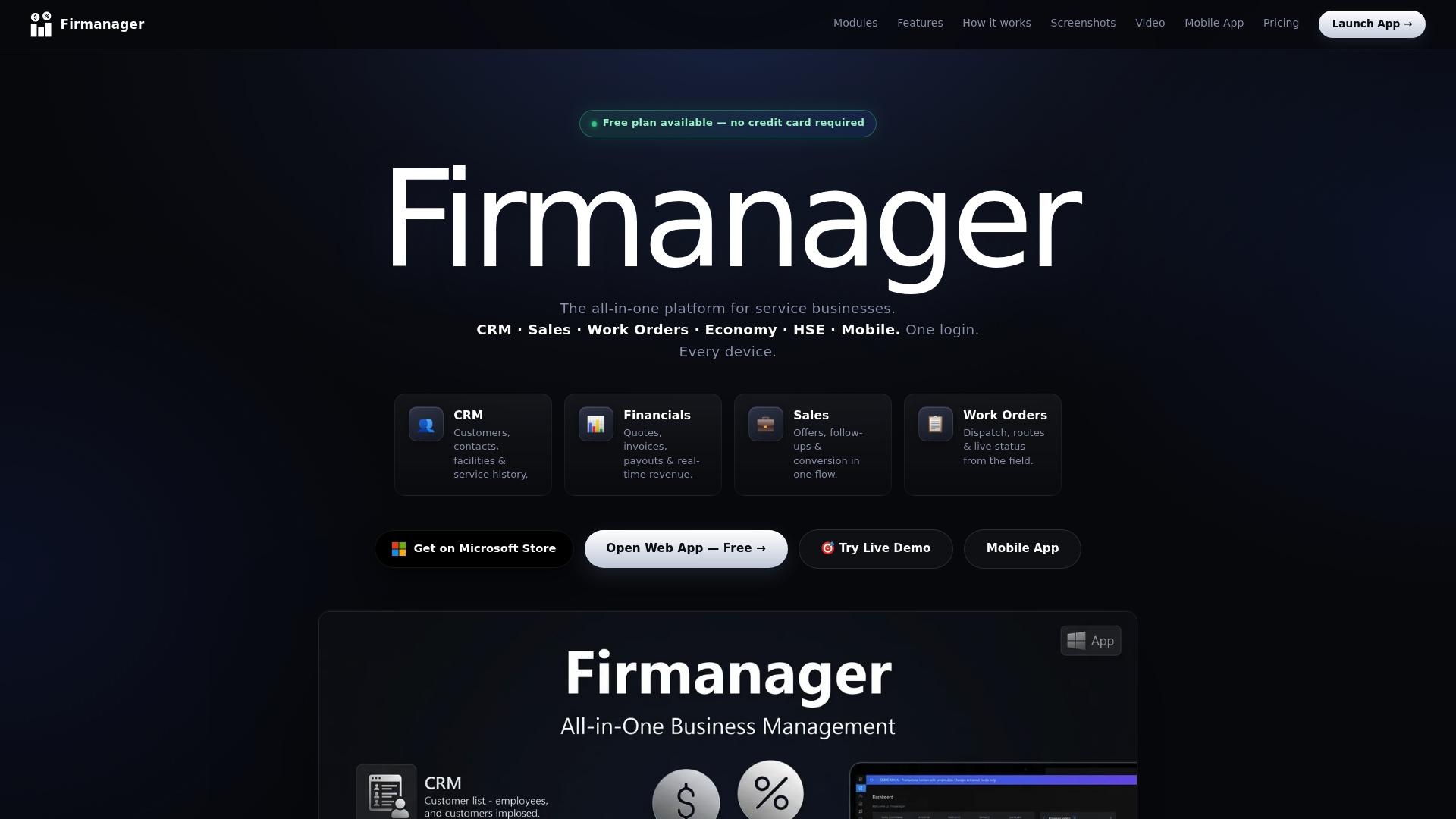
For service businesses specifically, that means a signed quote can trigger a work order and an invoice without a rep manually re-entering data three separate times. If you’ve been mapping stages on a whiteboard or wrestling with a CRM that doesn’t talk to your billing system, Firmanager’s platform is built to close that gap. Teams evaluating their options can also compare features directly in this breakdown of sales pipeline software built for service businesses, and organizations that want outside help building stage governance around their revenue process can work with a firm like Solano Advisory Group, which specializes in predictable revenue systems for B2B SaaS. Start a Firmanager trial to see how your stages, quotes, and invoices connect in one login.
Frequently Asked Questions
How many sales pipeline stages should a small business use? Most small and mid-sized teams do well with a moderate number of stages. Fewer stages reduce data entry friction, and simpler deals rarely need separate steps for legal review or multi-party negotiation.
What’s the difference between sales process steps and pipeline stages? Sales process steps are the internal actions a rep takes (research, call, follow-up email). Pipeline stages are the CRM checkpoints that track deal progress. Process steps often happen within a single stage.
How often should managers review pipeline stage data? Weekly, at minimum. A short audit of deals that have aged past your average time-in-stage catches stalled deals before they distort your forecast.
Can the same pipeline model work for both B2B and B2C sales? Not usually. B2C and high-velocity B2B sales work best with four or five stages, while complex enterprise B2B deals with multiple stakeholders typically need six to eight to capture procurement and legal review separately.
What causes most sales pipeline forecasting errors? Weak or missing exit criteria. When reps can advance deals based on opinion rather than a verified buyer action, pipeline data stops reflecting real progress, and forecasts built on it become unreliable.
Sources
Recommended
Run your whole business in one place
CRM, quotes, work orders, invoicing, expenses, HR and HSE — one login, every device. Free-forever plan.
Start free →