30 Day Vehicle Trunk Pilot for Field Service Inventory Tracking

30 Day Vehicle Trunk Pilot for Field Service Inventory Tracking
Service inventory tracking works when every technician vehicle is treated as its own inventory location and every part used on a job gets recorded on the work order the moment it leaves the truck. That single habit, backed by a system built for it, resolves most of the stock problems field teams face. Platforms like Firmanager are built around exactly this model: mobile-first, vehicle-level tracking tied to real work orders.
TL;DR:
- Tracking parts at the vehicle, depot, and warehouse level reduces stockouts and prevents repeat visits caused by inaccurate counts.
- Standardizing part names, statuses, and transaction types ensures clear inventory records that directly feed billing and replenishment systems.
- Daily logging of parts usage and routine cycle counts on high-value or fast-moving items help maintain accurate stock data and catch shrinkage early.
- Mobile solutions with offline support, work order integration, and audit trails are essential for maintaining real-time, reliable inventory records in the field.
- Running a pilot on five to ten trucks for 30 days with baseline metrics enables effective evaluation of stockout rates, repeat visits, and write-offs before wider implementation.
Table of Contents
- Why location-level tracking matters for dispatch, billing and repeat visits
- Core data model and transactions: locations, items, statuses, and life-cycle events
- Step-by-step checklist to set up tracking for trucks, depots and jobs
- Daily and weekly practices to keep records accurate and reduce drift
- What technology must support: mobile syncing, work order linkage, and audit trails
- Pilot plan and the short list of KPIs that show success
- What we have learned from field service teams running this model
- How Firmanager puts this workflow into practice
- FAQ
- Sources
Why location-level tracking matters for dispatch, billing and repeat visits
A spreadsheet showing 40 units of a part company-wide tells you nothing about whether the technician heading to a job has one in the trunk. Location-level tracking closes that gap: each vehicle, depot and warehouse gets its own balance, so a manager can see not just how much stock exists but where it sits right now.
Without that detail, stockouts and stale counts drive repeat visits, and every repeat visit stretches mean time to repair. Dispatch and scheduling logic can only factor a technician’s trunk stock into an assignment when that stock is recorded as “On Hand” and status “Good”, according to Oracle’s field service management documentation. When those fields lag behind reality, the dispatcher assigns a job the technician cannot finish, and the truck roll happens twice.

Core data model and transactions: locations, items, statuses, and life-cycle events
Any system you rely on for service inventory tracking needs a few non-negotiable building blocks. Dynamics 365 Field Service guidance from Stone Ridge Software frames the core requirement simply: every warehouse, depot and vehicle is modeled as a separate location, and transactions post against the specific location involved, not a company-wide bucket.
On top of that location model, you need:
- A controlled parts catalog with standardized names and units of measure, so “1/2-inch coupling” means the same thing on every truck.
- Inventory statuses, typically On Hand, Reserved, On Order, and Good or Defective, that tell dispatch and billing whether a part is actually usable.
- A defined set of transaction types: receipts, consumption (used), transfers, returns, adjustments, and lost or damaged write-offs.
- A work-order “Used” event that separates what a technician estimated needing from what the job actually consumed, since treating an estimate as the real number corrupts both billing and the next replenishment order.
Step-by-step checklist to set up tracking for trucks, depots and jobs
Setting this up does not require a long rollout. Work through these steps in order:
- Create a location record for every technician vehicle and depot, and assign each technician a default home warehouse that matches their truck.
- Standardize part names and units of measure across the catalog, then configure the transaction types your team actually uses: receipt, used, transfer, return, adjustment, lost or damaged.
- Map work-order consumption to vehicle deduction, so marking a part “used” on the job automatically reduces that technician’s truck balance and feeds billing.
- Set par, minimum, and maximum levels per vehicle based on recent usage rather than a copied template, and tie replenishment triggers to recorded consumption.
- Pilot the mobile commit flow on a handful of trucks, then run a baseline cycle count before expanding further.
Pro Tip: Start the pilot with your five busiest trucks, not your newest ones. Usage volume exposes gaps in the setup faster than truck age does.
The 30-day van stock management pilot guide walks through this exact sequence for mobile technicians consuming, transferring, and replenishing parts from their own vehicles.
Daily and weekly practices to keep records accurate and reduce drift
A good setup still drifts if nobody enforces the habits around it. The work order has to be the trigger for every part movement, not a memory exercise at the end of the week. Require technicians to log usage at the job with a mobile commit step or through an offline entry that syncs and commits once connectivity returns.
- Standardize truck layout and issue/return steps so a part leaving the bin always generates a transaction, reducing the mid-day transfers nobody logs.
- Schedule focused cycle counts regularly on fast-moving and high-value parts rather than counting everything at once.
- Log every adjustment with a reason code (damaged, lost, miscount) so variance has a traceable cause instead of a silent write-off.
- Review open “Reserved” lines weekly to catch parts tied up on jobs that already closed.
Pro Tip: A ten-minute end-of-day review of unresolved transactions catches more drift than a monthly full count ever will.
Standardized issue and return procedures, paired with scan-based events, are the practical controls called out in Microsoft’s inventory visibility guidance for exactly this kind of unlogged mid-day movement.
What technology must support: mobile syncing, work order linkage, and audit trails
Before you commit to a platform or finish configuring one you already have, confirm it handles these five requirements:
- A mobile client that works offline and supports a clear commit step, so field transactions validate and sync once connectivity returns, as described in Oracle’s service inventories documentation.
- Work-order integration that deducts used parts from the assigned vehicle the moment they’re marked consumed, feeding billing without a separate manual entry.
- A replenishment engine aware of location relationships, supporting transfers between trucks, excess inventory reuse, and repairable-return flows.
- An audit trail with required fields on every transaction, the backbone of audit-proof service history.
- Dispatch logic that treats parts status as an assignment input, pulling in trunk stock only when it is genuinely On Hand and Good.
A platform with modular inventory development support, like the approach described by Techneth’s inventory systems work, can fill gaps if your current stack lacks mobile commit or location-aware replenishment.
Pilot plan and the short list of KPIs that show success
Run the pilot on five to ten trucks for 30 days. Set a baseline before you start: current stockout rate, repeat-visit count, and average parts write-offs for that group.
- Track stockout rate: how often a technician arrives at a job without the part the work order required.
- Track repeat visits caused specifically by missing or wrong stock.
- Track parts write-offs from loss, damage, or expired shelf life.
- Track mean time to repair and replenishment lead time from “used” entry to restock on the truck.
Oracle’s Fusion Field Service inventory guidance recommends cycle counting 5 to 10% of parts weekly as a practical detection cadence, a workable starting point for spotting shrinkage before it shows up as a missed job. A pilot that holds this cadence for a month gives you a clean comparison against your baseline numbers before any full rollout decision.
What we have learned from field service teams running this model
Every team we have worked with underestimates how much a missing “used” entry costs downstream. The part itself is rarely the expensive part. The repeat visit, the dispatcher guessing at trunk stock, and the billing line that never gets created are what actually erode margin.
The checklist above holds up because it attacks the weak point directly: the gap between a part leaving the truck and that movement reaching the record. Close that gap and most of the rest, replenishment accuracy, cycle count variance, dispatch reliability, follows on its own. For deeper tactical detail, our parts inventory control guide and cycle count procedures walkthrough cover the mechanics section by section.
— KaiosMedia
How Firmanager puts this workflow into practice
We built Firmanager around the exact model this guide describes: every technician vehicle and depot as its own inventory location, every part movement tied to a transaction, and every “used” entry on a work order flowing straight into billing and replenishment. Parts status (On Hand, Reserved, On Order, Good, or Defective) feeds dispatch directly, so assignments account for what is actually sitting in the truck, not a company-wide guess.
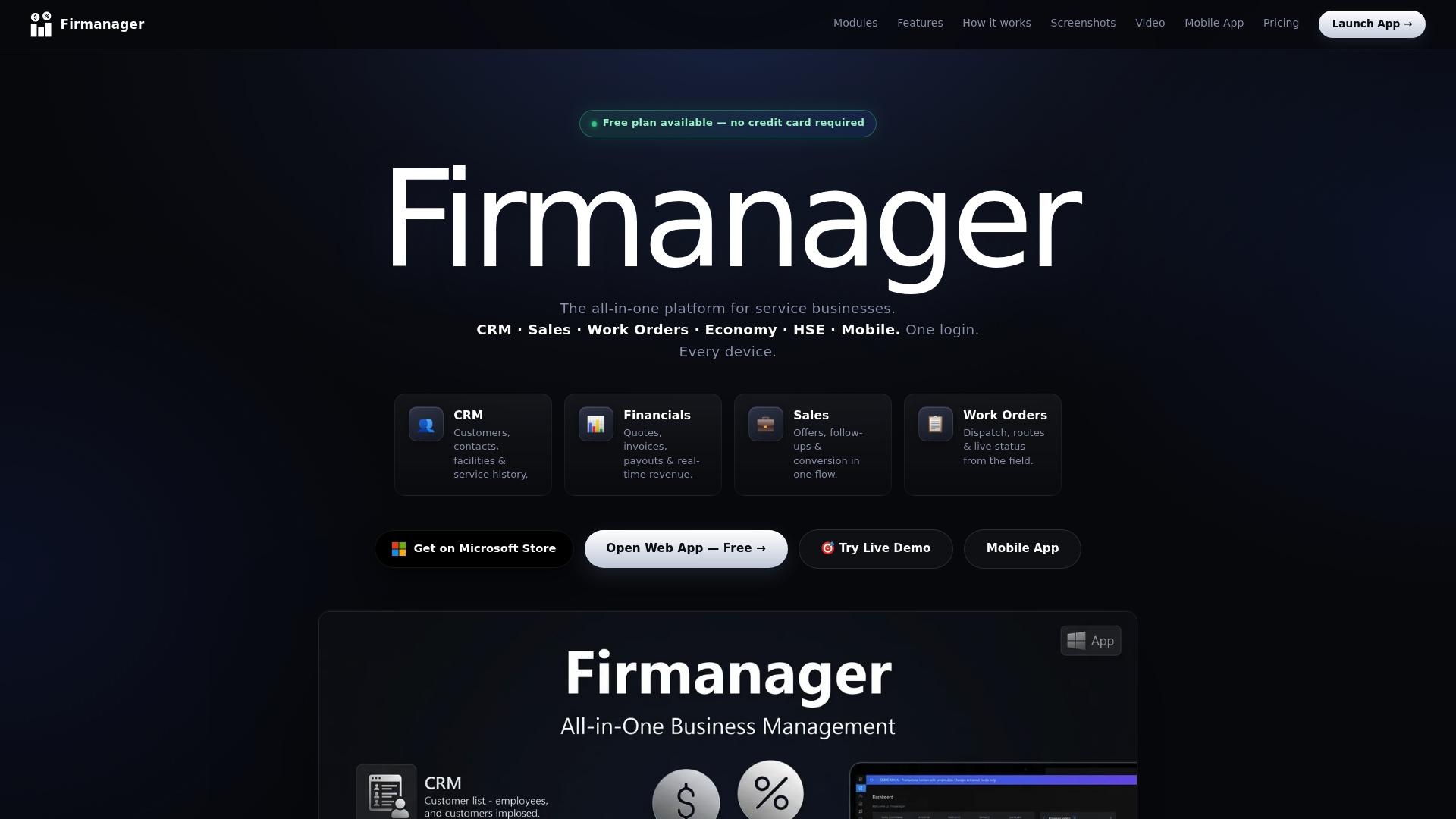
Here is how the core pieces map to what you just read:
| Guide requirement | Firmanager feature |
|---|---|
| Vehicle and depot as locations | Work order and field service module with location-level tracking |
| Work-order consumption linkage | Automated “used” entries tied to invoicing |
| Audit-proof service history | Required fields and transaction logging |
| Mobile commit for field techs | Employee self-service mobile portal |
A 30-day van stock pilot is a reasonable way to test this before a wider rollout:
- Start on a free plan to model a handful of trucks at no cost.
- Move to paid plans as you add technicians and reporting depth.
- Compare your pilot’s repeat-visit and write-off numbers against your baseline at day 30.
Visit Firmanager to start the pilot on the plan that fits your current fleet size.
FAQ
What is service inventory tracking in field service operations?
Service inventory tracking means recording parts, tools, and consumables by location, including technician vehicles, and tying every movement to a work order. It covers receipts, usage, transfers, returns, and adjustments so managers know what is on hand and where.
How do I track van stock without losing accuracy mid-day?
Require technicians to log every part movement at the point of use through a mobile commit step, and standardize truck layout so issue and return events are predictable. Offline entries should sync and commit once connectivity returns, per Oracle’s service inventories documentation.
How often should we run cycle counts on truck stock?
A practical cadence is counting 5 to 10% of parts weekly, focused on high-value or fast-moving items rather than a full count all at once, as outlined in Oracle’s Fusion Field Service guidance. This catches shrinkage early without pulling technicians off billable work.
Why does inventory status affect dispatch decisions?
Dispatch and scheduling logic only count a technician’s trunk stock toward an assignment when that part is marked “On Hand” and “Good.” Inaccurate or stale status fields lead to jobs assigned to trucks that cannot actually complete them, according to Oracle’s field service management documentation.
What does Firmanager cost for a small fleet?
Firmanager offers free and paid subscription plans scaling with seats and feature depth. Details and sign-up are available at Firmanager.
Sources
- Manage your warehouse and inventory in Dynamics 365 Field Service
- Oracle Field Service Management documentation
Recommended
Run your whole business in one place
CRM, quotes, work orders, invoicing, expenses, HR and HSE — one login, every device. Free-forever plan.
Start free →