Avoid Unenforceable Service Level Agreements for Service Managers
Avoid Unenforceable Service Level Agreements for Service Managers
A service level agreement, or SLA, is a written, measurable promise between a service provider and a customer that spells out expected service levels and what happens when the provider misses them. Its job is to turn vague expectations, “we’ll get to it fast”, into specific targets like uptime percentages, response times, and financial remedies. The real work of an SLA lives in its service level objectives and metrics, so read those clauses first, and draft or negotiate around them second.
TL;DR:
- SLAs should clearly specify measurement methods, data sources, and exclusions to prevent disputes over compliance.
- Typical SLA targets include 99.9% uptime and response times such as 15 minutes for P1 incidents, measured over specified windows.
- Internal OLAs and external underpinning contracts must support SLA targets to avoid built-in breaches caused by operational gaps.
- Monitoring should rely on trusted, transparent systems, ideally with third-party verification, for early detection of breaches before they escalate.
- Regular review, operational discipline, and realistic targets grounded in capacity are essential to prevent SLA failures and maintain trust.
Table of Contents
- What Goes Into a Service Level Agreement?
- Types of SLAs and When to Use Each
- Key SLA Components, Clause by Clause
- What Metrics Actually Belong in an SLA?
- Best Practices for Drafting and Negotiating SLAs
- How Are SLA Breaches Monitored and Resolved?
- How Do OLAs and Underpinning Contracts Support an SLA?
- Template Snippets You Can Adapt Today
- Where SLAs Actually Break Down
- Bring Your SLA Metrics Into One System
- Sources
- FAQ
What Goes Into a Service Level Agreement?
Most SLAs follow a predictable skeleton, even when the industry or vendor changes. You’ll typically find these sections stacked in order:
- Overview: parties involved, effective date, and the service being covered
- Scope: exactly what’s included and, just as important, what’s excluded
- Metrics and targets: the SLOs that define “good enough” performance
- Reporting: how and when compliance gets measured and shared
- Remedies: service credits, escalation steps, or termination rights if targets are missed
Service providers and customer representatives, often procurement or IT leadership on the buyer side, sign off on these documents. Terms commonly run for a fixed period, often with renewal language that either auto-renews or triggers a renegotiation window. A short SLA with a handful of metrics usually signals a simple, transactional relationship. A sprawling one with nested tables and multiple SLO tiers usually means the service is complex, mission-critical, or both.
Types of SLAs and When to Use Each
SLAs come in three structural flavors, and picking the wrong one creates friction later. The Wikipedia classification of SLA types breaks them down clearly:
- Customer-level SLA: covers everything one customer receives from a provider, regardless of how many services are involved. A managed IT provider might use a single customer-level SLA to cover network monitoring, help desk support, and backup services for one client account.
- Service-level SLA: applies uniformly to everyone receiving a specific service, no matter who they are. Cloud storage providers often use this model. Every customer on the same tier gets the same uptime guarantee.
- Multilevel SLA: layers corporate-wide terms, customer-specific terms, and service-specific terms into one framework. Large enterprises favor this structure because it lets legal negotiate baseline terms once, while individual service teams still set their own SLOs underneath.
Modular, single-service SLAs make sense when you expect to renegotiate one component without reopening the whole contract, say, adding a new backup service without touching your existing help desk terms. A master SLA makes more sense when a customer buys a bundled platform and wants one document, one renewal date, and one point of accountability. If you’re not sure which to choose, ask whether you expect to add or drop services independently. If yes, go modular.
Key SLA Components, Clause by Clause
An SLA is only as strong as its weakest clause, and vague language is where breaches hide. Here’s what a complete agreement needs, section by section:
- Parties and overview: names, effective dates, and a plain-language summary of the service, no legalese required at this stage
- Service description: what’s delivered, how often, and through what channel (on-site, remote, self-service portal)
- Scope and exclusions: explicitly list what’s not covered. Disputes usually start here, not in the metrics table
- SLO definitions: each target stated as a number, a measurement window, and the formula used to calculate it
- Measurement method: which tool or dataset determines compliance, and who owns the data
- Escalation and contacts: named roles (not just “support team”) with response expectations at each tier
- Reporting cadence: weekly, monthly, or quarterly, with a stated delivery format
- Remedies and indemnities: service credits, remediation timelines, or contract exit rights
- Maintenance windows: scheduled downtime that doesn’t count against uptime SLOs
A service level agreement is a binding contract, which means courts and arbitrators will read these clauses literally. If your measurement method clause says “provider’s internal logs” and the customer wants third-party verification, that gap surfaces during a dispute, not before. Nail down exclusions and measurement methods before signing, because those two clauses cause more contract friction than the headline metrics do.
What Metrics Actually Belong in an SLA?
Availability, response time, and resolution time form the backbone of nearly every SLA, but the details matter more than the labels. IBM’s SLA framework points to a common set of core metrics worth understanding before you draft or sign anything.
Uptime and availability: A high uptime guarantee sounds airtight until you consider permitted downtime. Always ask which figure your provider is quoting and over what window, as monthly or annual guarantees behave differently. Always ask which figure your provider is quoting and over what window, as monthly or annual guarantees behave very differently.
MTTR and its cousins: Mean Time To Repair (how long it takes to fix an issue once identified) is distinct from Mean Time Between Failures (how often issues occur in the first place). Confusing the two leads to SLAs that measure the wrong thing. A provider can hit an aggressive MTTR target while failures keep recurring, because MTTR says nothing about frequency.
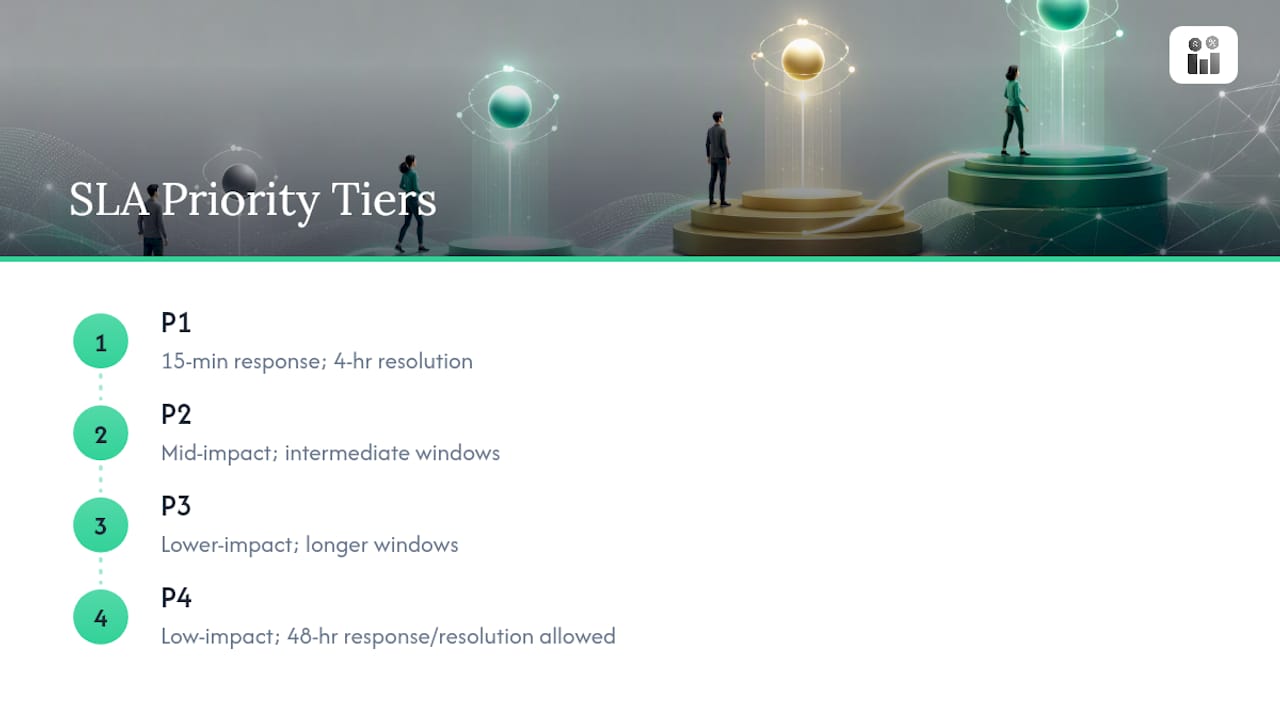
Response versus resolution time: Response time measures how fast someone acknowledges a ticket. Resolution time measures how fast the problem actually gets fixed. Priority tiers, typically P1 through P4, assign different response and resolution windows based on business impact. A P1 outage might demand a 15-minute response and 4-hour resolution, while a P4 cosmetic bug might allow 48 hours for either.
Technical metrics like uptime tell you whether infrastructure is healthy. Customer-focused metrics, sometimes captured through a companion Experience Level Agreement (XLA), tell you whether the customer actually felt the service was good. Pairing the two gives a fuller picture than uptime numbers alone. When setting any target, start from your team’s actual capacity data, not an aspirational number pulled from a competitor’s marketing page.
Pro Tip: Before committing to a resolution-time target, pull three months of historical ticket data and check your actual median resolution time. If your SLA target sits below that median, you’re signing up for a breach on day one.
Best Practices for Drafting and Negotiating SLAs
The strongest SLAs share a handful of habits that have little to do with legal wording and everything to do with operational discipline. Front’s guidance on SLA best practices emphasizes aligning targets to what your team can actually deliver, not what sounds impressive on a sales call.
- Write SMART metrics: specific, measurable, achievable, relevant, and time-bound, never vague language like “prompt response”
- Define the measurement method and data source in the same clause as the target itself
- Confirm your internal Operational Level Agreements (OLAs) and any supplier contracts can actually support the SLO before you commit to it externally
- Use tiered service levels so critical requests get priority over routine ones
- Build in a review cadence, quarterly or semiannual, so targets can adjust as volume or scope changes
- Include earn-back provisions that let a provider recover credits after a sustained period of compliance
- Name a dispute resolution process before you need one, not after
One of the more common ways SLAs fail is deceptively simple: a company promises sub-hour resolution times without checking whether its own OLA-and-supplier-contract structure can support that promise. The breach isn’t a performance failure. It’s a math failure that existed the day the contract was signed. A disciplined incident reporting workflow helps catch that gap before it becomes a pattern of missed targets.
Pro Tip: Ask for scoped, read-only access to your provider’s monitoring dashboard as a contract condition. Verifying compliance independently beats trusting a monthly PDF report after the fact.
How Are SLA Breaches Monitored and Resolved?
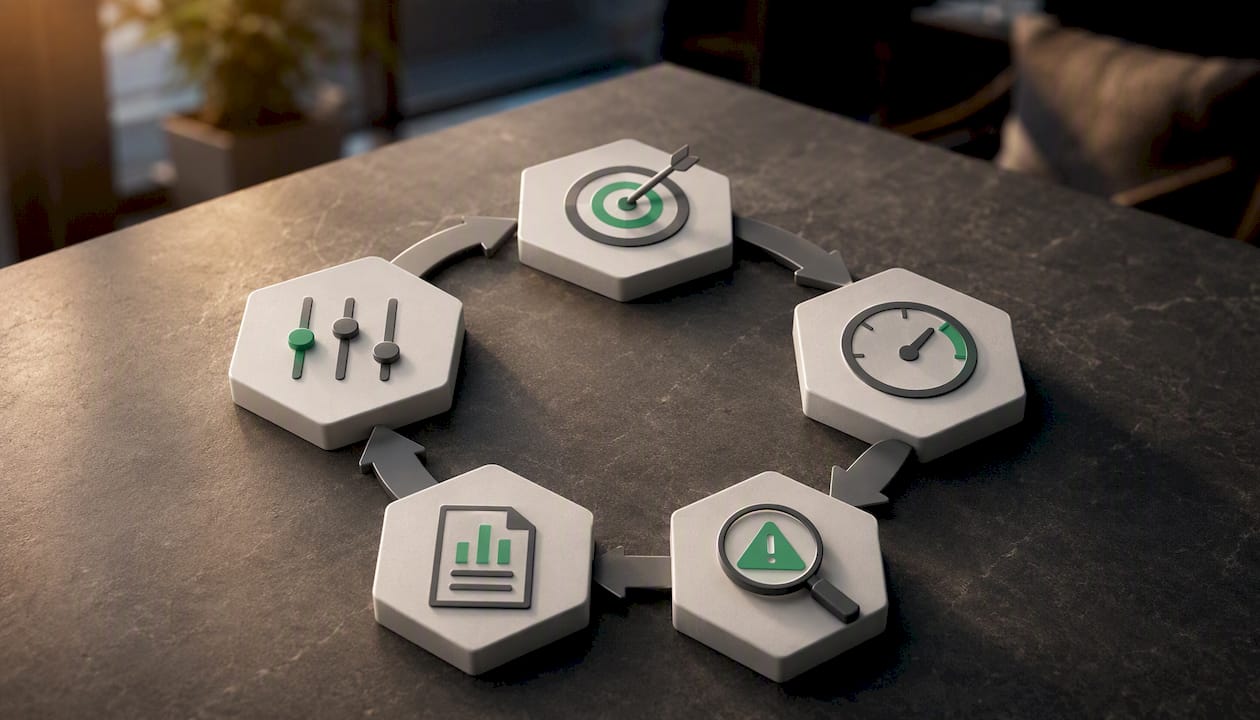
SLA management runs on a repeating cycle: set targets, monitor performance, detect violations, report findings, and adjust. BMC’s framework for SLA management treats this as continuous, not a one-time contract signing.
Monitoring typically relies on a mix of internal logs, live dashboards, and, for higher-stakes contracts, independent third-party monitors that neither party controls. That third-party layer matters most when trust between provider and customer is still being established. A well-built SLA tracking system gives both sides the same numbers, which eliminates the “your data versus my data” argument before it starts.
When a breach happens, evidence collection and notification timelines matter as much as the remedy itself. Common remedies include:
- Service credits: a percentage discount on the next billing cycle, scaled to how far the miss fell below target
- Remediation plans: a documented fix-it timeline with milestones the provider must hit
- Root-cause reports: a written explanation of what failed and why, often required within a set number of days
- Termination triggers: the right to exit the contract after a defined number of repeated breaches within a rolling period
As a customer, ask for standing access to SLA dashboards and a regular reporting cadence, monthly at minimum, rather than waiting for a breach to surface the data. If you manage recurring service contracts, tracking those commitments systematically makes the difference between catching a slip early and discovering it three invoices later.
How Do OLAs and Underpinning Contracts Support an SLA?
An SLA is a promise to the customer. An Operational Level Agreement (OLA) is the internal agreement between departments that makes that promise achievable. An underpinning contract (UC) is the same idea applied to outside suppliers. If your SLA promises 4-hour resolution but your OLA with the internal network team allows 8 hours, you’ve built a breach into the contract before anyone signs it.
- Service Level Requirement (SLR): what the customer actually needs, gathered before drafting begins
- SLA: the external, customer-facing commitment built from that requirement
- OLA: the internal agreement between teams that supports the SLA’s targets
- UC: the contract with an external supplier whose performance feeds into your own SLA
ITIL 4’s service level management practice treats these four pieces as one connected chain. A service owner and a designated service level manager should review that chain regularly, not just at renewal, since a supplier contract renegotiated without updating the matching SLA clause is exactly how gaps reappear months later.
Template Snippets You Can Adapt Today
A workable SLA doesn’t need to be exotic. It needs five sections, populated with numbers your team can actually hit.
- Overview clause: “This agreement, effective [date], covers [service name] provided by [provider] to [customer] for a term of [duration].”
- SLO table: list each metric, its target, measurement window, and formula in one table rather than scattered paragraphs.
- Measurement clause: “Compliance is measured using [tool/dataset], reported on a [cadence] basis, with data owned by [party].”
- Reporting clause: state delivery format and recipient by name or role, not department.
- Remedies clause: state the credit percentage, the remediation timeline, and the breach count that triggers termination rights.
Two example SLOs worth adapting directly:
- Availability: “Service will be available 99.9% of the time, measured monthly, excluding scheduled maintenance windows under 4 hours notified 48 hours in advance.”
- P1 response: “Priority 1 incidents will receive acknowledgment within 15 minutes and a resolution or workaround within 4 hours, measured from ticket creation timestamp.”
Before signing anything, walk the SLA against a short checklist: does your OLA support every SLO you’re promising? Is the measurement method specific enough to survive a dispute? Are exclusions listed, not implied? If a property services provider is drafting recurring-service clauses, contract tips for recurring exterior work offer a useful parallel for building remedy language that survives contact with reality.
Where SLAs Actually Break Down
Most SLA disputes trace back to the same root cause: someone signed a target their own operation couldn’t support. It’s rarely bad faith. It’s usually a sales team promising a number that operations never confirmed against an OLA or a supplier contract. That gap is entirely preventable, and it’s the single most common failure pattern in service contracts.
What separates SLAs that hold up from ones that generate constant friction isn’t stricter penalties. It’s operational discipline: monitoring that both sides trust, ownership that’s named rather than implied, and targets grounded in real capacity data instead of aspiration. Real-time work order and compliance tracking gives service teams a practical way to keep SLA-linked KPIs visible day to day, rather than discovering a miss during a quarterly review.
— KaiosMedia
Bring Your SLA Metrics Into One System
Drafting a solid SLA is only half the job. The other half is proving, week after week, that you’re hitting it. Firmanager gives service businesses a single platform to track work orders, response times, and compliance data in real time, so SLA reporting doesn’t turn into a scramble at renewal time. If you manage recurring service contracts across a team, having that data cloud-synced and accessible from any device closes the gap between what your SLA promises and what your dashboards can actually prove.
Sources
- Service-level agreement definition — TechTarget
- What Is an SLA (service level agreement)? | IBM
- 6 SLA best practices for service management — BMC
FAQ
What Is Included in a Service Level Agreement?
A complete SLA includes an overview of the parties and service, scope and exclusions, measurable SLOs with defined measurement methods, a reporting cadence, and remedies such as service credits or termination rights for missed targets.
Is an SLA Legally Binding?
Yes. An SLA is a binding contract between a provider and customer, which means its clauses, including exclusions and remedies, are enforceable and get read literally in a dispute.
What’s the Difference Between an SLA and an OLA?
An SLA is the external promise made to a customer, while an Operational Level Agreement (OLA) is the internal agreement between departments that makes that promise achievable. Misalignment between the two is a leading cause of SLA breaches.
How Is SLA Uptime Usually Measured?
Uptime is typically expressed as a percentage over a monthly or annual window, such as 99.9%. Always confirm which time window and which exclusions, like scheduled maintenance, apply to the figure.
What Happens When an SLA Is Breached?
Common remedies include service credits, documented remediation plans with milestones, root-cause reports, and, after repeated breaches, contract termination rights for the customer.
Recommended
Run your whole business in one place
CRM, quotes, work orders, invoicing, expenses, HR and HSE — one login, every device. Free-forever plan.
Start free →