Technician Time Tracking for Managers: Close Billable Gaps in 30–90 Days

Technician Time Tracking for Managers: Close Billable Gaps in 30–90 Days
The fastest way to stop losing billable hours is to require job-based mobile time capture tied to work orders and give managers a live activity view. Pilot a mobile timer on one crew for two weeks and compare captured hours against invoiced hours. Industry field service KPI benchmarks and platforms like Firmanager both point to the same fix: tie time to the job, not the clock.
TL;DR:
- Mobile timers linked to work orders significantly reduce errors and administrative work compared to paper or punch clock methods, especially for mobile crews.
- Key software features include automatic job attachment, live supervisor dashboards, offline mode, and seamless payroll and invoicing integration to improve accuracy and efficiency.
- A staged pilot, focusing on adoption, friction points, and metrics like utilization and first-time fix rates, helps ensure successful company-wide implementation.
- Connecting time data to KPIs allows managers to identify whether high utilization reflects efficiency or rushing, guiding better operational decisions.
- An integrated platform that consolidates work orders, timers, invoices, and approvals minimizes orphan hours, accelerates period closes, and enhances overall transparency.
Table of Contents
- Comparing clock-in methods: paper, kiosks, and mobile timers
- Software features that actually capture accurate hours
- How to roll out time tracking without losing your crew
- Turning time data into KPIs that drive real decisions
- Setting up approvals and audit logs without micromanaging
- Connecting time data to payroll, invoicing, and scheduling
- How an integrated platform cuts admin time and missed hours
- Treat time tracking as insight, not surveillance
- Try Firmanager for job-based time tracking and approvals
- Sources
- FAQ
Comparing clock-in methods: paper, kiosks, and mobile timers
Most teams start with paper timesheets or a punch clock, then outgrow them as crews get bigger or jobs get spread across more locations. Each method has a different cost in accuracy, admin time, and technician friction.
- Paper timesheets: Zero software cost, but hours get rounded, reconstructed from memory, and entered twice, once by the technician and once by payroll.
- Punch clocks and kiosks: Fast for a fixed location, but useless for a mobile crew that never touches the same building twice.
- Mobile timers: A technician taps start and stop from a phone, tied to a specific job, which keeps the record close to the actual work.
- GPS and geofencing: Confirms a technician was on site, automatically prompting a clock-in or flagging a mismatch between location and logged hours.
Paper and punch clocks create the most admin time because someone has to retype every entry before it reaches payroll. Mobile timers cut that step out, but only if technicians actually use them, which depends on how much friction the app adds to an already busy day.
A few signals tell you it is time to upgrade: technicians consistently under-report hours worked, payroll close takes longer than a day, or an audit turns up gaps between scheduled jobs and billed time. Mobile workers already lose a meaningful share of the day to administrative tasks, Salesforce research puts it at roughly 30%, with technicians estimating about seven hours a week wasted on non-productive work. Paper-based tracking adds directly to that total.
Software features that actually capture accurate hours
Choosing software is less about the brand name and more about whether the feature set closes the gap between work performed and hours recorded. A handful of capabilities make the biggest difference.
- Job-based timers linked to work orders: Every minute logged attaches to a specific job, so billing and payroll pull from the same record instead of two separate guesses.
- Auto-attach and orphan-time prevention: The system should flag any clocked time that is not linked to a job, instead of letting it disappear into a general “labor” bucket.
- One-tap start and stop: If logging time takes more than a few seconds, technicians will delay it until end of day, and accuracy drops.
- Live manager dashboard: Shows who is clocked in, on what job, and for how long, in real time rather than after the timesheet is submitted.
- Audit logs: A timestamped history of every edit, who made it, and when, which matters the moment payroll or a client disputes an invoice.
- Offline mode: Technicians working in basements, rural sites, or buildings with poor signal still need to log time; the app should queue entries and sync once connectivity returns.
- Payroll and invoicing integration: Approved hours should flow into payroll runs and client invoices without a second data entry step.
The common thread across these features is that they remove the manual transcription step that causes most errors. A technician who taps a job-linked timer on a phone, even offline, generates a record that a manager can review, approve, and export without retyping anything. That is the baseline worth testing before committing a whole company to a new system.
How to roll out time tracking without losing your crew
A rollout works best as a staged pilot, not a company-wide mandate on day one. Technicians who feel ambushed by a new tracking system tend to resist it, while those given a trial period and a clear reason tend to adopt it.
- Set a baseline: Pull the last two or three payroll periods and compare clocked hours to invoiced hours; the gap is what you are trying to close.
- Pick a pilot crew: Choose a crew of three to six technicians covering a mix of job types, not just your best performers.
- Define the rules: Decide what counts as billable, how travel time is logged, and how breaks are recorded before the pilot starts.
- Train in one session: Walk through clock-in, clock-out, and job linking live, then let technicians try it on a real job the same day.
- Run the pilot for two weeks: Track adoption rate, missed clock-ins, and any disputes over logged hours.
- Review at 30, 60, and 90 days: At 30 days, check adoption and friction complaints; at 60 days, check whether billable hours captured increased; at 90 days, check whether admin time for payroll close dropped.
- Scale with structure: Once the pilot clears your threshold, standardize job categories, connect payroll and invoicing integrations, and set a formal timesheet approval policy before rolling out to the full team.
Pro Tip: Run the pilot during a normal workload, not your slowest week. A quiet week hides the friction points that show up when technicians are juggling four jobs in a day.
Travel time deserves its own rule before the pilot begins, since the Department of Labor’s guidance on compensable work hours treats certain travel as paid time, and getting that wrong creates payroll corrections later.

Turning time data into KPIs that drive real decisions
Raw hours only become useful once you turn them into ratios. Four metrics cover most of what a service manager needs to know about how technician time is spent.
- Technician utilization = billable hours ÷ total available hours. This shows how much of a paid shift turns into revenue-generating work.
- Billable utilization narrows that further to hours actually invoiced, which can diverge from logged hours when jobs run over quote.
- First-time fix (FTF) rate = jobs resolved on the first visit ÷ total jobs. A technician with low utilization but a high FTF rate may be doing complex work, not wasting time.
- Mean time to repair (MTTR) = total repair time ÷ number of repairs, a direct measure of how long jobs take once a technician is on site.
- Avoidable dispatch rate tracks visits that should not have happened, often a sign of bad triage before the job was scheduled.
Typical technician billable utilization runs between 75% and 85%, with pacesetter teams approaching 90.2%. First-Time-Fix benchmarks sit near 77% industry-wide, and top performers reach roughly 88%, according to field service KPI benchmarks. Those ranges give you a target without pretending every team will hit the top of the range immediately.
The real value comes from reading these metrics in pairs. A technician with climbing utilization but falling FTF is likely rushing jobs, which shows up later as repeat visits and a rising MTTR. Aquant’s 2026 field service benchmark found that top-performing teams close cases faster and need fewer repeat visits, in part by scaling the kind of job knowledge that keeps FTF high even as utilization rises. Chasing one number in isolation tends to damage another.

Setting up approvals and audit logs without micromanaging
A timesheet approval process exists to catch errors before they reach payroll, not to second-guess every technician’s day. The structure matters more than the strictness.
- Define a reporting period: Weekly or biweekly periods give managers a predictable review window instead of a constant stream of edits.
- Require manager review before close: A standard approval workflow has the manager check entries against the job schedule, flag anomalies, and approve or reject before the period locks.
- Lock approved periods: Once a period closes, entries should be frozen, with any correction requiring a visible, logged exception.
- Keep an audit trail: Every edit, approval, and rejection should carry a timestamp and a name, which protects both the business and the technician if an invoice or paycheck is disputed.
- Separate approvers from self-approval: A technician should never be able to approve their own hours, and approvers should get a notification when a timesheet is waiting.
Reducing time theft works better as a policy conversation than a surveillance project. Framing the system around outcomes like FTF and MTTR, rather than minute-by-minute monitoring, keeps the focus on results technicians already care about.
Connecting time data to payroll, invoicing, and scheduling
Time tracking only pays for itself once it feeds the systems that move money and plan work. Three integrations matter most.
- Invoicing: Time entries linked to a work order should generate invoice line items automatically, closing the gap where billable hours quietly disappear.
- Payroll: Exports need approved periods, overtime flags, and locked pay windows, so payroll never has to guess which version of a timesheet is final.
- Scheduling and routing: Historical utilization and job duration data help a dispatcher plan realistic capacity instead of overbooking a crew that is already running at 85% utilization.
Orphan time, hours logged without a job attached, is the single biggest source of lost billing. Fixing that link between the timer and the work order closes most of the gap between hours worked and hours invoiced.
How an integrated platform cuts admin time and missed hours
A fully integrated platform connects work orders, mobile timers, invoicing, and timesheet approvals in one login, which removes the re-entry step that causes most tracking errors. When a technician’s job-linked time flows straight into invoicing and payroll exports, managers spend less time reconciling spreadsheets and more time reviewing exceptions. Expect fewer orphaned hours, faster period close, and a clearer utilization picture once mobile timers and approvals run through the same system instead of multiple disconnected tools.
Treat time tracking as insight, not surveillance
The managers who get the most out of technician time tracking are the ones who use it to ask better questions, not to watch the clock. A utilization number on its own tells you almost nothing; paired with FTF and MTTR, it tells you whether a crew is fast because they’re skilled or fast because they’re cutting corners.
The mistake I see most often is chasing a single metric until it breaks something else, pushing utilization up while first-time fix rates quietly fall. Pilot changes in small groups, tell technicians what you’re measuring and why before you measure it, and let the data confirm or correct your assumptions instead of replacing your judgment.
— KaiosMedia
Try Firmanager for job-based time tracking and approvals
Running mobile timers, work orders, invoicing, and timesheet approvals through separate tools is exactly the gap that causes missed billable hours in the first place. Firmanager keeps those pieces under one login, so a technician’s clocked time on a job flows into the same record used for invoicing and payroll.
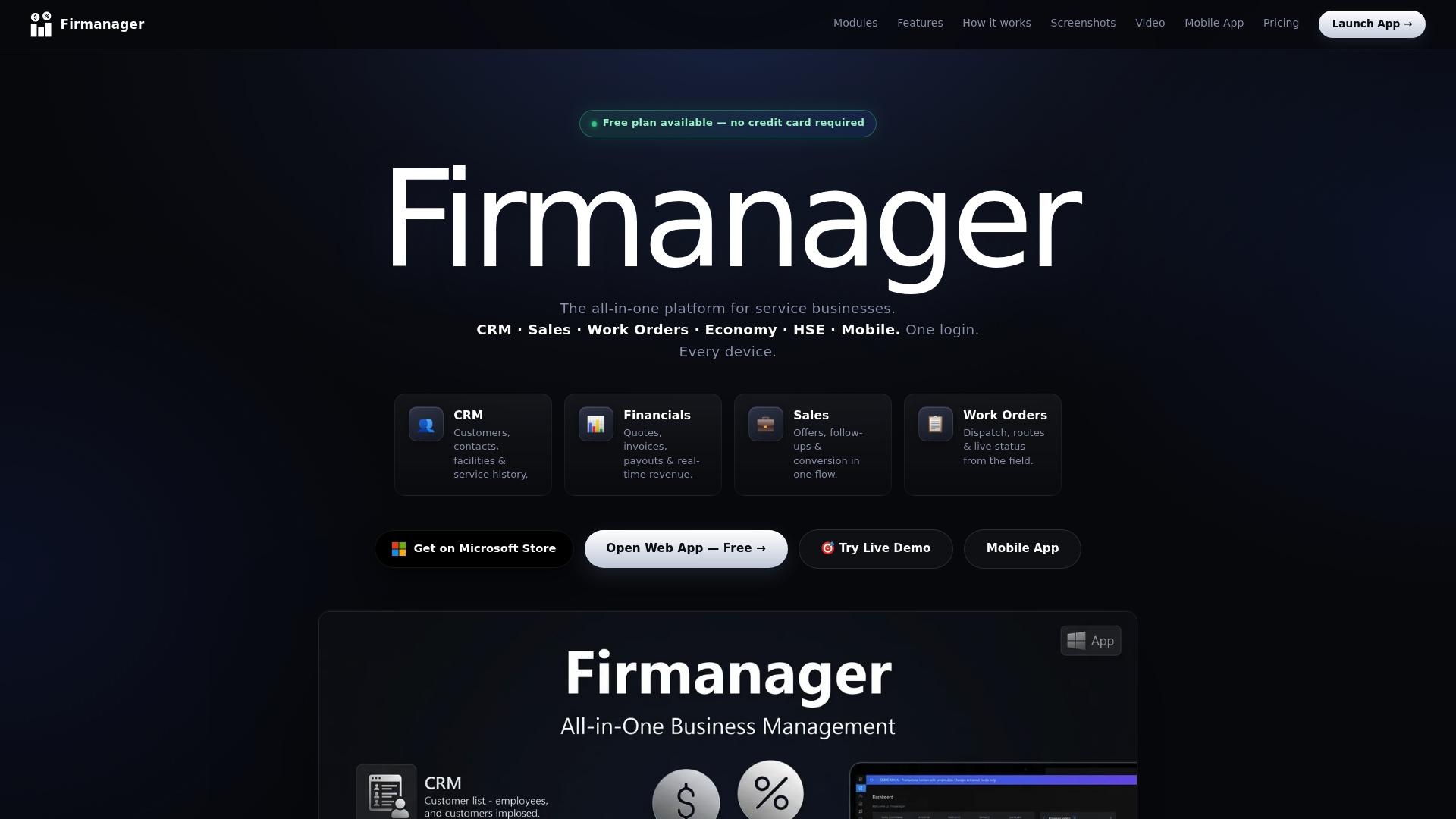
- Work orders: Every job carries its own timer, so hours are never disconnected from the task that generated them.
- Mobile timers: Technicians clock in and out from a phone, with entries syncing across devices.
- Invoicing: Approved time converts into invoice line items without manual re-entry.
- Timesheet approvals: Managers review and lock periods before payroll runs, with a full audit trail behind every change.
If you want to test this on a small crew before committing company-wide, Firmanager’s Free plan is a reasonable place to start, with Pro and Business tiers available once you are ready to scale across more technicians and modules.
Sources
- Mobile worker research & worksheet for success (Salesforce)
- Field service KPIs: Formulas & Benchmarks | VSight
- Aquant’s 2026 Field Service Benchmark
- Travel time (U.S. Department of Labor)
FAQ
What is the best way to track technician time in the field?
Job-based mobile time capture tied to work orders, paired with manager dashboard visibility, gives the most accurate record with the least admin work. GPS or geofencing adds a location check, which helps confirm a technician was actually on site when the timer started.
How do timesheet approvals reduce payroll errors?
A structured approval process has a manager review entries against the job schedule before a pay period locks, catching mismatches before they reach payroll. Once approved, the period is frozen, and any correction requires a logged exception rather than a silent edit.
What KPIs should managers track alongside technician hours?
Utilization, first-time fix rate, and mean time to repair give the clearest picture together, since each one checks the others. Industry benchmarks put typical billable utilization at 75% to 85%, with first-time fix rates averaging near 77% and top performers closer to 88%.
How does time tracking handle poor connectivity in the field?
A reliable system queues time entries locally when a technician has no signal and syncs them automatically once connectivity returns. This matters most in basements, rural job sites, or older buildings where cell coverage is weak.
Does technician time tracking count as surveillance?
Not when it is framed around job-linked hours and outcome metrics like utilization and first-time fix rate rather than minute-by-minute monitoring. Clear communication about what is being measured and why tends to reduce technician pushback during rollout.
Recommended
Run your whole business in one place
CRM, quotes, work orders, invoicing, expenses, HR and HSE — one login, every device. Free-forever plan.
Start free →