Job Costing Methods: A Practical Guide for 2026

Job Costing Methods: A Practical Guide for 2026
Job costing methods assign direct materials, direct labor, and allocated overhead to individual jobs so you can measure profitability at the project level, not just across the business as a whole. Three method families cover most use cases: actual costing (track real inputs as they occur), standard costing (use preset rates for repeatable processes), and activity-based costing, or ABC (allocate overhead through multiple cost drivers when indirect costs are complex). Choose actual costing for unique, reimbursable, or custom projects. Choose standard costing when you run repeatable batches and want variance analysis. Choose ABC when your overhead pool is large and driven by several distinct activities.
FASB’s accounting standards govern how costs flow through your books, and the IRS requires accurate job-level cost records to support deductions and contract reporting. Platforms like Firmanager bring these requirements into a single operational system, which matters most when you are managing multiple concurrent jobs.
Table of Contents
- What are job costing methods and how do costs flow through accounting?
- What are the main job costing methods and when should you use each?
- How do you measure and allocate direct materials, labor, and overhead?
- How do you calculate job costs step by step?
- How does job costing adapt to construction, manufacturing, and service businesses?
- What software features matter most for job costing?
- What mistakes undermine job costing accuracy?
- Getting started: a realistic implementation timeline
- Firmanager makes job costing practical for service businesses
- What the most important job costing insights come down to
- Sources
What are job costing methods and how do costs flow through accounting?
Job costing, formally called a job order cost system, assigns costs to a discrete unit of work — a contract, a batch, a client engagement — rather than averaging them across all output. That distinction separates it from process costing, which spreads costs evenly across identical, high-volume units. Many businesses use hybrid approaches when they have both unique and repeatable processes.
Three cost components make up every job:
- Direct materials: Raw materials or components physically traceable to the job (lumber on a construction site, circuit boards in a custom assembly run).
- Direct labor: Wages, payroll taxes, and benefits for workers whose time is directly tied to the job.
- Manufacturing or operational overhead: Indirect costs — facility rent, equipment depreciation, supervision — allocated to jobs using a predetermined rate.
Costs flow in a predictable sequence. Raw materials enter inventory, then move to work-in-process (WIP) when issued to a job. Direct labor and applied overhead accumulate in WIP alongside materials. When the job is complete, costs transfer out of WIP into finished goods inventory or, for service firms, directly into cost of services. Upon delivery or billing, those costs hit cost of goods sold (COGS) or cost of services on the income statement.
Three quick examples show how dominant cost drivers shift by industry:
- Construction contract: A $180,000 commercial renovation tracks lumber, drywall, and subcontractor labor as direct costs; equipment rental and site supervision flow through overhead.
- Custom manufacturing batch: A specialty metal fabricator builds 50 custom brackets; steel and machining labor are direct; CNC machine depreciation is allocated overhead.
- Professional services engagement: A consulting firm bills a 3-month project; nearly all cost is direct labor (hours × burdened rate), with software licenses and office overhead allocated as a percentage of labor dollars.
As AccountingTools explains, materials should be charged to specific jobs when issued, and direct labor must be recorded and assigned to each job through timecards, timesheets, or networked time clocks.
What are the main job costing methods and when should you use each?
The three principal methods differ in how they source the cost figures that flow into a job cost sheet.
Actual costing
Every cost is recorded at its real, incurred amount. Materials are priced at actual purchase cost; labor is recorded at actual hours and actual wages; overhead is applied after the fact using actual totals. This gives the most accurate picture per job but requires waiting until period close to know true overhead. It suits reimbursable government contracts, legal matters, or any engagement where the client audits your cost records.
Standard costing
Predetermined rates replace actual figures for labor and overhead. You set a standard labor rate and a standard overhead rate at the start of the period, apply them to jobs as work occurs, then compare actual costs to standard at period end. The gap is a variance, which tells you whether your estimates are drifting. Standard costing works well in manufacturing environments with repeatable processes, stable material prices, and a need for fast mid-period reporting.
Activity-based costing (ABC)
ABC replaces a single overhead pool with multiple cost pools, each driven by a specific activity (machine setups, quality inspections, purchase orders). Each job is charged based on how many of each activity it actually consumes. This is more accurate than a single overhead rate when jobs vary widely in complexity, but it demands more data infrastructure to maintain. Complex service operations, hospitals, and multi-product manufacturers tend to benefit most.
| Method | Accuracy | Implementation effort | Best-fit industries | Typical allocation base |
|---|---|---|---|---|
| Actual costing | Highest per job | Low setup, high close effort | Government contracts, legal, reimbursable projects | Actual labor hours or dollars |
| Standard costing | Moderate (variance-adjusted) | Moderate setup, fast period reporting | Repetitive manufacturing, batch production | Budgeted labor hours or machine hours |
| Activity-based costing | Highest for complex overhead | High setup, ongoing maintenance | Multi-product manufacturing, complex services, healthcare | Activity drivers (setups, inspections, orders) |
Choosing between them comes down to four business conditions: data availability (can you capture actual inputs in real time?), volume and variability (are jobs similar or wildly different?), customer billing needs (do clients require cost transparency?), and overhead complexity (is one pool enough, or do you have several distinct cost drivers?).
How do you measure and allocate direct materials, labor, and overhead?
Getting the numbers right at the component level is where job costing either works or falls apart.
Direct materials
Pull material costs from purchase orders or inventory records at the time of issue. For manufactured goods, a bill of materials (BOM) lists expected quantities; actual usage is captured on material requisition forms or through inventory software. Subcontractor invoices and direct expenses billed specifically to a job are treated the same way: charged directly to the job, not pooled into overhead.
Burdened labor
Raw wages understate the true cost of an employee. The correct formula is:
Burdened Labor Cost = Hours Worked × (Hourly Wage + Payroll Taxes + Benefits)
Benefits include health insurance, retirement contributions, workers’ compensation, and paid time off. For service businesses/02%3A_Job_Order_Costing/2.03%3A_Job_Order_Costing_for_a_Service_Company), this burdened rate is often the single largest cost on a job sheet, so precision here matters more than anywhere else. Overtime premiums should be included when they are job-specific; if overtime is caused by general scheduling rather than a specific job’s demands, route the premium to overhead instead.

Predetermined overhead rate
Because actual overhead is only known at period close, you apply overhead to jobs in real time using a predetermined rate:
Predetermined Overhead Rate = Estimated Total Overhead ÷ Estimated Allocation Base
Common allocation bases include direct labor hours, direct labor dollars, machine hours, and activity drivers. Direct labor hours work well when labor drives most overhead costs. Machine hours fit capital-intensive manufacturing. Activity drivers (setups, inspections) are the foundation of ABC.
For example: if you estimate $120,000 in overhead for the year and expect 10,000 direct labor hours, your rate is $12 per direct labor hour. A job that uses 40 labor hours gets $480 of applied overhead.
- Direct labor hours: Best when overhead tracks closely with workforce activity.
- Direct labor dollars: Useful when wage rates vary significantly across job types.
- Machine hours: Preferred in automated or capital-intensive environments.
- Activity drivers: Required when overhead pools are distinct and driven by different behaviors.
Pro Tip: Integrate your time-tracking system directly with payroll. Manual re-entry of hours between systems is the most common source of burdened labor inaccuracy, and even small errors compound across dozens of concurrent jobs. Platforms that sync workforce management with payroll eliminate this risk at the source.
How do you calculate job costs step by step?
The QuickBooks job costing guide outlines a practical implementation sequence; the seven steps below expand that into a full operational workflow.
The 7-step process
- Identify and open the job. Assign a unique job number or cost code. Define the scope, billing type (fixed-fee or time-and-materials), and cost budget.
- Estimate and requisition materials. Pull quantities from the BOM or scope document. Issue materials from inventory to the job; record at actual cost.
- Capture labor hours. Record hours by employee and task against the job number daily or weekly. Apply the burdened rate to convert hours to dollars.
- Capture direct expenses. Log subcontractor invoices, equipment rentals, and any other costs directly attributable to this job.
- Apply overhead. Multiply actual labor hours (or your chosen base) by the predetermined overhead rate.
- Summarize the job cost sheet. Total direct materials + direct labor + applied overhead = total job cost. Compare to budget and contract value to compute gross margin.
- Reconcile applied vs. actual overhead at period close. Compare total applied overhead across all jobs to actual overhead incurred. Adjust for underapplied or overapplied overhead.
Worked example
Assume a service firm completes Job #1042, a 3-week HVAC installation:
- Direct materials: $4,200 (parts and supplies)
- Direct labor: 80 hours × $45 burdened rate = $3,600
- Applied overhead: 80 hours × $12 per labor hour = $960
- Total job cost: $8,760
- Contract value: $11,500
- Gross margin: $2,740 (23.8%)
Sample job cost sheet
As OpenStax’s managerial accounting resource demonstrates, costs accumulate in WIP and transfer to cost of services upon completion:
| Line item | Amount |
|---|---|
| Direct materials | $4,200 |
| Direct labor (80 hrs × $45) | $3,600 |
| Applied overhead (80 hrs × $12) | $960 |
| Total job cost | $8,760 |
| Contract value | $11,500 |
| Gross margin | $2,740 |
Journal entries and overhead reconciliation
When materials are issued: debit WIP, credit Raw Materials Inventory. When labor is recorded: debit WIP, credit Wages Payable. When overhead is applied: debit WIP, credit Manufacturing Overhead. At job completion: debit Cost of Services, credit WIP.
At period close, compare total applied overhead to actual overhead. If actual overhead was $115,000 and you applied $112,000, you have $3,000 underapplied. You can charge the entire variance to COGS, or allocate it proportionally across WIP, finished goods, and COGS. OpenStax notes that each disposal method carries different accounting and managerial trade-offs — the proportional allocation is more accurate but more complex to execute.
How does job costing adapt to construction, manufacturing, and service businesses?
The core mechanics stay the same across industries, but what you track and how you organize it shifts considerably.
Construction
Construction job costing runs on cost codes, which are standardized numeric identifiers that map costs to phases (site prep, framing, electrical, finish work). Every material purchase, subcontractor invoice, and labor entry carries a cost code so you can see profitability by phase, not just by project. Construction Coverage’s glossary notes that change-order management is equally critical: scope changes must be priced, approved, and logged as separate cost events, not absorbed into the original job budget.
Key items to capture in construction:
- Material lot numbers and delivery receipts tied to cost codes
- Subcontractor invoices with lien waiver documentation
- Change-order IDs with approved contract values
- Retainage amounts withheld and expected release dates
- Equipment hours on site (for owned equipment overhead allocation)
Manufacturing
Batch costing is the most common form in manufacturing. A production run of 200 custom assemblies is one job; materials are kitted from inventory using a BOM, and machine hours typically serve as the overhead allocation base. When the batch is complete, costs transfer to finished goods inventory at total job cost divided by units produced. That per-unit cost becomes the basis for COGS when units are sold.
Key items to capture in manufacturing:
- Material lot numbers for traceability and quality control
- Machine setup time (often a separate cost pool in ABC)
- Scrap and rework costs (track separately to identify process inefficiencies)
- Finished goods transfer at actual or standard cost per unit
Service businesses
Labor dominates in service firms, often representing a majority of total job cost. Materials are minimal or absent. The critical discipline is time capture: every billable and non-billable hour must be logged against a specific job, because LibreTexts confirms that detailed time tracking is the most significant requirement for accurate service job costing. Overhead is frequently allocated as a percentage of labor dollars rather than labor hours, which simplifies the calculation when wage rates vary across a team.
Billing model matters too. Fixed-fee engagements require tight cost control because overruns come directly out of margin. Time-and-materials billing passes cost risk to the client but demands airtight time records to support invoices.
Key items to capture in services:
- Task-level time entries (not just daily totals) by employee and job
- Reimbursable expenses with receipts
- Subcontractor or freelancer costs billed to the job
- Non-billable time (training, travel, rework) tracked separately for overhead analysis
Pro Tip: For service businesses, automate time capture with a mobile app that lets field staff log hours at job completion rather than at day’s end. End-of-day entry consistently underreports time per task, which compounds into significant margin leakage across a full crew. Tools that support mobile work order management close this gap at the source.
What software features matter most for job costing?
The right platform eliminates the manual re-entry that turns job costing into a data reconciliation exercise rather than a management tool. Practitioners warn that manual spreadsheets create cost-leakage and that integrated platforms reduce errors and improve real-time profitability visibility. The cost of manual SaaS work compounds quickly when multiple systems fail to sync.
Features to prioritize
- Job codes and cost codes: Granular tagging at the task or phase level, not just the project level.
- Mobile time tracking: Field staff log hours in real time against job numbers from any device.
- Material and inventory integration: Issues from inventory automatically debit the job; no separate entry required.
- Subcontractor cost capture: Vendor invoices linked to job codes without manual allocation.
- Real-time job dashboards: Live margin by job, phase, or crew — not a report you run at month end.
- Payroll and invoicing integration: Burdened labor flows from payroll to job cost; job cost flows to client invoices.
- Automated overhead application: The system applies the predetermined rate as labor hours are posted.
Vendor options
Firmanager is an all-in-one platform built for service businesses, combining work orders, time tracking, invoicing, CRM, and real-time financial dashboards in a single login — making it a strong fit for field service firms that want integrated job costing without stitching together separate tools.
QuickBooks offers job costing through its Enterprise tier, with class and job tracking that suits small-to-mid construction and service firms already in the QuickBooks ecosystem.
NetSuite provides project costing with multi-entity support and advanced revenue recognition, typically suited to mid-market and enterprise businesses with complex reporting needs.
Procore is purpose-built for construction, with native cost codes, subcontractor management, change-order workflows, and budget-vs-actual reporting at the project phase level.
Sage Intacct delivers project accounting with dimensional reporting and strong integration with payroll systems, often chosen by professional services firms and nonprofits that need GAAP-compliant project financials.
Implementation tips
Integrate work orders, payroll, and inventory before you set overhead rates — fragmented data sources produce fragmented cost sheets. Set standard cost baselines at the start of each fiscal year and schedule monthly overhead reconciliations as a calendar event, not an ad hoc task. For field service alternatives, look for platforms that expose margin leakage through job profitability by phase, labor efficiency (actual vs. budgeted hours), and change-order impact reporting.
What mistakes undermine job costing accuracy?
Most job costing failures are process failures, not accounting failures.
Missing indirect costs is the most common. Firms charge direct labor and materials correctly but forget to allocate supervision, software licenses, vehicle costs, or insurance. The job looks profitable on paper; the business loses money in practice.
Reclassifying direct costs as indirect happens when teams avoid the administrative work of assigning costs to specific jobs. A subcontractor invoice gets dumped into overhead because no one logged the job code. That inflates overhead rates for future jobs and understates the true cost of the current one.
Infrequent reconciliations let overhead variances accumulate for quarters at a time. A job that looked profitable in month one may be underwater by month three if applied overhead drifted significantly from actual.
Siloed data sources — time in one system, materials in another, invoicing in a third — guarantee manual re-entry errors. AccountingTools notes that some clients will disallow certain overhead or expense categories on reimbursable contracts, which means your system must support job-level rule sets, not just a single global overhead pool.
Best practices
- Lock cost code conventions before the first job opens; changing codes mid-project breaks historical comparisons.
- Require job-specific time entries for every employee, every day — no “miscellaneous” or “general” time codes.
- Run a monthly overhead reconciliation as a standing close procedure.
- Use job-level variance analysis (actual vs. budgeted hours, actual vs. standard material cost) to adjust pricing on future bids.
Metrics to track
Monitor job gross margin, labor efficiency ratio (actual hours ÷ budgeted hours), overhead variance (applied vs. actual), and change-order profitability as a separate line. These four metrics tell you whether your estimates are accurate, your crew is efficient, and your overhead model is calibrated.
Getting started: a realistic implementation timeline
Starting with every job across the business at once is the fastest way to create a data mess. A phased rollout works better. In the first month, pick one business line, instrument time capture and materials tracking for that line only, and review WIP job sheets weekly. By month two, you have real data to calibrate your overhead rate and identify where estimates are off. Month three is when you roll the method to a second business line, using the refined rates and cost codes from the pilot.
The single most impactful first action: enable mobile time capture and require field staff to log hours at job completion, not the next morning. That one change closes the most common source of margin leakage before you touch anything else in the system.
Firmanager makes job costing practical for service businesses
Tracking job costs across work orders, time entries, materials, and invoices is straightforward when all of that data lives in one place. Firmanager connects every piece: field staff log hours on the mobile app, work orders pull materials from inventory, and invoices generate directly from job cost totals — no re-keying, no reconciliation between disconnected tools.
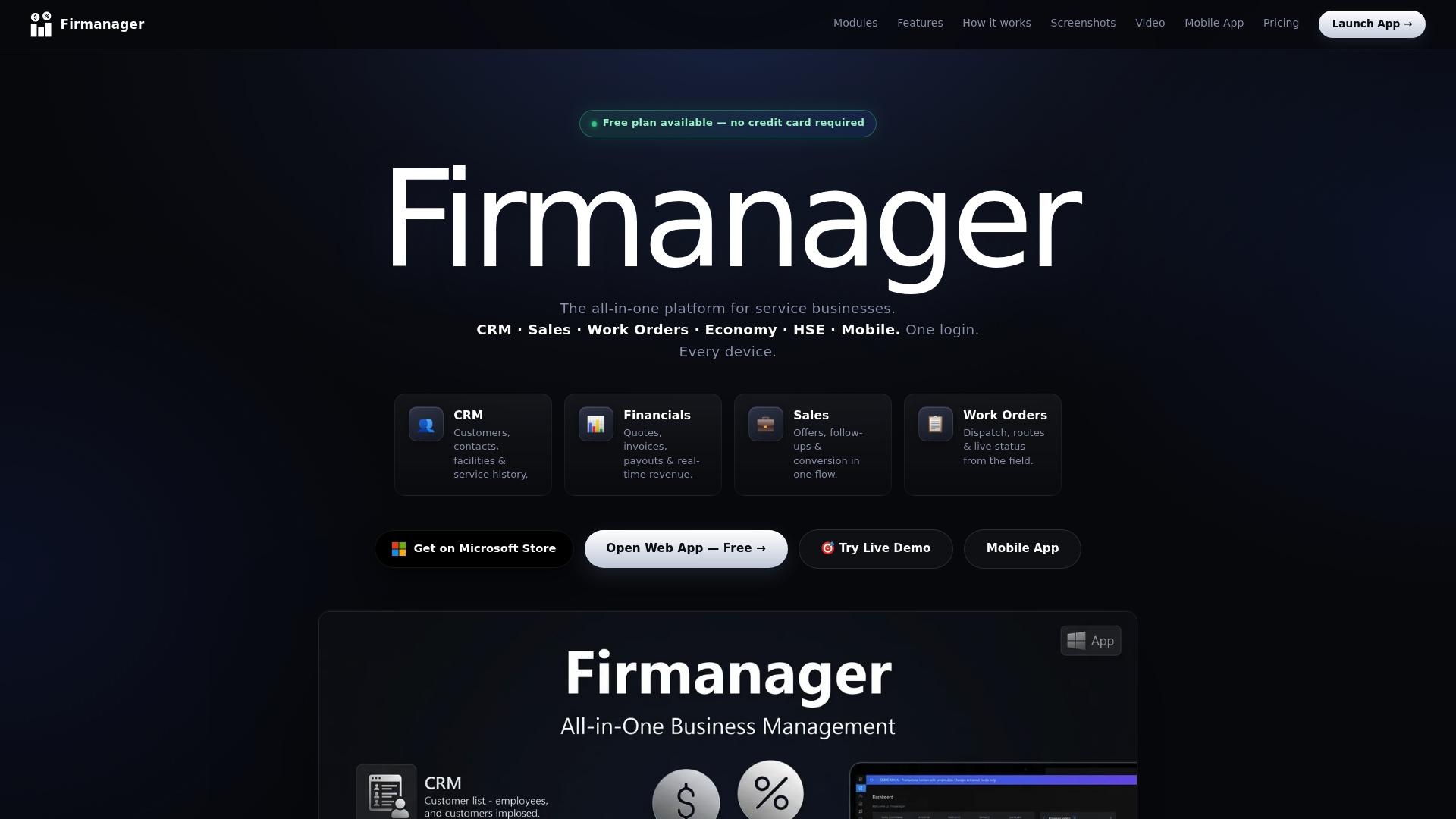
Real-time job profitability dashboards show margin by job and by crew as work happens, not after month-end close. For service businesses moving off spreadsheets, the setup is fast: configure your cost codes, connect payroll, and your first job cost sheets are live within days. Firmanager’s HSE compliance tracking, route management, and CRM round out the operational picture so job costing data feeds directly into pricing and sales decisions.
Ready to see how it works for your business? Start with Firmanager and get your first job cost sheet running without the spreadsheet overhead.
What the most important job costing insights come down to
Accurate job costing requires three things working together: the right method for your business type, disciplined cost capture at the job level, and monthly reconciliation to keep overhead rates calibrated.
| Point | Details |
|---|---|
| Match method to business type | Use actual costing for unique projects, standard costing for repeatable batches, and ABC for complex overhead structures. |
| Burdened labor is the key formula | Calculate direct labor as hours × (wage + payroll taxes + benefits) to avoid understating job costs. |
| Predetermined overhead rate | Set it as estimated overhead ÷ estimated allocation base; reconcile applied vs. actual overhead every month. |
| Time capture drives accuracy | Mobile, real-time time entry is the highest-impact change for service businesses — manual logging creates margin leakage. |
| Firmanager for service firms | Firmanager integrates work orders, time tracking, invoicing, and real-time job dashboards in one platform for service businesses. |
Sources
- Overview and compute the cost of a job using job order costing — OpenStax
- Job costing system definition — AccountingTools
- Job order costing simplified: A step-by-step guide to accurate pricing — QuickBooks
- Job costing — Wikipedia
Recommended
Run your whole business in one place
CRM, quotes, work orders, invoicing, expenses, HR and HSE — one login, every device. Free-forever plan.
Start free →