
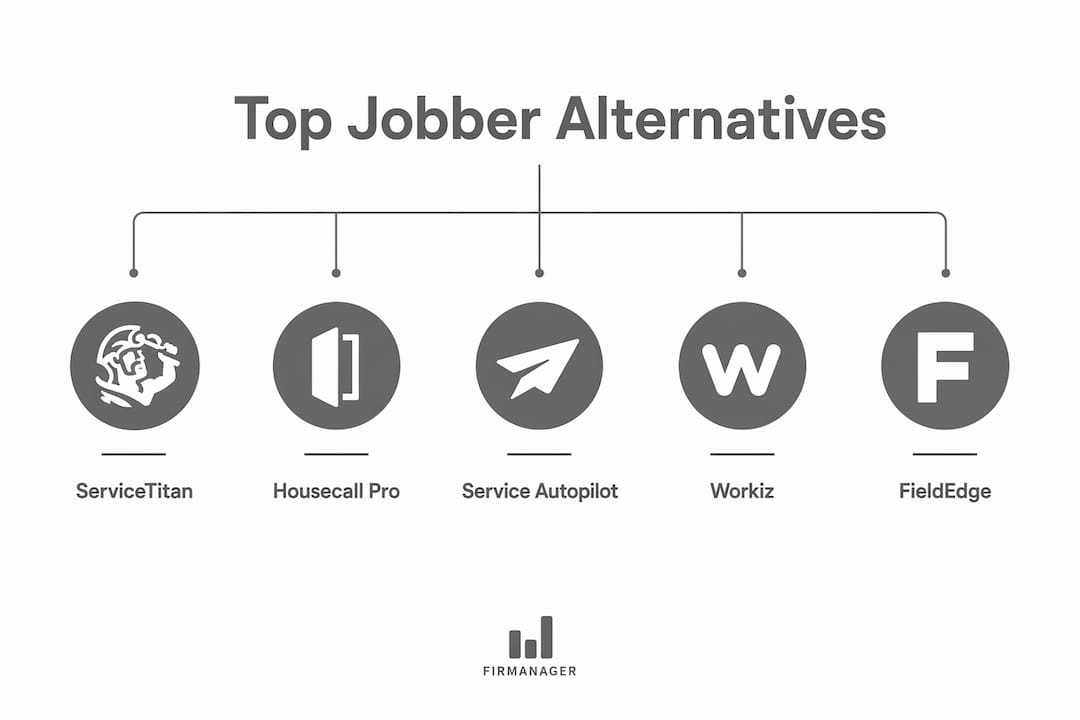
The strongest Jobber alternatives for US service businesses in 2026 are ServiceTitan, Housecall Pro, Service Autopilot, Workiz, FieldEdge, Service Fusion, MobiWork, and Synchroteam. Each solves a different operational gap, so the right pick depends on your trade, team size, and the specific friction you're hitting with Jobber today.
| Software | Best For | Industry Focus | Key Features | Rating |
|---|---|---|---|---|
| ServiceTitan | Large multi-trade contractors | HVAC, plumbing, electrical | Full FSM, dispatch, billing, marketing | 4.4★ |
| Service Autopilot | Small to mid-size service businesses | Landscaping, pest control, cleaning | Automation, GPS tracking, campaigns | 4.2★ (551) |
| Housecall Pro | Small to mid-size teams | Plumbing, HVAC, landscaping | AI assistant, two-way QuickBooks sync | 3.7★ (423) |
| Workiz | Entry-level field service businesses | HVAC, locksmith, appliance repair | Scheduling, payments, missed-call tools | 4.2★ (293) |
| FieldEdge | Mid-market multi-truck contractors | HVAC, plumbing, electrical | Business intelligence, marketing spend | 3.6★ (252) |
| Service Fusion | HVAC and related trades | Field service, HVAC | Scheduling, GPS, invoicing, mobile app | 3.1★ (192) |
| MobiWork | Mobile-first field teams | General field services | Work orders, dispatch, integrations | 5★ (16) |
| Synchroteam | Teams focused on dispatch accuracy | General field services | Scheduling, dispatching, task tracking | 3★ (4) |
What sets the best Jobber alternatives apart?
Most contractors looking at Jobber alternatives are hitting one of three walls: per-user pricing that compounds as the crew grows, workflow structure that doesn't bend to their trade, or missing capabilities that require expensive add-ons. Understanding which wall you're hitting shapes which platform actually fixes the problem.

ServiceTitan: built for businesses that have outgrown Jobber
ServiceTitan is the #1 software for commercial and residential trades, trusted by major contractors including Southland, Roto-Rooter, and Del-Air HVAC. It covers the full field service management stack: dispatch, billing, marketing, and reporting in one platform. The tradeoff is cost and complexity. ServiceTitan is generally a higher-cost option with monthly fees and implementation costs, making it the right call for high-revenue operations, not small crews looking to cut costs.
Housecall Pro: the most direct fix for QuickBooks frustration
Many contractors switch to Housecall Pro specifically because of its two-way QuickBooks Online sync, a recurring limitation with Jobber's one-way sync. Beyond accounting integration, it supports over 200,000 US professionals with automated marketing, job dispatch, payment processing, and an AI assistant for calls and bookings. It fits teams from 1 to 100+ and covers trades from plumbing and HVAC to window cleaning and handyman work.

Service Autopilot: automation depth for recurring-service businesses
Service Autopilot is built around automation: scheduling, payment collection, GPS tracking, marketing campaigns, and customer feedback all run on configurable workflows. It holds a SourceForge Partner 2025 designation and strong reviews on Software Advice. The platform offers four plan tiers (Startup, Pro, Pro Plus, Elite), making it a practical fit for landscaping, pest control, and cleaning businesses that need to scale without adding admin headcount.
Workiz: strong on missed-call conversion
Workiz handles job scheduling, field payment processing, and team collaboration, but its real differentiator is missed-call tracking and automated response. If lost phone leads are costing you jobs, Workiz has more purpose-built tools for that than Jobber does. It serves HVAC, locksmith, appliance repair, and junk removal businesses across the US.
FieldEdge: multi-truck operations with business intelligence
FieldEdge targets mid-market HVAC, plumbing, and electrical contractors running multiple crews. Its business intelligence layer tracks marketing spend effectiveness alongside dispatch and billing, giving owners a clearer picture of which jobs and channels actually drive profit. For a growing contractor who needs more than a scheduling tool, FieldEdge fills that gap.
Service Fusion, MobiWork, and Synchroteam
Service Fusion delivers all-in-one scheduling, dispatch, invoicing, GPS tracking, and a technician mobile app, with industry partnerships including Woman in HVACR, HARDI, and PHCC. It claims a 40% productivity boost for field service teams. MobiWork, based in Boca Raton, Florida, focuses on mobile-first work order management and dispatching with integration capabilities for businesses that need field mobility above all else. Synchroteam, based in Coral Gables, Florida, keeps its scope narrow: scheduling and dispatch accuracy for field teams that want less complexity, not more.
How to choose the right Jobber alternative for your business
Before switching platforms, get specific about what's actually broken. A full migration is expensive in time and training. Many contractors discover that a companion tool resolves their pain point without disrupting established workflows.
Ask yourself these questions before committing to a replacement:
- What's the primary friction? Pricing, QuickBooks sync, workflow flexibility, or missing features?
- What's your team size now, and in 12 months? Per-user pricing models compound fast.
- Do you run service-based or project-based work? Jobber fits short-cycle service work well; multi-phase construction projects need different tools entirely.
- Which integrations are non-negotiable? Two-way QuickBooks sync, Stripe payments, and GPS tracking vary widely across platforms.
- What does onboarding look like? Implementation support and training resources differ significantly between vendors. Evaluate responsiveness before signing.
- Is there a free trial or demo? Testing with a real job before committing saves significant switching cost.
For scheduling software comparisons that go deeper on appointment and dispatch features, those evaluations can sharpen your criteria before you demo a platform.
Pro Tip: If your only frustration with Jobber is field documentation, GPS-tagged photos, or inspection checklists, you likely don't need to switch platforms at all. Adding a specialized companion tool is faster, cheaper, and less disruptive than a full migration.
What is field service management software, and why look beyond Jobber?
Field service management (FSM) software handles the core operational loop for service businesses: schedule a job, dispatch a tech, complete the work, collect payment. Most platforms also cover CRM, invoicing, mobile access, and integrations with accounting tools like QuickBooks.
Jobber does this loop well for short-cycle service trades. Its scheduling, dispatch, and mobile workflow are purpose-built for HVAC, plumbing, landscaping, and similar businesses running same-day or next-day jobs. Where it starts to show limits:
- Per-user pricing scales poorly for growing crews.
- Workflow structure is fixed; trades with custom job stages find it inflexible.
- Project-based work is underserved. Long-term construction projects need section-based estimating, permit tracking, and document management that Jobber doesn't offer.
- QuickBooks sync runs one-way, creating reconciliation overhead for bookkeepers.
- Marketing automation is limited compared to platforms like Service Autopilot or Housecall Pro.
The decision to replace Jobber versus supplement it depends entirely on which of these gaps is costing you the most time or money.
Expert perspectives on picking the right platform
The most common mistake contractors make is treating a software switch as a solution to an operational problem that the software didn't create.
Evaluating true functional gaps before switching is the discipline most service businesses skip. Jobber is genuinely strong at scheduling, invoicing, and client management. Most contractors who leave do so for one of three specific reasons: pricing at scale, QuickBooks sync quality, or workflow rigidity. If none of those three apply, a companion tool for field documentation or CRM depth is almost always the faster, cheaper fix. Full platform migrations carry real costs in training, data transfer, and workflow disruption that rarely show up in the vendor's demo.
Service-based software excels in quick dispatch and invoicing, but businesses with project-based operations often need platforms supporting multi-phase workflows and document management. For contractors in that category, ServiceTitan or a construction-focused platform is the more honest recommendation than any of the direct Jobber competitors. For CRM-focused evaluations, a separate comparison of contractor CRM options can clarify whether the gap is in field operations or customer relationship management.
Key Takeaways
The right Jobber alternative depends on your specific operational gap, not on which platform has the most features.
| Point | Details |
|---|---|
| Identify your friction first | Pricing, QuickBooks sync, workflow flexibility, or missing features each point to a different platform. |
| Match platform to business type | Service-based trades fit Housecall Pro or Workiz; large contractors fit ServiceTitan; project-based work needs different tools. |
| Companion tools save migration cost | Adding a specialized tool often resolves pain points faster and cheaper than a full platform switch. |
| Integration depth varies widely | Two-way QuickBooks sync, Stripe payments, and GPS tracking are not standard across all platforms. |
| Firmanager as an all-in-one option | Firmanager covers CRM, work orders, invoicing, dispatch, and financial management in one subscription with a free tier. |
The real cost of switching software too soon
The field service software market pushes you toward switching. Every vendor demo is designed to make their platform look like the obvious upgrade. What those demos rarely show is the 60-to-90-day productivity dip that follows a migration, the staff retraining, and the data cleanup that comes with moving years of job history.
The contractors who get the most from their software investments are the ones who audit their actual workflows before they evaluate platforms. They know exactly which three features they're missing and which integrations are genuinely broken. That specificity makes vendor comparisons faster and prevents paying for a platform that solves problems you don't have.
For businesses that do need a full replacement, the platforms in this comparison are the strongest options available in the US market in 2026. But for a meaningful share of Jobber users, the answer is a targeted addition, not a wholesale switch.
Firmanager covers the gaps most field service tools leave open
If you've worked through this comparison and realized your real need is a single platform that handles CRM, work orders, invoicing, dispatch, financial reporting, and compliance without stitching together three separate tools, Firmanager is worth a close look.
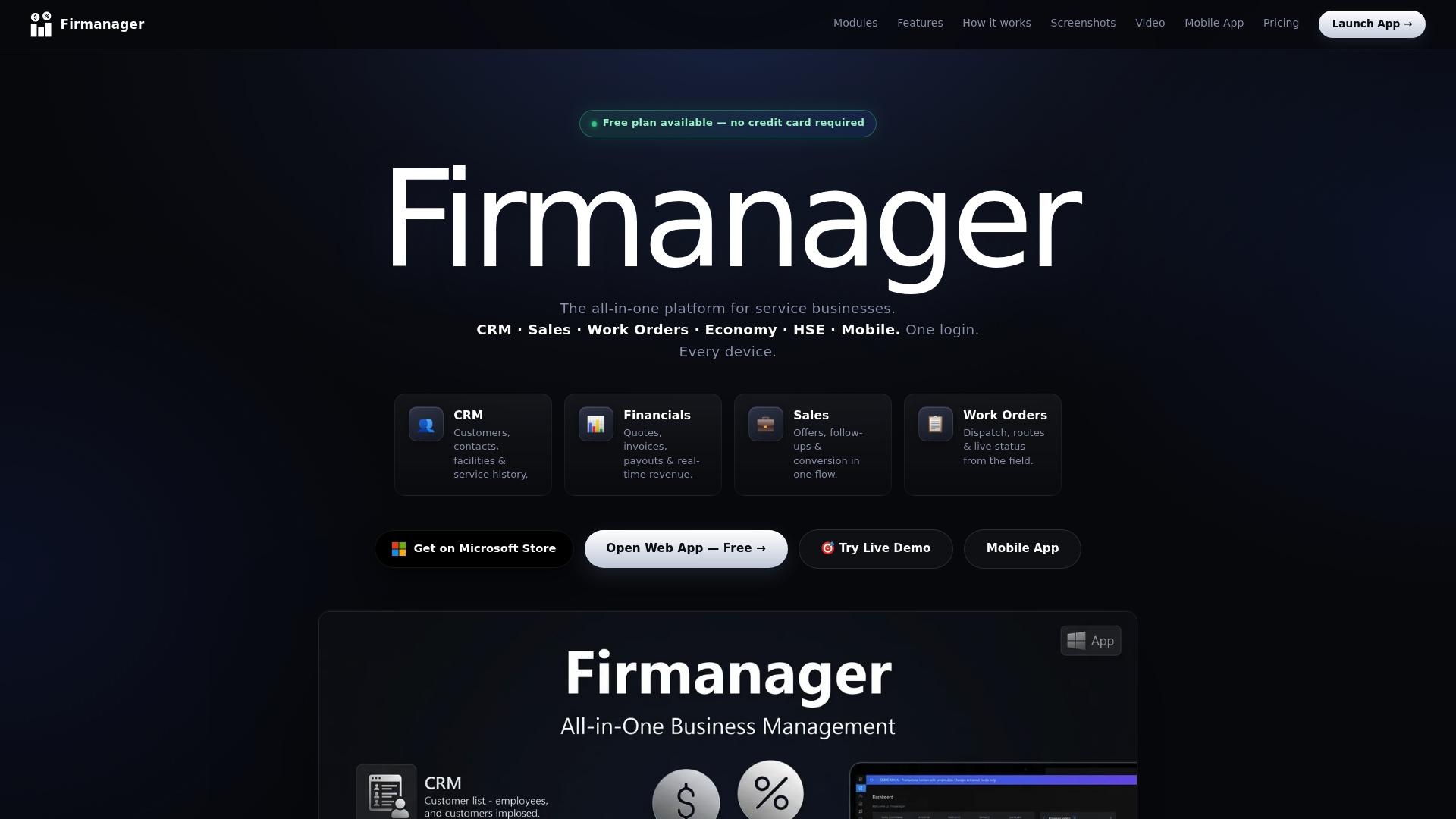
Firmanager is built specifically for service businesses, with real-time dashboards, an employee self-service mobile portal, Stripe-integrated invoicing, route and dispatch management, HSE compliance tracking, and SMS and email notifications all in one subscription. Unlike most field service platforms that charge per user from day one, Firmanager offers a free tier and tiered paid plans so you can start without a financial commitment and scale as your team grows. For service businesses that want one platform instead of a patchwork of tools, explore Firmanager and see how it fits your operation.