The Complete Service Customer Portal Guide for 2026
The Complete Service Customer Portal Guide for 2026
A service customer portal is a secure, authenticated self-service workspace where your customers log in to track orders, view invoices, open support tickets, manage subscriptions, and access account documents, all without calling or emailing your team. If recurring billing questions, job status requests, or order tracking inquiries consume a meaningful share of your support capacity, prioritize building or buying a portal now. The return on that investment shows up fast: less ticket volume, faster resolution, and customers who feel in control of their relationship with your business.
The industry term you’ll see in vendor documentation is client portal or self-service customer portal. Both refer to the same concept: a branded, account-scoped digital workspace tied to your backend systems. As Decagon makes clear, the fastest operational ROI comes from prioritizing ticket visibility, knowledge base integration, and billing views from day one — not from chasing every feature on a vendor’s marketing page.
Key Takeaways
A service customer portal delivers the fastest ROI when it connects to your real systems, prioritizes your highest-frequency support tasks, and is actively promoted by your support team from day one.
| Point | Details |
|---|---|
| Prioritize three features first | Ticket visibility, billing view, and KB search deliver the fastest deflection and resolution gains. |
| Integration determines portal value | A portal showing real-time CRM and billing data outperforms a feature-rich portal with disconnected systems. |
| Adoption requires active promotion | Agents directing customers to the portal during live interactions drive more adoption than email campaigns alone. |
| Measure deflection and adoption early | Track portal adoption rate, ticket deflection rate, and self-service resolution rate from the first 90 days. |
| Firmanager covers the full stack | Firmanager’s integrated CRM, invoicing, work orders, and customer portal eliminate the integration project most teams face. |
Table of Contents
- What a service customer portal actually is — and which type you need
- Core features every customer portal should include
- How portals improve CX, operations, and revenue
- Common implementation obstacles and how to handle them
- Best practices that drive adoption and reduce friction
- Your step-by-step portal implementation checklist
- Integrations, security, and U.S. compliance considerations
- How to measure portal success from day one
- Three real-world use cases that show portals in action
- How Firmanager covers the portal requirements in this guide
- What successful portal rollouts actually look like
- Firmanager gives service businesses a ready-built portal foundation
- Sources
What a service customer portal actually is — and which type you need
A customer portal is not a help center or a static FAQ page. It’s an account-level workspace with identity verification, meaning each customer sees only their own data: their jobs, their invoices, their tickets, their documents. That per-account data scope is what separates a portal from a public knowledge base.
The Fleetbase customer portal architecture illustrates this well: a functioning portal bundles authentication, dashboards, orders, billing, documents, and support into an extendable workspace tied to backend services. Strip any one of those layers and you have a partial solution that frustrates customers instead of helping them.
Portal variants your business might need:
- Field-service portals — customers view scheduled jobs, track technician arrival, reschedule appointments, and sign off on completed work orders.
- Subscription portals — customers manage their plan, pause or skip a cycle, swap products, update payment methods, and view billing history.
- B2B account portals — multiple users within a client organization access shared documents, approve invoices, submit service requests, and view contract terms.
- Embedded client portals — a portal experience built into a larger platform (e.g., a CRM or field-service management tool) rather than a standalone web app.
The audience inside each portal varies too. End customers complete tasks. Payers review and approve invoices. Service contacts open tickets and track jobs. Business admins manage user access and permissions. A well-scoped portal design accounts for all of these roles before a single screen gets built.
Core features every customer portal should include
Feature selection is where most portal projects go sideways. Teams either try to ship everything at once or launch with so little functionality that customers ignore the portal entirely. The right approach is to map features to your top support drivers first, then expand.
Top-tier features (ship these first)
- Secure authentication and SSO — customers log in with existing credentials; no new password friction.
- Ticket creation and status tracking — customers open requests and see real-time status without emailing your team.
- Searchable knowledge base — self-service answers for the questions your agents answer most often.
- Billing and invoice view with in-portal payments — customers see what they owe and pay without a phone call.
- Order and appointment tracking — real-time job status, technician ETA, and appointment management.
- Document sharing — contracts, service agreements, compliance certificates, and reports in one place.
- Account and user management — customers update contact info, manage sub-users, and control notification preferences.
Secondary features (add in phase two)
- In-portal live chat or messaging
- Subscription controls: pause, skip, swap, or upgrade
- Retention CTAs surfaced before a cancellation request
- Role-based access and multi-user account management for B2B clients
- Merchandising tiles for upsells or add-ons
Feature-to-goal mapping:
| Business Goal | Priority Features |
|---|---|
| Ticket deflection | Searchable KB, ticket status visibility, FAQ automation |
| Faster resolution | Ticket creation with attachments, status updates, agent notes |
| Retention | Subscription controls, pause/skip options, retention CTAs |
| Revenue expansion | In-portal upsells, payment history, plan upgrade prompts |
| Compliance and audit | Document sharing, signed work orders, access logs |
For field-service businesses, job tracking and appointment rescheduling deliver the most immediate value. For subscription businesses, plan controls and billing transparency reduce churn. For B2B accounts, document exchange and multi-user access are the features that win renewals.
Pro Tip: Before your vendor demo, list your top five inbound support request types by volume. Ask the vendor to show you exactly how a customer would self-serve each one. If they can’t demo it in under three clicks, the UX isn’t ready.
How portals improve CX, operations, and revenue
The business case for a self-service customer portal is straightforward: fewer repetitive contacts, lower cost per resolution, and customers who stay longer because they feel in control. HBR’s research on customer service supports this directly — operational choices that empower customers to resolve issues quickly are a core driver of superior service outcomes, not just a cost-cutting measure.
Ticket deflection is the most immediate win. When customers can check job status, view an invoice, or find an answer in the knowledge base without contacting support, your team handles fewer low-value contacts. That frees agents to work on complex issues that actually require human judgment.
Faster cash collection is an underrated benefit. In-portal invoice viewing and one-click payment reduce the lag between invoice delivery and payment receipt. Customers who can see their balance and pay in the same session don’t need a follow-up call from your billing team.
Retention is where portals earn their long-term ROI. Subscription businesses that give customers positive alternatives to cancellation — pause, skip, swap — see measurable reductions in churn. Stay AI’s case studies show that surfacing these options before the cancellation flow is one of the most effective retention levers available to subscription brands.
Metrics to track from launch: portal adoption rate, ticket deflection rate, self-service resolution rate, time-to-first-response for portal-originating tickets, CSAT for self-service interactions, and revenue generated via in-portal payments or upsells.
HubSpot’s documentation on customer portal capabilities notes that embedding knowledge base access and ticket visibility in the portal can meaningfully reduce support call volume when tightly integrated with support workflows. The key word is integrated — a portal that pulls stale data from a disconnected system delivers none of these benefits.
Common implementation obstacles and how to handle them
Portal projects stall for predictable reasons. Knowing them in advance lets you plan around them rather than react to them mid-project.
-
Integration gaps — the portal can’t show real-time data because it isn’t connected to the systems of record (CRM, billing, OMS). Mitigation: build your integration map before you write a single line of portal code. Identify which system owns each data type and confirm API availability early. MuleSoft’s case-study guidance shows that integration architecture is the single most common differentiator between portals that deliver value and those that don’t.
-
Poor UX leading to low adoption — customers visit once, can’t find what they need, and go back to calling. Mitigation: run usability tests with five to eight real customers before launch. Optimize for the three highest-frequency tasks first. If those flows aren’t intuitive, nothing else matters.
-
Adoption lag — even a well-built portal gets ignored if customers don’t know it exists or aren’t motivated to use it. Mitigation: send onboarding emails at account creation, train agents to direct customers to the portal during every interaction, and consider a small incentive (faster response SLA for portal-submitted tickets) to drive first use.
-
Data access and security concerns — customers worry about who can see their data; your security team worries about exposure. Mitigation: implement role-based access control (RBAC) from day one, enforce MFA for sensitive actions (payments, document downloads), and conduct a security review before launch.
-
Stale knowledge base content — the KB answers questions from six months ago, not the ones customers are asking today. Mitigation: assign a content owner and set a quarterly review cadence. Use ticket trend data to identify gaps. Zendesk’s guidance on AI-assisted KB management shows that automation can flag content gaps based on unresolved ticket patterns.
-
Initial support spike — the first weeks after launch often bring more contacts, not fewer, as customers ask how to use the portal. Mitigation: prepare a short onboarding guide and a “how to use your portal” email sequence. Brief your support team so they can answer portal navigation questions quickly.
-
Cross-team coordination — portal projects touch CX, IT, finance, and product simultaneously. Without a clear owner, decisions stall. Mitigation: assign a single project lead with authority to make scope decisions, and hold a weekly cross-functional sync during the build phase.
Best practices that drive adoption and reduce friction
The portals that get used are the ones built around what customers actually do most often, not around what the vendor’s template includes by default.
Start with the highest-frequency flows. Billing questions, job status checks, and ticket creation are almost always the top three. Optimize those flows to three clicks or fewer before you add anything else.
UX principles that matter most:
- Prominent search bar on the home screen — customers who can’t find something in five seconds will leave.
- Task-first information architecture — lead with actions (“Pay invoice,” “Check job status,” “Open a request”), not with account information.
- One-click status checks for active jobs or open tickets — no drilling through menus.
- Mobile-first design — a large share of your customers will access the portal from a phone, especially in field-service contexts.
- Clear CTA placement — every page should have one obvious next action.
Rollout recommendations:
- Pilot with a segment of engaged customers (10–20% of your base) before full launch.
- Send a three-email onboarding sequence: welcome, feature highlight, and “did you know?” tips at days 1, 7, and 30.
- Train every support agent to say “You can also do that in your portal” during live interactions.
- Track which portal features get used and which don’t — cut or redesign the unused ones within 90 days.
Pro Tip: Retention-driven portal design places high-value positive actions — swap, pause, add-on — before the cancellation flow. If a customer has to scroll past three upsell options to find the cancel button, that’s intentional friction that works. Just don’t make it deceptive; customers who feel manipulated churn harder.
For subscription businesses, Stay AI’s portal examples show that surfacing plan-control options prominently reduces cancellation rates by giving customers a positive alternative before they reach the exit.
Your step-by-step portal implementation checklist
A portal rollout has five phases. Each phase has a clear owner and a realistic time range. Skipping a phase or compressing it too aggressively is the most common cause of a failed launch.
-
Discovery and goal-setting — Owner: CX lead + product/service ops Map your top support request types by volume. Define two or three primary goals (ticket deflection, faster billing, retention). Set measurable targets for each. Confirm budget and internal resource availability.
-
System inventory and integration map — Owner: IT + CX List every backend system the portal needs to connect to: CRM, billing processor, OMS or work-order system, document storage, identity provider. Confirm API availability and data ownership for each. This is where you decide between a low-code portal builder, a vendor-provided portal module, or a custom build. For a practical walkthrough of the build-vs-buy decision, this guide on building a client portal covers the tradeoffs clearly.
-
Content and knowledge base preparation — Owner: CX + content Write or migrate your top 20–30 KB articles. Map each article to a support request type. Assign a content owner and set a review cadence before launch, not after.
-
Authentication, SSO, and security setup — Owner: IT + security Configure your identity provider, set up RBAC roles, enforce MFA for sensitive actions, and conduct a pre-launch security review. Never skip this phase to hit a deadline.
-
Pilot launch and measurement — Owner: CX lead Launch to your pilot segment. Instrument analytics events (page views, task completions, payment events). Review weekly. Identify the top three friction points and fix them before full rollout.
-
Full rollout and iteration (ongoing) — Owner: CX + product/service ops Expand to your full customer base. Set a 90-day review cadence for KB content, feature usage, and KPI performance. Treat the portal as a product, not a project — it needs ongoing ownership.
Cost notes: a vendor-provided portal module (included in a platform like Firmanager) is the fastest path to launch and the lowest upfront cost. A low-code build adds flexibility but requires more internal configuration time. A custom build gives you full control but typically adds 8–16 weeks and significant engineering cost.
Integrations, security, and U.S. compliance considerations
A portal that isn’t connected to your real systems is a static brochure. MuleSoft’s integration guidance is direct on this point: integration architecture that connects portals to CRM, billing, and order systems is what makes real-time, account-scoped self-service possible. Without it, you’re showing customers yesterday’s data.
Integration priorities:
- CRM — customer identity, contact history, account status, and segmentation data.
- Billing and payments — invoice history, outstanding balances, payment processing (Stripe or equivalent).
- OMS or work-order system — job status, technician assignment, appointment scheduling.
- Document storage — contracts, signed work orders, compliance certificates.
- Identity provider (SSO) — single sign-on so customers don’t manage a separate portal password.
- Analytics — event tracking tied to portal user IDs and CRM records.
For teams evaluating service integrations via API, confirming that your portal vendor supports webhooks and standard REST APIs before signing a contract saves significant rework later.
Security checklist:
- TLS 1.2 or higher for all data in transit
- Encryption at rest for stored customer data
- SOC 2 Type II certification for your portal vendor (or equivalent audit evidence)
- Least-privilege RBAC — customers see only their own data; admins see only what their role permits
- MFA or 2FA for payment actions and document downloads
- Session timeout and re-authentication for sensitive operations
- Audit logs for all access and data export events
U.S. compliance considerations:
- State privacy laws — California (CPRA), Virginia (VCDPA), Colorado (CPA), and others require data access, deletion, and opt-out mechanisms. Your portal’s account management section is the natural place to surface these controls.
- PCI scope reduction — use a hosted payment page or tokenized payment flow (Stripe’s hosted checkout, for example) to keep card data out of your portal’s scope entirely.
- Data residency — enterprise customers may require U.S.-only data storage. Confirm your vendor’s data residency options before signing.
For service businesses operating in regulated contexts, compliance management software that integrates with your portal can automate audit trails and document retention requirements.
How to measure portal success from day one
Measurement starts before launch, not after. Define your baseline — current ticket volume by type, average time-to-resolution, CSAT scores — so you have something to compare against at the 90-day mark.
KPIs to track:
- Portal adoption rate — percentage of active customers who log in at least once per month.
- Ticket deflection rate — reduction in inbound contacts for tasks the portal handles (billing, status, KB).
- Self-service resolution rate — percentage of portal sessions that end without a ticket being opened.
- Time-to-resolution for portal-originating tickets — tickets submitted through the portal should resolve faster than phone or email tickets because they arrive with structured data attached.
- CSAT for self-service interactions — a short survey after a completed portal task (payment made, ticket resolved) gives you direct feedback on the experience.
- Revenue via in-portal actions — payments collected, upsells accepted, plan upgrades initiated.
Instrumentation notes:
- Tag every portal user with their CRM record ID so you can correlate portal behavior with support history, churn risk, and lifetime value.
- Track task-completion events, not just page views. A customer who lands on the billing page but doesn’t pay is a friction signal, not a success.
- Set up a weekly dashboard that shows deflection rate, adoption rate, and open ticket volume side by side. Trends matter more than point-in-time numbers.
In the first 90–180 days, expect adoption to climb gradually as onboarding emails and agent referrals take effect. Ticket deflection typically lags adoption by four to six weeks — customers need to use the portal successfully once before they trust it enough to use it instead of calling.
Three real-world use cases that show portals in action
Field-service business: job tracking and appointment management
A residential HVAC company launches a portal where customers can view their scheduled maintenance appointment, see the assigned technician’s name and estimated arrival window, reschedule within a 48-hour window, and sign off on completed work digitally. The support team stops fielding “when is my tech arriving?” calls entirely. Post-job, the portal surfaces the signed work order and invoice in the same session, reducing billing disputes.

Features mapped: appointment tracking, technician ETA, digital sign-off, invoice view, in-portal payment.
Expected benefit: significant reduction in inbound status calls; faster payment collection; higher CSAT from transparency.
Subscription business: plan control and retention
A commercial cleaning subscription service adds pause, skip, and swap controls to its customer portal. When a customer navigates toward cancellation, the portal surfaces a “pause for 30 days” option first, then a plan downgrade option, before showing the cancellation form. Retention-focused portal design like this — placing positive alternatives before the exit — is a documented approach to reducing churn without requiring agent intervention.

Features mapped: subscription controls (pause/skip/swap), retention CTAs, billing history, plan management.
Expected benefit: lower cancellation rate; higher average order value from swap-to-upgrade flows.
B2B account portal: multi-user access and document exchange
A commercial facilities management company serves corporate clients with multiple locations. Each client organization gets a portal with role-based access: a billing contact sees invoices and payment history; a facilities manager sees work orders and compliance certificates; an executive sees account-level reporting. Document exchange replaces email threads for contract renewals and service agreements.

Features mapped: multi-user RBAC, document sharing, invoice approval, work-order visibility, account-level reporting.
Expected benefit: faster contract cycles; fewer billing disputes; stronger compliance posture for enterprise clients.
How Firmanager covers the portal requirements in this guide
Firmanager is built specifically for service businesses, and its feature set maps directly to the checklist this guide covers.
Feature mapping:
- CRM and customer management — centralized account records, contact history, and segmentation, all tied to the customer-facing portal. Explore customer management software options to understand how Firmanager fits the broader landscape.
- Invoicing with Stripe integration — customers view invoices and pay in-portal; your team sees payment status in real time.
- Work orders and field-service management — job status, technician assignment, route and dispatch, and appointment scheduling are all visible to customers through the portal layer.
- Document handling — contracts, signed work orders, compliance certificates, and reports stored and shared through the platform.
- Real-time notifications via SMS and email — appointment reminders, job updates, and invoice alerts keep customers informed without portal logins for routine updates.
- HSE compliance tracking — relevant for service businesses operating in regulated environments; audit trails and compliance documents are accessible through the platform.
- Employee self-service mobile portal — a separate portal layer for your team, so field staff and office staff operate from the same data source.
Who benefits most: owners and managers of field-service businesses — maintenance, cleaning, technical services, facilities management — who need integrated CRM, billing, work-order visibility, and a customer-facing portal without stitching together five separate tools.
Onboarding timeline: Firmanager’s modular design means you can configure your core portal features (CRM, invoicing, work orders) early, run a pilot with a customer segment in the middle phases, and scale to your full base in a typical rollout timeframe. The platform is cloud-synced, so data is always current — the integration gap that kills most portal projects doesn’t apply when your portal and your operations system are the same platform.
For a comparison of CRM options for service businesses that integrate with portal tools, that resource covers the evaluation criteria in detail.
What successful portal rollouts actually look like
The portals that deliver results share one characteristic: they were built around what customers do most often, not around what looked impressive in a vendor demo. The teams that succeed treat the portal as a product with an owner, a roadmap, and a measurement cadence. The teams that fail treat it as a one-time IT project.
Three lessons from portal rollouts that worked:
-
Integration first, features second. A portal with five features and real-time data from your CRM and billing system outperforms a portal with twenty features and stale data. Customers notice immediately when the invoice they’re looking at doesn’t match what they were billed.
-
Adoption doesn’t happen by itself. The best-built portals still need active promotion. Agents who direct customers to the portal during every interaction are the single most effective adoption driver — more effective than any email campaign.
-
Stakeholder alignment is where projects derail. When CX, IT, and finance don’t agree on scope before build starts, scope creep adds weeks and the launch date slips. A two-page scope document signed off by all three teams before development begins prevents most of this.
The HBR finding on customer service operations applies here: operational choices that empower customers to resolve issues quickly matter more than adding features. Build the fast path first.
Firmanager gives service businesses a ready-built portal foundation
Most service businesses spend months evaluating portal vendors, then more months integrating them with their CRM, billing system, and work-order platform. Firmanager eliminates that sequence. Because CRM, invoicing, work orders, and the customer-facing portal are all part of the same platform, your portal shows real-time data from day one — no integration project required.
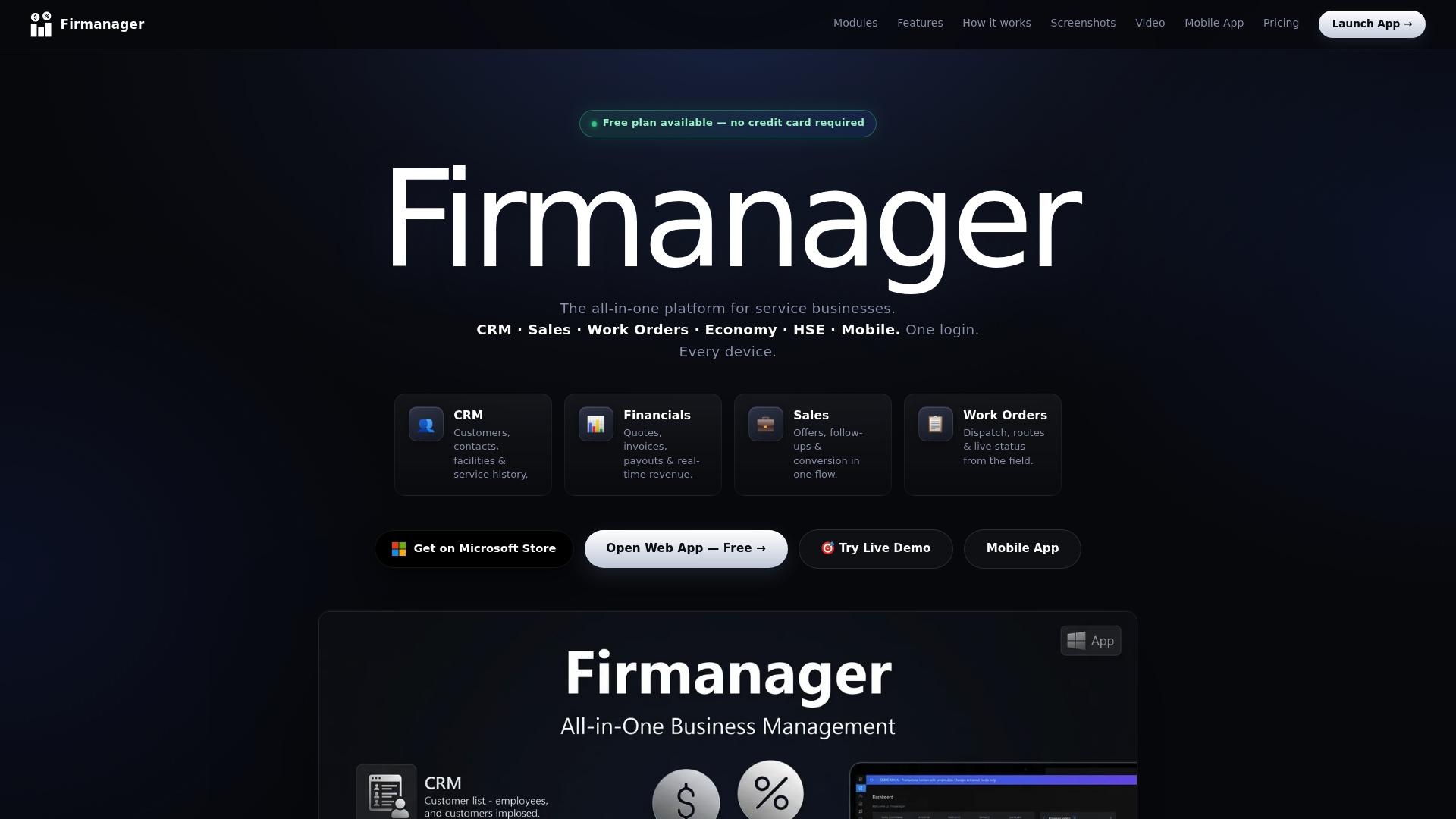
Your customers get a portal where they can track jobs, view and pay invoices, access documents, and manage their account. Your team gets a single dashboard where every customer interaction, job status, and payment is visible in one place. Firmanager’s Stripe integration handles in-portal payments; SMS and email notifications keep customers informed between logins. For field-service businesses ready to move from scattered tools to a single platform, start with Firmanager — the free plan lets you configure your core modules before committing to a paid tier.
Sources
- Hbr
- fleetbase/customer-portal
- Mulesoft
- What is a customer service portal and what features to prioritize
Recommended
Run your whole business in one place
CRM, quotes, work orders, invoicing, expenses, HR and HSE — one login, every device. Free-forever plan.
Start free →