Best CRM for Service Business: Top Picks for 2026
Best CRM for Service Business: Top Picks for 2026
For most U.S. service businesses, Firmanager is the strongest all-in-one choice — it combines CRM, work orders, dispatch, invoicing with Stripe, and an employee mobile portal in a single platform built specifically for service operations. If you’re running a lean operation on a tight budget, HubSpot CRM’s free tier covers contact management and basic pipelines without charge. For large, multi-location enterprises with complex sales cycles, Salesforce Sales Cloud offers the depth and customization to match.
Here’s the short version of the top picks:
- Firmanager — Best all-in-one for small to mid-size and multi-site service businesses; work orders, dispatch, invoicing, and mobile portal included out of the box.
- HubSpot CRM — Best free starting point; strong contact management and reporting, but field-service features require paid add-ons.
- Salesforce (Sales Cloud) — Best for enterprise service organizations; unmatched customization and AI, but significant setup investment required.
The biggest mistake service businesses make when choosing CRM software is optimizing for sales pipeline features when they actually need scheduling, dispatch, and job-costing tools. A CRM built for a sales team will leave your field technicians working around the software instead of with it. Match the tool to the workflow your team actually runs.
Table of Contents
- What’s the best CRM for a service business at a glance?
- How do you choose the right CRM for your service business?
- Which CRM platforms are built for service businesses?
- What’s the right CRM pick for your service business profile?
- Key takeaways
- Why integrated service CRMs outperform general-purpose tools
- Firmanager covers the full service business checklist
- Sources and further reading
What’s the best CRM for a service business at a glance?
The table below covers all 19 options across the key dimensions service teams care about most. Field-service features like scheduling, dispatch, and work orders are weighted heavily because that’s where generic CRMs consistently fall short.
| CRM | Best for | Key service features | Integrations | Starting price / free tier | Setup / scalability | Pros | Cons |
|---|---|---|---|---|---|---|---|
| Firmanager | Small to mid-size & multi-site service businesses | Work orders, dispatch, scheduling, mobile portal, invoicing, HSE compliance | Stripe, SMS/email notifications, API | Free tier available; paid tiers by seat | Fast setup; scales to multi-site | All-in-one; no tool-switching; Stripe invoicing built in | Newer brand; smaller third-party app ecosystem |
| HubSpot CRM | Budget-conscious teams needing contact + pipeline | Contact management, deal pipelines, reporting, AI automation | — | Free tier available; paid plans vary | Very easy; scales with paid tiers | Generous free plan; strong marketing tools | Field-service features require paid modules |
| Salesforce (Sales Cloud) | Enterprise multi-location service orgs | AI agents, custom workflows, service cloud add-on, reporting | Massive AppExchange | No free tier; paid plans vary | Complex setup; highly scalable | Most customizable; industry-leading AI | High cost; long implementation timeline |
| Zoho CRM | Growing SMBs needing field-service depth | Scheduling, dispatch console, job sheets, recurring work orders, mobile FSM app | —, Zoho suite | Free for 3 users; paid from ~$14/seat/mo | Moderate setup; scales well | Strong field-service vertical; affordable | UI can feel cluttered; steep learning curve |
| Pipedrive | Sales-led service teams reducing missed jobs | Contact management, appointment scheduling, automation, mobile app | — | From ~$14/seat/mo; 14-day trial | Easy setup; mid-scale | Clean UI; strong automation for reminders | Limited native field-service/work order tools |
| monday.com CRM | Teams wanting flexible, visual workflows | AI automations, scheduling, visual pipelines | — | From ~$12/seat/mo; free trial | Easy; scales to enterprise | Highly visual; strong AI automations | Not purpose-built for field service |
| Close CRM | Inside sales and service follow-up teams | Built-in calling, SMS, email sequences, pipeline | — | From ~$49/mo; 14-day trial | Easy setup; SMB-focused | Excellent communication tools | Weak on field dispatch and work orders |
| Freshsales (Freshworks) | SMBs wanting AI-assisted sales + service | AI lead scoring, phone, email, mobile app | Freshworks suite + 3rd party | Free plan; paid from ~$9/seat/mo | Easy; moderate scalability | Affordable; solid AI features | Field-service depth limited without Freshdesk |
| Thryv | Local service businesses needing marketing + CRM | Appointment booking, invoicing, reputation management, client portal | — | Paid plans vary; free trials available | Easy for small teams | Built for local service businesses | Expensive at scale; limited customization |
| Zendesk Sell | Service teams prioritizing customer support | Pipeline management, email tracking, reporting, support integration | Zendesk suite + 3rd party | From ~$19/seat/mo; free trial | Easy; scales with Zendesk | Tight support/sales integration | Weak on field operations |
| Zendesk | Support-heavy service operations | Ticketing, omnichannel support, reporting, AI | — | From ~$19/agent/mo; free trial | Moderate; scales to enterprise | Best-in-class support tools | Not a field-service CRM |
| Creatio CRM / Creatio Service | Mid-market teams needing no-code customization | No-code workflow builder, service management, omnichannel | — | Paid plans vary; free trials available | Moderate; highly customizable | Flexible no-code platform | Requires configuration effort |
| SAP Sales Cloud | Large enterprises with SAP ecosystems | AI-guided selling, forecasting, mobile, SAP integration | SAP ecosystem | Enterprise pricing; no free tier | Complex; enterprise-scale | Deep SAP integration; strong analytics | High cost; not for SMBs |
| Agile CRM | Startups and micro-businesses on a budget | Contact management, deal tracking, email marketing, telephony | 50+ integrations | Free tier available; paid plans vary | Easy; limited scalability | Best free plan in the space | Dated UI; limited field-service features |
| Freshdesk by Freshworks | Support-first service teams | Ticketing, SLA management, omnichannel, knowledge base | Freshworks suite | Free tier available; paid plans vary | Easy; scales well | Strong support tools; generous free tier | Not a sales or field-service CRM |
| Maximizer | Financial and professional services firms | Pipeline, contact management, reporting, compliance tools | 50+ integrations | Paid plans vary; free trials available | Moderate; SMB to mid-market | Strong compliance and reporting | Niche fit; limited field-service features |
| Kickstart | Early-stage service businesses | Basic contact management, pipeline, task tracking | Limited | Low-cost or free entry; varies | Very easy; limited scalability | Simple onboarding | Minimal advanced features |
| monday CRM | Visual project + CRM hybrid teams | Visual boards, automations, task management, reporting | — | From ~$12/seat/mo; free trial | Easy; scales to enterprise | Flexible; strong project-CRM overlap | Not purpose-built for service dispatch |
| Close CRM (duplicate) | See Close CRM above | — | — | — | — | — | — |
Pricing callout: Most CRM platforms offer free trials ranging from 14–30 days, and several (HubSpot, Zoho, Agile CRM, Freshsales, Freshdesk) offer permanent free tiers for small teams. Paid plans for SMBs typically start between $9–$49 per seat per month. Enterprise platforms like Salesforce and SAP Sales Cloud carry custom pricing and often require implementation fees on top of seat costs.
How do you choose the right CRM for your service business?
The right CRM for a service business isn’t the one with the most features — it’s the one that fits the actual jobs your team runs every day. Field-service features, integrations, and vendor support are the three most decisive selection criteria in 2026.
Start with this prioritized checklist:
- Scheduling and dispatch — Does the platform let you assign jobs, manage technician calendars, and track field status in real time? This is non-negotiable for any team with mobile workers.
- Mobile field app — Can technicians access job details, capture photos, log time, and update job status from the field? Mobile-first workflows matter especially where connectivity is intermittent.
- Work orders and job costing — Does the CRM create, assign, and close work orders linked to customer records? Can you export job-costing fields for accounting reconciliation?
- Invoicing and payments — Can you generate invoices from completed jobs and collect payment in the same platform? Stripe integration or a direct payment gateway connection saves significant reconciliation time.
- Integrations — Does it connect to your accounting software (QuickBooks, Xero), calendar (Google, Outlook), and GPS or routing tools?
- Reporting — Can you track job completion rates, technician utilization, revenue by service type, and customer retention in one dashboard?
- Support and training — Does the vendor offer onboarding support, live chat, and documentation? A CRM with no implementation help costs more in lost time than it saves in subscription fees.
Vendor questions to ask during demos
- “Show me how a work order is created, assigned, and closed — and where that data lives on the customer record.”
- “Can field data (photos, job sheets, time logs) stay linked to the customer record permanently?”
- “What does your API export for job-costing fields, and which accounting platforms are natively supported?”
- “What is the typical onboarding timeline for a team our size, and what support is included?”
- “Are there seat minimums or annual contract requirements at our usage level?”
What to expect on pricing
SMB-focused platforms typically have moderate per-seat monthly pricing. Enterprise platforms like Salesforce and SAP Sales Cloud often require significant additional implementation budgets. Free-tier plans are useful for validating core contact and pipeline workflows, but advanced field-service features usually require paid plans.
Pro Tip: Before your demo, map out your three most common job types as a simple workflow: customer inquiry → quote → scheduled job → completed work order → invoice. Ask each vendor to walk through that exact sequence. If they can’t demo it in under 10 minutes, the platform probably isn’t built for service operations.
Red flags to watch for
- Onboarding that takes more than 60 days with no dedicated support contact
- Closed ecosystems with no API or limited export options
- Pricing that hides per-feature fees until after you sign
- No native mobile app or an app that requires full connectivity to function
- Work orders and invoicing sold as separate add-on modules at extra cost
Which CRM platforms are built for service businesses?
Firmanager: the integrated service business platform
Firmanager is built from the ground up for service companies, which is what separates it from general-purpose CRMs that bolt on field-service features as afterthoughts. The platform covers the full operational loop: CRM and contact management, work order creation and assignment, route and dispatch management, scheduling, invoicing with Stripe, an employee self-service mobile portal, HSE compliance tracking, supplier management, and real-time notifications via SMS and email.
Core service features:
- Work order management with assignment, status tracking, and job history linked to customer records
- Route and dispatch management for field teams
- Scheduling with recurring job and maintenance plan support
- Invoicing with Stripe integration for same-day payment reconciliation
- Employee self-service mobile portal for field technicians
- Live dashboards and real-time financial reporting
- HSE (health, safety, and environment) compliance module
- Document handling and supplier management
Pricing: Free tier available; paid tiers scale by seat and usage. No public per-seat pricing listed; contact Firmanager for current plan details.
Best for: Small to mid-size service businesses and multi-site operations that need CRM, field service, and invoicing in one platform without stitching together multiple tools.
Migration note: Start by migrating active customer records and recurring job data first. Pilot scheduling and dispatch with one crew before rolling out company-wide. Firmanager’s Stripe integration means invoicing can go live on day one, which is one of the fastest wins available during implementation.

Entry-level field apps and sales-focused CRMs
Platforms like Pipedrive, Close CRM, and monday.com CRM are strong for managing sales pipelines, automating follow-up reminders, and tracking customer communication. Pipedrive’s appointment scheduling and automation tools help reduce missed jobs and follow-up gaps. These platforms work well for service businesses where the sales cycle is the primary pain point, but they don’t natively handle work orders, dispatch, or job costing. You’ll need integrations or add-ons to cover field operations.
Freshsales (Freshworks) and Agile CRM sit in the affordable-to-free tier and cover contact management, deal tracking, and basic automation well. Agile CRM’s free plan supports small teams, making it a practical starting point for micro-businesses. Neither platform is purpose-built for field service.
Thryv takes a different angle: it’s designed specifically for local service businesses and bundles appointment booking, invoicing, reputation management, and a client portal. The tradeoff is cost — Thryv’s all-in-one pricing is higher than most per-seat alternatives, which may be harder to justify for teams needing only a subset of its features.
Vertical service CRMs and support-first platforms
Zoho CRM offers one of the more complete field-service feature sets among general-purpose CRMs, with a dedicated dispatch console, job sheets, recurring work orders, and a mobile FSM app. It’s a strong option for growing SMBs that want field-service depth without enterprise pricing. The learning curve is real, though — Zoho’s breadth can feel overwhelming during initial setup.
Zendesk and Freshdesk by Freshworks are built for support-heavy operations. If your service business runs a high volume of customer tickets, SLA management, and omnichannel support, these platforms are best-in-class. They’re not field-service CRMs, but they integrate well with platforms that are.

Creatio CRM / Creatio Service stands out for mid-market teams that need no-code workflow customization. Its process automation engine lets operations managers build custom service workflows without developer help. The configuration investment is higher than plug-and-play options, but the flexibility payoff is significant for businesses with non-standard service processes.
Enterprise CRM platforms
Salesforce (Sales Cloud) remains the most customizable CRM on the market. Its agentic AI and AppExchange ecosystem make it capable of handling almost any service workflow — but that capability comes with implementation complexity and cost that most SMBs can’t absorb. For large, multi-location service organizations with dedicated IT resources, Salesforce is a legitimate choice. For everyone else, the setup overhead outweighs the benefits.
SAP Sales Cloud fits organizations already running SAP ERP. The integration depth is unmatched within the SAP ecosystem, but it’s enterprise-only in both pricing and complexity. Maximizer targets financial and professional services firms that need strong compliance and reporting tools alongside pipeline management.
Zendesk Sell bridges the gap between Zendesk’s support platform and a sales CRM, making it a natural fit for service businesses that already use Zendesk for customer support and want unified pipeline visibility.
| Platform category | Work orders | Dispatch | Mobile app | Invoicing | Starting price |
|---|---|---|---|---|---|
| Firmanager | ✓ Native | ✓ Native | ✓ Native | ✓ Stripe | Free tier |
| Zoho CRM | ✓ Native | ✓ Dispatch console | ✓ FSM app | Via integration | Free (3 users) |
| Thryv | Partial | — | ✓ | ✓ Native | Paid plans vary |
| HubSpot CRM | — | — | ✓ | Via integration | Free forever |
| Pipedrive | — | — | ✓ | Via integration | ~$14/seat/mo |
| Salesforce Sales Cloud | Via AppExchange | Via AppExchange | ✓ | Via AppExchange | Paid plans vary |
| Creatio CRM | ✓ Configurable | ✓ Configurable | ✓ | Via integration | Paid plans vary |
What’s the right CRM pick for your service business profile?
For the majority of U.S. service businesses, Firmanager is the most direct path to operational efficiency because it eliminates the need to connect separate tools for CRM, field service, and invoicing.
Match your profile to the right pick:
- Small local operation (1–10 technicians): Firmanager’s free tier or a low-cost entry plan covers CRM, scheduling, and invoicing without per-seat costs that add up fast. HubSpot’s free plan works if your primary need is contact management and you’re not yet running work orders.
- Growing regional service business (10–50 staff): Firmanager scales cleanly to multi-site operations. Zoho CRM is a strong alternative if you need deep field-service features and are comfortable with a longer setup process.
- Enterprise or multi-location operation (50+ staff): Salesforce Sales Cloud with a Service Cloud add-on handles the complexity, but budget for a 3–6 month implementation. Creatio CRM is worth evaluating if you need no-code workflow customization without Salesforce’s price tag.
Migration and implementation checklist
Follow this sequence to avoid the most common rollout failures:
- Export and clean your contact data — remove duplicates, standardize address formats, and tag active vs. inactive customers before importing.
- Migrate active customer records and recurring jobs first — don’t try to move your full history on day one.
- Pilot scheduling and dispatch with one crew — validate the workflow before rolling out to all teams.
- Activate appointment reminders — automating reminders is the fastest way to reduce no-shows and is typically a same-day configuration.
- Connect invoicing to your payment gateway — Stripe integration in Firmanager enables same-day payment reconciliation from the first invoice.
- Train staff on the mobile app — field technicians need a 30-minute walkthrough, not a full training day. Keep it focused on job access, status updates, and photo capture.
- Set go-live metrics — track job completion rate, invoice cycle time, and no-show rate in the first 30 days to confirm the platform is working.
Quick wins in the first 90 days: automated appointment reminders, centralized customer invoices, and a single dashboard showing open jobs and outstanding payments. These three changes alone typically recover more time than the CRM costs.
If you want to accelerate CRM workflow automation beyond what’s built in, AI automation services can add dispatch routing, customer messaging, and task automation on top of your existing platform.
Key takeaways
For most U.S. service businesses, the best CRM is one that handles scheduling, work orders, and invoicing natively — not a sales-first platform retrofitted with field-service add-ons.
| Point | Details |
|---|---|
| Match CRM to your workflow | Service businesses need scheduling, dispatch, and work orders — not just pipeline management. |
| Free tiers validate, not replace | Free plans cover contacts and pipelines; advanced field-service features almost always require a paid tier. |
| Implementation sequence matters | Migrate active records first, pilot one crew, then automate reminders before full rollout. |
| Enterprise platforms carry real costs | Salesforce and SAP Sales Cloud require implementation budgets beyond seat fees — not suitable for most SMBs. |
| Firmanager for service teams | Firmanager combines CRM, work orders, dispatch, Stripe invoicing, and mobile portal in one platform built for service businesses. |
Why integrated service CRMs outperform general-purpose tools
The conventional wisdom in CRM selection is to start with the most popular platform and customize it to fit your business. For service businesses, that approach consistently underdelivers. General-purpose CRMs are designed around sales pipelines, not job workflows. Customizing a sales CRM to handle work orders, dispatch, and field data usually means paying for integrations, maintaining multiple platforms, and training staff on workarounds.
The real tradeoff isn’t flexibility versus features. It’s time-to-value versus long-term configurability. A platform like Firmanager gets a service team operational in days because the core workflows — scheduling, dispatch, invoicing — are already built in. A highly configurable platform like Salesforce or Creatio can eventually do more, but “eventually” often means months of setup and a consultant’s invoice.
There’s also a data integrity argument. When field data (photos, job sheets, time logs) stays linked to the customer record inside one platform, you get a complete service history without manual reconciliation. When that data lives across three tools connected by a fragile integration, you get gaps. For service businesses where job history drives repeat business and warranty claims, those gaps are expensive.
The one scenario where a general-purpose CRM makes sense: your primary bottleneck is sales and follow-up, not field operations. If you’re running a consulting or professional services firm with no field technicians, Pipedrive or HubSpot will serve you well. But if your business dispatches people to job sites, a purpose-built service business CRM is the more direct path.
Firmanager covers the full service business checklist
Every feature on the service CRM checklist above — scheduling, dispatch, work orders, invoicing, mobile portal, reporting — is built into Firmanager’s platform, not sold as a separate module.
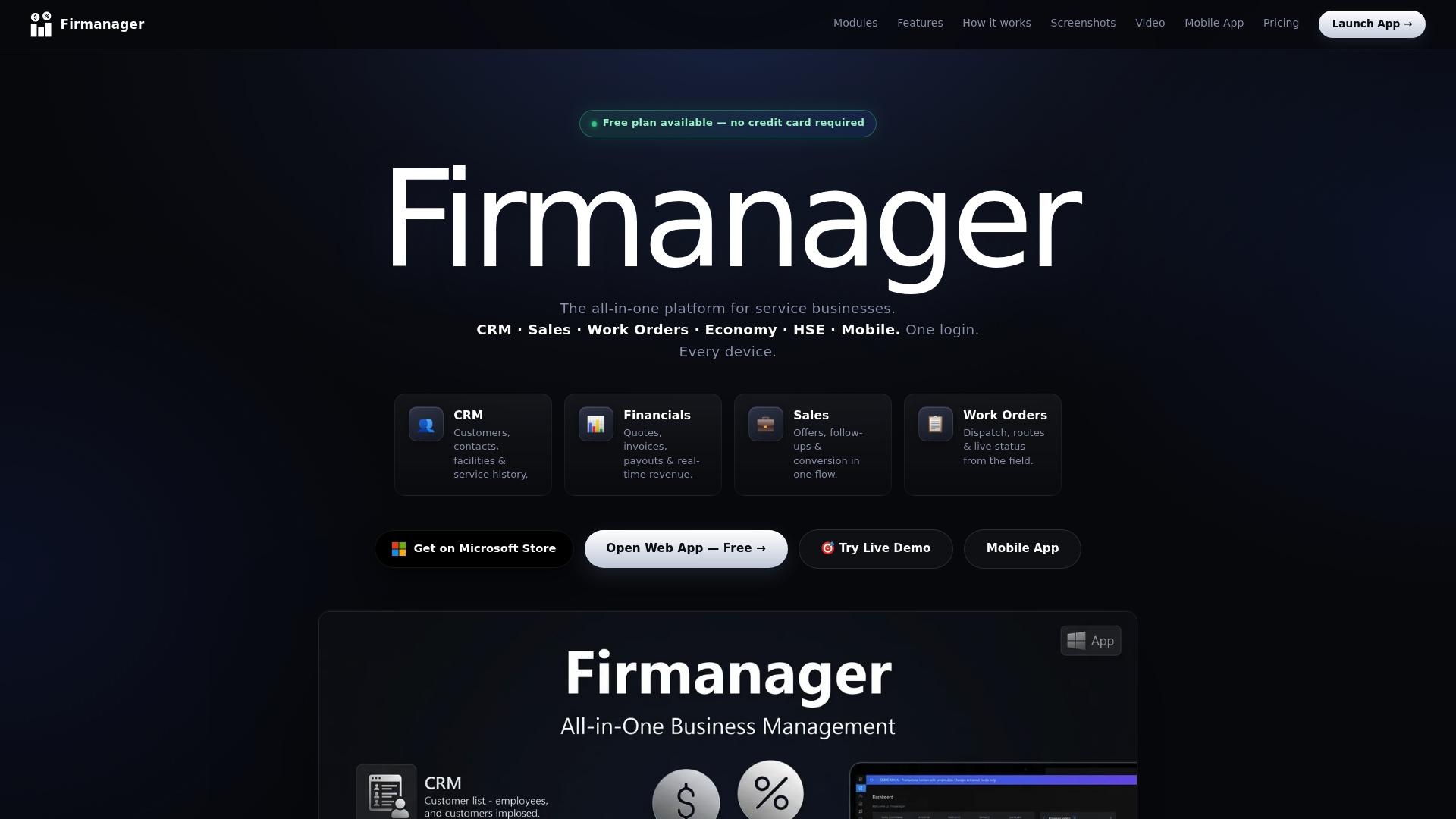
For service businesses that are tired of switching between a CRM, a scheduling tool, a separate invoicing app, and a spreadsheet for job tracking, Firmanager consolidates all of it. The free tier lets you test core CRM and scheduling workflows before committing to a paid plan. Paid tiers scale by seat as your team grows, with no surprise per-feature fees for work orders or dispatch.
Firmanager also includes HSE compliance tracking, supplier management, and real-time SMS and email notifications — features that most CRMs don’t offer at any price tier. The Stripe integration means your team can send an invoice and collect payment the same day a job closes, which cuts invoice cycle time significantly for most service businesses.
Start your free trial or request a demo at firmanager.cloud to see how the platform fits your specific service workflows.
Sources and further reading
The claims and comparisons in this article draw on vendor documentation, market roundups, and platform-specific feature pages. The sources below are the primary references used.
| Source | What it covers |
|---|---|
| Firmanager – All-in-One Business Management Platform | Platform features, pricing tiers, and field-service capabilities |
| CRM For Service Businesses: 6 Best Solutions For 2026 | Market roundup; AI automation trends and selection criteria |
| CRM for Service Industry – Zoho CRM | Field-service feature set: scheduling, dispatch, job sheets, mobile FSM |
| The Best Service Industry CRM – Pipedrive | Appointment scheduling, automation, and mobile access for service teams |
| Streamline Your Entire Business With a Free CRM – HubSpot | Free-tier capabilities; contact management and AI automation |
| Salesforce CRM | Enterprise CRM capabilities, AI agents, and AppExchange ecosystem |
| Cannatract – AI Automation Agency | AI automation add-ons for CRM dispatch, routing, and messaging workflows |
Related reading from Firmanager:
- Best customer management software for service businesses — broader comparison of customer management tools
- Best CRM for contractors: top alternatives — contractor-specific CRM workflows and tradeoffs
- Best Jobber alternatives for U.S. service businesses — field service platform comparisons and migration notes
- Top field service software alternatives — feature comparisons for specialized field-service platforms
- Best quoting software for U.S. businesses — quoting and proposal tools that integrate with CRM platforms
This article is general information for comparison purposes. Pricing and feature availability change frequently — confirm current details directly with each vendor before making a purchasing decision.
Recommended
Run your whole business in one place
CRM, quotes, work orders, invoicing, expenses, HR and HSE — one login, every device. Free-forever plan.
Start free →