Job Hazard Analysis: A Field Guide for Safety Managers
Job Hazard Analysis: A Field Guide for Safety Managers
A job hazard analysis (JHA) is a task-level process that identifies hazards step by step, ranks risk, and defines controls before work begins. Start one today by selecting your highest-risk job, scheduling a worker-led observation, and recording findings on the OSHA Job Hazard Analysis worksheet.
Quick-action checklist — use before your next shift:
- Pick one job with a recent injury, near-miss, or high exposure frequency
- Schedule a 30–60 minute field observation with the workers who perform that task
- Download the OSHA JHA worksheet and bring it to the observation
- Break the job into no more than 10 sequential steps during the walkthrough
- Assign a control owner and a completion date before you leave the site
Pro Tip: Print the OSHA worksheet double-sided, one side for the hazard/control columns and one side for worker signatures. That single sheet becomes your training record and your audit evidence.
Key Takeaways
A job hazard analysis is only effective when it is worker-led, management-supported, and treated as a living document that updates with every change to the task, equipment, or environment.
| Point | Details |
|---|---|
| Start with your highest-risk job | Use injury records, near-miss reports, and worker input to select and prioritize the first JHA. |
| Keep steps to 6–10 per task | Concise step lists produce more precise hazard identification and more targeted controls. |
| Lead with elimination, not PPE | Work down the hierarchy of controls; use PPE as a supplement to engineering and administrative measures. |
| Three audit-ready records | Every completed JHA needs a signed training record and documented evidence of implemented controls. |
| Firmanager centralizes JHA workflows | Firmanager’s HSE compliance and document management modules store JHA forms, link them to work orders, and trigger scheduled reviews. |
Table of Contents
- What is a job hazard analysis and why does it matter?
- Who should be involved and which jobs do you prioritize first?
- How to conduct a job hazard analysis: step-by-step
- How the hierarchy of controls guides your choices
- Where to find JHA templates and how to use them correctly
- Common hazard categories and control examples
- How to implement controls, train workers, and keep JHAs current
- Why worker involvement and living documents make JHAs work
- Authoritative resources and templates
- The part of JHA guidance most safety managers get wrong
- Firmanager keeps your JHA program running in the field
- Sources
What is a job hazard analysis and why does it matter?
A job hazard analysis is a structured method for examining a specific job task, identifying every hazard associated with each step, and selecting controls to eliminate or reduce those hazards before an injury occurs. In U.S. workplaces, the terms JHA and JSA (Job Safety Analysis) are used interchangeably. Practitioner guidance confirms that the two labels describe the same process; the practical recommendation is to standardize one internal template while matching whatever terminology a client contract or permit requires.
The three core purposes of a JHA are hazard identification, control selection, and documentation for training and compliance. Done well, a completed JHA functions as a standard operating procedure, a training script for new hires, and evidence of due diligence during an OSHA inspection or litigation.
Concrete benefits for organizations include fewer recordable injuries, clearer safe work procedures, faster onboarding for new employees, and documented evidence for audits. On the regulatory side, several OSHA standards explicitly reference or require hazard analysis for specific tasks: permit-required confined space entry (29 CFR 1910.146), lockout/tagout procedures (29 CFR 1910.147), and process safety management (29 CFR 1910.119) all depend on task-level hazard assessment. Even where OSHA does not mandate a JHA by name, the General Duty Clause requires employers to address recognized hazards, and a completed JHA is the clearest paper trail showing you did.
Who should be involved and which jobs do you prioritize first?
Roles and responsibilities
The supervisor or safety manager typically leads the JHA, but the workers who perform the task every day are the most valuable contributors. They know the shortcuts, the equipment quirks, and the conditions that shift between morning and afternoon. A safety professional reviews the completed form for technical accuracy and regulatory alignment, and a department manager or site lead signs off to confirm resources for implementing controls.
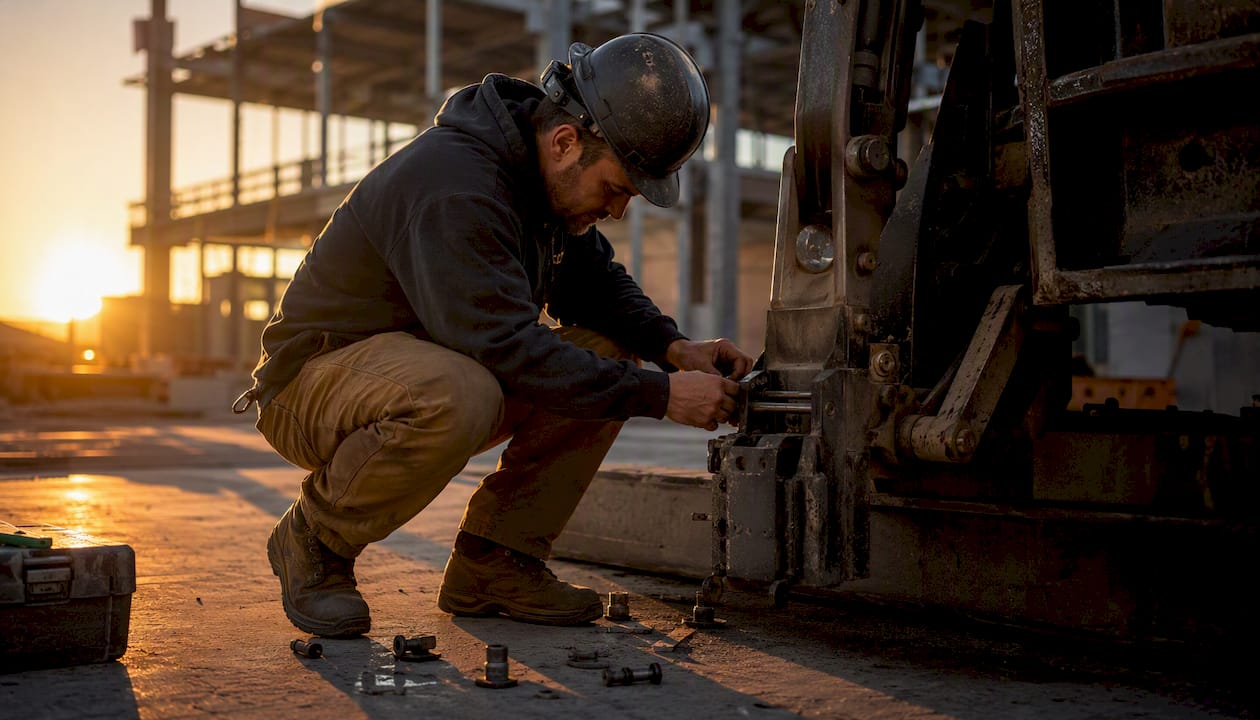
OSHA’s JHA guidance is explicit: involve employees in every phase of the process. That means observation, hazard identification, and control selection, not just the final sign-off. Worker involvement improves hazard detection and increases the likelihood that crews will actually follow the controls.
Prioritizing which jobs to analyze first
Not every job needs a full JHA this week. Use OSHA’s hazard-identification framework to prioritize by severity, likelihood, and number of workers exposed. Rank jobs higher when they meet any of these criteria:
- Injury or illness records show repeated incidents for that task
- A near-miss or close call occurred recently
- The job is new, recently changed, or performed infrequently
- The task requires a permit (confined space, hot work, LOTO)
- High consequence: a single failure could cause a fatality or permanent disability
- Multiple workers are exposed simultaneously
A basic JHA for a well-defined, 6–8 step job typically takes 1–3 hours from observation to completed form. For nonroutine or complex tasks, budget a half day. For high-risk or nonroutine work, a fresh pre-task JHA or a brief Field Level Hazard Assessment (FLHA) at the point of work is best practice before each occurrence.
Pro Tip: Build a one-page priority matrix: list your top 10 jobs by injury frequency and severity, then check which ones already have a current JHA. The gap between those two lists is your 90-day work plan.
How to conduct a job hazard analysis: step-by-step
University EHS programs define the JHA workflow as five repeating stages: select the job, break it into steps, identify hazards, determine controls, and review or update. The field-ready version below adds the documentation and training steps that turn a completed form into lasting change.
-
Select and prioritize the job. Pull injury logs, near-miss reports, and worker input. Choose the job that scores highest on your priority matrix. Confirm the scope: are you analyzing the whole task or a specific phase?
-
Observe the job and break it into steps. Watch at least two workers perform the task under normal conditions. Record each distinct action in sequence, using active language (“climb the ladder,” “connect the hose,” “start the grinder”). Keep the list to 6–10 steps; site-specific guidance recommends staying under 10 steps for most jobs. If the list runs longer, the job likely contains sub-tasks that each need their own JHA.
-
Identify hazards for each step. For every step, ask: What could go wrong here? Who is exposed? What triggers the hazard? What is the worst-case consequence? What conditions make it more likely? Document each hazard as a scenario, not a category. Instead of writing “fall hazard,” write: “Worker climbs 8-foot ladder on uneven concrete; ladder base shifts; worker falls and strikes head on equipment.” That scenario language maps directly to the controls you will select.
-
Evaluate risk. Score each hazard by severity (how bad is the worst outcome?) and likelihood (how often does the exposure occur?). High-severity, high-likelihood hazards get interim controls immediately, before the full JHA is finalized.
-
Select controls using the hierarchy of controls. Work from the top of the hierarchy down. Document the selected control, the person responsible for implementing it, and the target completion date. More on this in the next section.
-
Brief the crew, train, get signatures, and file. Walk affected workers through the completed JHA before they return to the task. Collect signatures as evidence of training. File the original and store a copy at the point of work.
Field observation tips:
- Ask workers: “What’s the hardest part of this step?” and “Has anything ever gone wrong here, even a small thing?”
- Photograph or video the task with worker consent; visuals catch hazards that written notes miss
- Observe the task at the time of day it is normally performed — lighting, fatigue, and traffic patterns change
- Note the tools, equipment, and materials in use, not just the actions
How the hierarchy of controls guides your choices
The hierarchy of controls is the standard framework for selecting the most effective hazard control. It runs from most to least effective:
- Elimination: Remove the hazard entirely. Redesign the process so the dangerous step no longer exists. Example: automate a manual lifting task with a mechanical lift.
- Substitution: Replace the hazardous material or method with a safer one. Example: switch from a solvent-based cleaner to a water-based formula with a lower toxicity rating.
- Engineering controls: Isolate workers from the hazard through physical means. Example: install a machine guard on a rotating shaft; add local exhaust ventilation at a grinding station.
- Administrative controls: Change how work is organized or performed. Example: rotate workers to limit cumulative ergonomic exposure; require a two-person team for overhead lifts above 50 pounds.
- PPE (Personal Protective Equipment): Protect the worker’s body when the hazard cannot be adequately controlled above. Example: cut-resistant gloves for blade handling; hard hat and safety glasses in overhead work zones.
Combinations are often necessary. A grinding operation might require an engineering control (wheel guard), an administrative control (LOTO procedure before changing wheels), and PPE (face shield, hearing protection). The key is to lead with the highest-level control available and use PPE as a supplement, never as the primary defense.
After implementation, verify effectiveness. Observe the task again, ask workers whether the control is working as intended, and document the verification date on the JHA form. UW EHS guidance lists common controls and PPE examples that you can cross-reference when selecting measures for your specific hazard scenarios.
Pro Tip: When documenting control selection, note WHY a higher-level control was not feasible if you had to drop to PPE. That reasoning protects you in an audit and prompts a future review when technology or budget changes.
Where to find JHA templates and how to use them correctly
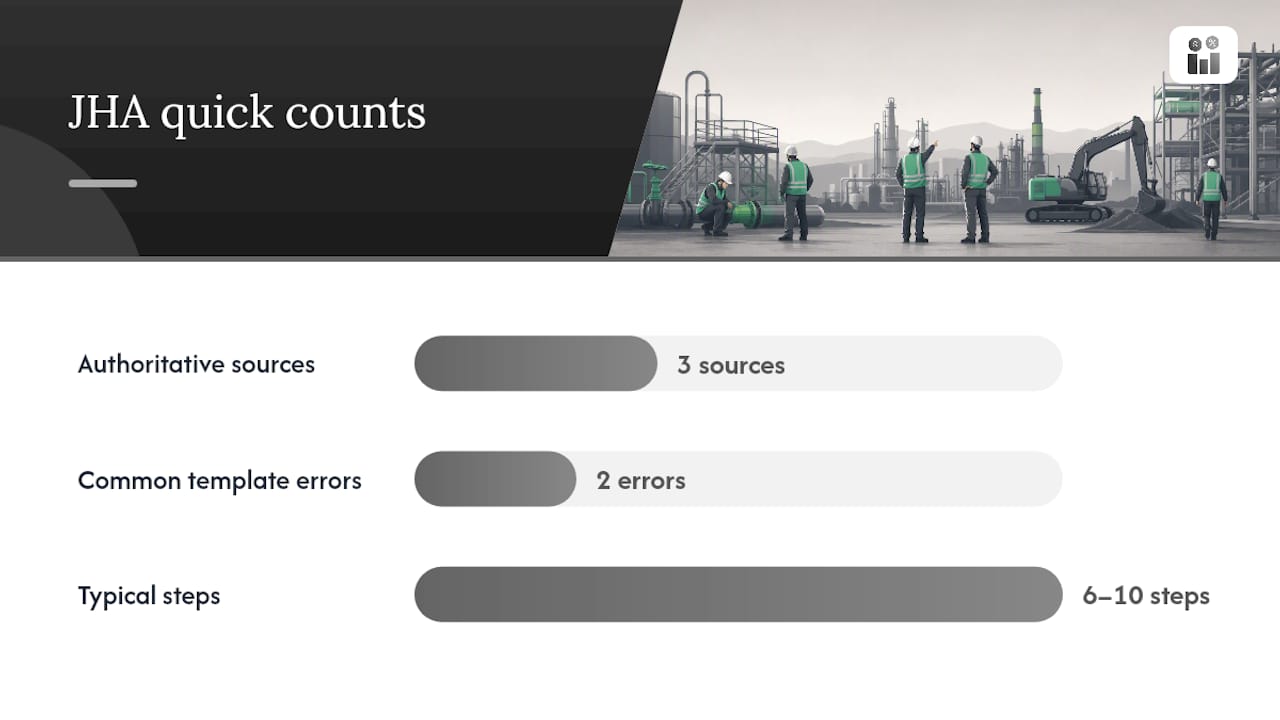
Three authoritative sources cover most U.S. workplaces:
- OSHA Job Hazard Analysis worksheet: A two-page PDF with columns for job steps, hazards, and controls, plus a worked example. Best for supervisors who want a ready-to-use paper form for field observations.
- OSHA JHA template (.docx): An editable Word document for teams that want to customize column headers, add a company logo, or build a digital archive. Adapt the header to include your site name, job title, date, and revision number before distributing.
- NC State EHS JHA guidance: Particularly useful for lab environments and higher-education settings; the form fields map well to chemical and ergonomic hazard categories.
When filling any template, avoid two common errors. First, do not write steps so broadly that a hazard cannot be pinned to a specific action (“perform maintenance” is not a step; “remove the access panel using a flathead screwdriver” is). Second, do not list so many steps that the form becomes unmanageable; most jobs fit cleanly into 6–10 steps.
A short worked example for a facility maintenance task — “Replace overhead fluorescent light fixture”:
- Step 1: Position 8-foot stepladder below fixture. Hazard: Ladder placed on waxed tile; base slides; worker falls from height. Control: Use ladder with rubber feet; have a second worker hold the base; inspect ladder before use.
- Step 2: Disconnect power at the breaker. Hazard: Breaker not locked out; power restored by another worker; electrical shock. Control: Apply LOTO; tag the breaker panel; verify zero energy with a non-contact tester.
- Step 3: Remove old fixture and install new one. Hazard: Sharp edges on fixture housing; lacerations to hands. Control: Wear cut-resistant gloves rated for the task.
UTSA’s JHA resources note that completed JHAs also serve as effective training tools for new employees and for refreshers on infrequently performed tasks, making the investment in a well-documented form pay off repeatedly.
Common hazard categories and control examples
CCOHS categorizes workplace hazards into chemical, ergonomic, physical, psychosocial, biological, and safety categories. Consulting Safety Data Sheets (SDSs), equipment manuals, and incident records helps avoid missing an entire hazard class during your JHA.
| Hazard category | Typical triggers | Control examples | Verification step |
|---|---|---|---|
| Slips, trips, falls | Wet floors, uneven surfaces, overhead work | Non-slip mats, guardrails, fall arrest systems | Post-task walkthrough; inspect anchor points |
| Mechanical | Rotating parts, pinch points, stored energy | Machine guards, LOTO procedure, two-hand controls | Observe lockout before maintenance begins |
| Chemical | Solvent exposure, dust inhalation, skin contact | Substitution, local exhaust ventilation, gloves/respirator | Air monitoring; SDS review at task start |
| Ergonomic | Repetitive motion, awkward posture, heavy lifting | Mechanical assists, job rotation, workstation redesign | Supervisor observation; worker symptom check |
| Electrical | Live circuits, damaged cords, improper grounding | LOTO, GFCI protection, insulated tools | Test before touch; inspect cords pre-shift |
| Psychosocial | Lone worker, time pressure, workplace violence risk | Buddy system, check-in schedule, workplace threat assessment | Incident report review; worker debrief |
For permit-linked hazards, the JHA must connect directly to the permit. A confined space entry JHA should reference the permit number, the atmospheric testing protocol, and the rescue plan. A hot work JHA should specify the fire watch duration and the equipment inspection checklist. If the hazard complexity exceeds your team’s expertise — multi-hazard chemical processes, structural work at height, or tasks with potential for catastrophic release — escalate to a certified industrial hygienist or safety engineer before proceeding.
Industry-specific examples worth noting: facility maintenance teams frequently encounter LOTO and fall hazards simultaneously (rooftop HVAC work); lab workers face chemical and ergonomic hazards in the same pipetting task; field service technicians working in customer facilities must account for site-specific hazards they did not control during the JHA.
How to implement controls, train workers, and keep JHAs current
A completed JHA form is only the starting point. Implementation requires assigned ownership and a clear timeline.
Implementation checklist:
- Assign a named owner for each control action (not “the team” — a specific person)
- Set a target completion date and a follow-up date for verification
- Procure required equipment (guards, PPE, signage) before the task resumes
- Update the relevant SOP or work instruction to reflect new controls
- Notify all affected workers before the next time the task is performed
Training validation: Walk workers through the JHA using teach-back: ask them to explain each hazard and the corresponding control in their own words. Observe the first post-JHA performance of the task and note whether controls are being used correctly. Collect dated signatures on the JHA form as evidence of training completion.
Documentation and recordkeeping: File the original signed JHA in a location accessible to supervisors and auditors. Store a working copy at the point of work. Tag the form with the revision date and the name of the approving manager. Safety management software can centralize JHA storage, link forms to work orders, and trigger review reminders automatically.
Review triggers: Conduct a fresh review of any JHA when the job changes (new equipment, new materials, new location), after any incident or near-miss involving that task, and on a scheduled periodic basis — annually at minimum for high-risk tasks. Pre-task briefings before each occurrence of a nonroutine job are a practical way to keep the JHA active rather than archived.
Integrating JHAs into daily pre-task briefings (toolbox talks) keeps hazard awareness current without requiring a full re-analysis every day. Reference the relevant JHA at the start of each shift for the tasks planned that day.
Why worker involvement and living documents make JHAs work
The most technically complete JHA will fail if workers distrust the process or management ignores the findings. Two practices prevent that outcome.
Worker involvement from the start. Workers who perform a task daily notice hazards that a supervisor observing once will miss: the valve that sticks on cold mornings, the floor drain that backs up after rain, the customer who enters the work area without warning. OSHA’s JHA booklet recommends involving employees in every phase, from observation through control selection. That involvement also builds ownership: workers who helped write the JHA are more likely to follow its controls and flag when conditions change.
Management commitment and visible follow-through. When findings sit unresolved for months, workers conclude that the JHA is a compliance exercise rather than a genuine safety tool. Assign controls to named managers, set public deadlines, and report completion status at safety meetings. That visible follow-through is what separates a functioning safety program from a paper one.
A practical checklist for maintaining JHA value over time:
- Include at least one affected worker in every JHA observation session
- Review and update the JHA whenever the task, equipment, or environment changes
- Tie JHA controls directly into permit-to-work systems for high-risk tasks
- Reference the relevant JHA during every toolbox talk for that task
- Track open control actions in a register with owner names and due dates
Pro Tip: Attach the relevant JHA number to each work order for permit-required tasks. When a technician pulls the work order, they see immediately which JHA applies and whether it has been reviewed within the last 12 months.
Digital assessment platforms can help teams track JHA completion rates, flag overdue reviews, and analyze incident trends against open control actions, turning a paper-based process into a data-driven one.
Authoritative resources and templates
- OSHA Job Hazard Analysis booklet (PDF): The primary U.S. reference; covers the full JHA process, worker involvement, and the hierarchy of controls. Read this first.
- OSHA JHA worksheet (PDF): A ready-to-print two-page form with a worked example. Use it for field observations immediately.
- OSHA JHA template (.docx): Editable Word version for teams building a customized or branded internal template.
- NC State EHS JHA guidance: Detailed form-field guidance suited to lab and higher-education environments; useful for chemical and ergonomic hazard categories.
- UW EHS JHA guidance: Covers the five-stage workflow and lists common controls and PPE examples by hazard type.
- CCOHS hazard identification: Comprehensive hazard category taxonomy; use it as a checklist to confirm you have not missed a hazard class.
When a task involves multiple simultaneous hazard classes, complex chemistry, or potential for catastrophic release, consult a certified industrial hygienist (CIH) or a professional safety engineer before finalizing the JHA. The best compliance management software can also help teams track which tasks require specialist review and document that consultation for audits.
The part of JHA guidance most safety managers get wrong
Most JHA training focuses on the form. Fill in the columns, get the signatures, file it. That is the wrong emphasis, and it produces exactly the shelf documents that OSHA warns against.
The real value of a job hazard analysis is the conversation it forces. When a supervisor sits with two workers and asks “what could go wrong at this step?”, the answers are almost always more specific and more alarming than anything the supervisor would have written alone. The worker who has been doing the task for three years knows that the hoist cable frays at the 40-foot mark, that the relief valve sticks in cold weather, and that the customer’s loading dock is always wet on Tuesday mornings when the cleaning crew finishes. None of that appears on a generic hazard checklist.
The second failure is treating the JHA as a one-time event. Jobs change. Equipment ages. Crews turn over. A JHA written 18 months ago for a task that now uses different equipment is not just outdated — it is actively misleading, because it gives workers false confidence that the hazards have been analyzed. The review trigger system matters as much as the initial analysis.
The third failure is the gap between documented controls and actual practice. If the JHA says workers will use a two-person lift for loads over 50 pounds but supervisors routinely allow solo lifts because it is faster, the JHA is evidence of a known hazard with a known control that was not enforced. That is a worse legal position than having no JHA at all.
The fix for all three: treat the JHA as a management commitment, not a paperwork exercise. Assign controls to named people, verify implementation, and revisit the form whenever something changes. That discipline is what separates organizations with genuinely lower injury rates from those with impressive binders.
Firmanager keeps your JHA program running in the field
Running JHAs across multiple job sites means managing dozens of forms, training records, control action deadlines, and permit links simultaneously. Firmanager’s HSE compliance and document management modules give your safety team one place to store completed JHAs, attach them to work orders, and set automatic review reminders when a task changes or a scheduled review date arrives.

Field technicians access the relevant JHA directly from their mobile portal before starting a task. Supervisors track open control actions, assign owners, and confirm completion without chasing paper. Every signed training record stays linked to the job and the worker, audit-ready at any time. For service businesses managing recurring maintenance, cleaning, or technical field work, Firmanager connects safety documentation to the operational workflow rather than keeping it in a separate binder that no one opens.
Visit Firmanager to see how the HSE compliance and work-order modules work together for your team.
Sources
Recommended
Run your whole business in one place
CRM, quotes, work orders, invoicing, expenses, HR and HSE — one login, every device. Free-forever plan.
Start free →