What is the best compliance management software in 2026?
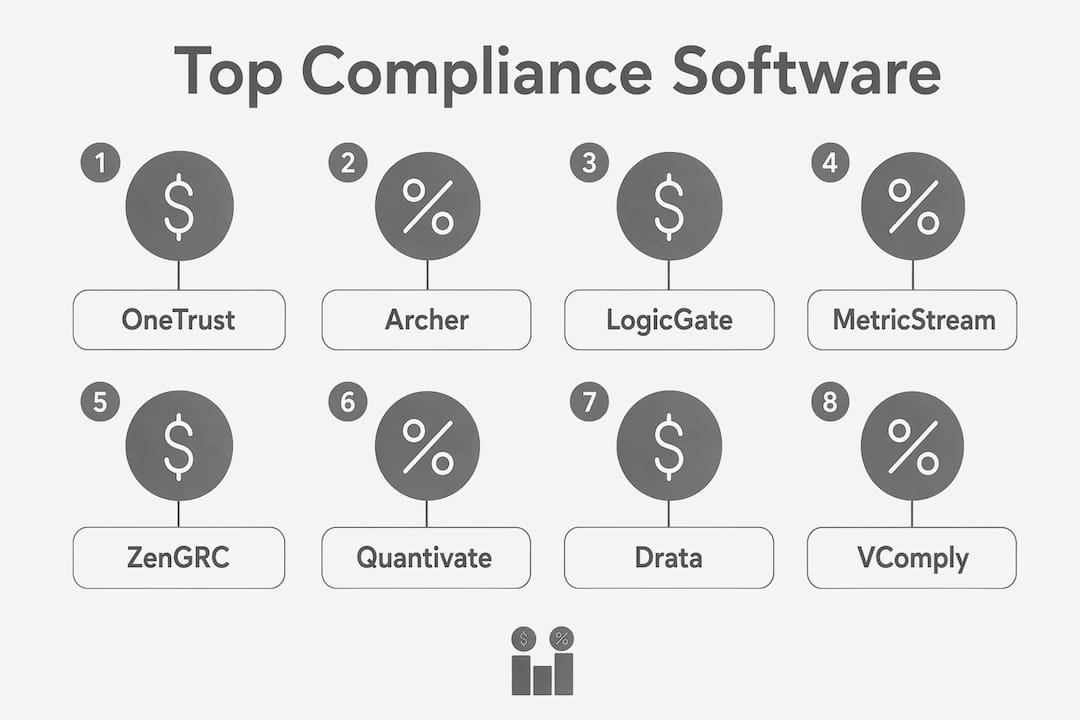
The eight platforms below represent the strongest compliance management software available to U.S. organizations right now. Each one addresses a different organizational profile, from global enterprises managing AI governance to financial institutions building risk maturity programs.
| Platform | Best For | Key Features | AI and Automation | Certifications | Rating |
|---|---|---|---|---|---|
| OneTrust | Enterprises: AI governance and privacy | Privacy automation, data use governance, third-party risk | AI-driven policy enforcement, workflow automation | Gartner Magic Quadrant Visionary 2026 | 4.3★ (55) |
| Archer | Large enterprises: regulatory change | Regulatory change management, audit evidence, control mapping | Compliance automation, audit lineage | Gartner, Forrester, Verdantix leader | 4.5★ (28) |
| LogicGate | Organizations wanting no-code GRC | No-code app development, automated evidence collection, analytics | AI agents for GRC, no-code automation | Gartner MQ Leader, Forrester Wave Leader (28 quarters) | 4.2★ (11) |
| MetricStream | Enterprises: integrated risk intelligence | Enterprise GRC, cybersecurity GRC, third-party risk | AI-first risk intelligence, connected GRC | #1 Enterprise GRC by Chartis, IDC MarketScape Leader | 4.4★ (9) |
| ZenGRC | Organizations wanting all-inclusive pricing | Framework integration (ISO, HIPAA, NIST, PCI), AI assistant GRACI | Agentic AI core automation | ISACA Global Innovation Award 2024 | 4.3★ (6) |
| Quantivate | Financial institutions | ERM, compliance, vendor management, internal audit | Configurable SaaS automation | SOC 2 Type 2 compliant | 5★ (6) |
| Drata | High-growth mid-market companies | Continuous security posture, third-party risk, agentic trust | Autonomous AI agents | — | 3★ (4) |
| VComply | Businesses replacing manual tracking | Control mapping, task tracking, audit-ready reporting, built-in frameworks | AI-powered alerts and automation | G2 4.8/5 | 3.7★ (3) |
Standout qualities at a glance:
- OneTrust: Named a Visionary in the 2026 Gartner Magic Quadrant for AI Governance Platforms
- Archer: Full audit lineage with regulatory intelligence across enterprise programs
- LogicGate: Leader recognized by G2 for 28 consecutive quarters
- MetricStream: Ranked #1 Enterprise GRC by Chartis Research across seven GRC categories
- ZenGRC: First GRC platform to embed agentic AI core automation; ISACA award winner
- Quantivate: SOC 2 Type 2 certified with deep financial services specialization
- Drata: Pioneer in autonomous AI agents for real-time compliance monitoring
- VComply: Built-in frameworks including ISO, SEC, and OSHA with automated alerts
How these platforms were selected and evaluated
Every platform on this list was assessed against a consistent set of criteria. No vendor paid for placement.
Evaluation criteria used:
- AI and automation capabilities: Does the platform automate evidence collection, control testing, and workflow routing without manual intervention?
- Integration depth: How many native API connections does the platform offer to cloud services, SaaS tools, and enterprise systems?
- Compliance framework coverage: Does it support the frameworks your organization actually needs (SOC 2, ISO 27001, HIPAA, NIST, PCI, GDPR)?
- User interface and no-code configurability: Can compliance officers update workflows without filing IT tickets?
- Scalability: Does the platform grow with your organization's regulatory footprint?
- Pricing transparency: Are costs predictable, or do hidden modules inflate total cost of ownership?
Data sources consulted:
- Gartner Magic Quadrant and Gartner Peer Insights for GRC tools
- Forrester Wave for GRC Platforms Q2 2026
- Chartis Research GRC rankings
- ISACA award records
- Vendor-published certifications and positioning statements
- G2 and independent user review aggregates
Weighting favored platforms with genuine automation depth, continuous compliance support, and verifiable third-party recognition.
How the compliance software market has shifted in 2026
The compliance software market has moved decisively away from annual audit cycles. Continuous compliance through automated evidence collection is now the baseline expectation, not a premium feature.
Three forces are driving this shift:
- Agentic trust platforms: According to Forrester's Q2 2026 GRC Wave, agentic trust platforms that autonomously manage compliance tasks represent the frontier of GRC innovation, backed by strong vendor R&D and deep integration capabilities.
- Single source of truth: Control mapping across multiple regulatory frameworks lets organizations map internal controls once and apply them across overlapping requirements, cutting redundant audit work.
- Automation impact: IBM's case study with CNP Vita Assicura showed 70% reduction in manual data entry after deploying compliance automation, a figure that reflects what leading platforms now deliver at scale.
The platforms that win in 2026 treat compliance as a continuous operational function, not a periodic checkbox exercise.
Detailed profiles of the top compliance management software platforms
Each platform below serves a distinct organizational need. Depth of coverage reflects the substance each vendor brings to the table.
Pro Tip: Before evaluating any platform, map your top three regulatory frameworks and confirm the vendor supports them natively. Integration depth matters more than feature count: without native API connections, automated evidence collection often reverts to manual uploads despite the vendor's automation claims.
OneTrust is built for enterprises that need to govern AI, privacy, and data compliance from a single platform. Its real-time policy enforcement and third-party management automation make it a strong fit for global brands managing GDPR, CCPA, and AI governance simultaneously.

Archer (Archer Evolv) handles the complexity of regulatory change at enterprise scale. Its audit lineage capability means every compliance decision is traceable, which matters when regulators ask for documentation history rather than just current status.
LogicGate stands out for teams that need to build custom GRC workflows without writing code. Its no-code application development environment lets compliance officers configure risk assessments, audit workflows, and reporting dashboards independently. That no-code configurability directly reduces IT dependency and accelerates adaptation to new regulations.

MetricStream connects risk intelligence across the enterprise with its AI-first Connected GRC platform. Chartis Research ranks it #1 in Enterprise GRC, and its coverage spans cybersecurity GRC, third-party risk, and operational resilience in one system.
ZenGRC takes a different approach to pricing: one flat, all-inclusive rate with no hidden module costs. Its AI assistant, GRACI, performs analyst-level work on audit and compliance tasks. The ISACA Global Innovation Award 2024 reflects the platform's technical credibility in the GRC community.
Quantivate is the clearest choice for banks and credit unions. Its SOC 2 Type 2 certification and financial-services-specific configuration options address the regulatory environment that community financial institutions face, including vendor management and operational resilience requirements.
Drata uses autonomous AI agents to monitor security posture and compliance status continuously across frameworks. It suits high-growth mid-market companies that need to manage multiple frameworks simultaneously without building a large compliance team.
VComply replaces spreadsheet-based compliance tracking with structured control mapping, automated task assignment, and audit-ready reporting. Built-in frameworks covering ISO, SEC, and OSHA make it accessible for organizations that are formalizing compliance programs for the first time.
How to choose the right compliance software for your organization
Selecting the right platform starts with knowing what your organization actually needs, not what a vendor's demo shows you.
Key questions to ask every vendor:
- Which of our specific regulatory frameworks do you support natively, and how often are they updated?
- What does your API integration library cover, and how many connections require custom development?
- How does your platform handle evidence collection: automated, semi-automated, or manual upload?
- What does implementation typically take, and what internal resources do we need to commit?
- How is pricing structured: per user, per module, or all-inclusive?
Pricing and total cost of ownership:
ZenGRC publishes simple all-inclusive pricing. Most other platforms in this comparison use tiered or custom enterprise pricing, which means your total cost of ownership depends heavily on seat count, module selection, and integration requirements. Always request a total cost projection that includes implementation, training, and ongoing support.
Common pitfalls to avoid:
- Choosing a platform based on feature lists without confirming integration depth with your existing cloud stack
- Treating implementation as a one-time IT project rather than a change management program involving compliance officers, legal, and operations
- Selecting a "set it and forget it" solution that lacks real-time monitoring; static compliance tools leave gaps that regulators find
Implementation timeline expectations:
Most enterprise GRC platforms require 3–6 months for full deployment, including configuration, integration, and user training. Platforms with no-code configurability, like LogicGate and ZenGRC, tend to shorten that timeline because compliance teams can self-configure workflows without waiting on IT.
Pro Tip: Involve your compliance officers in the platform selection process from day one. Platforms with no-code workflow configuration give compliance teams direct control over how the system adapts to regulatory changes, which reduces bottlenecks and keeps your program current.
Emerging compliance approaches reshaping service industries in 2026
Service industry organizations face a specific challenge: compliance is no longer just an IT or legal function. It touches operations, field teams, vendors, and customer interactions.
Four shifts are redefining how service companies approach compliance management:
- Cultural change beyond IT: Compliance programs that succeed in 2026 require buy-in from operations, HR, and frontline managers, not just the legal and IT departments. Platforms that offer role-based dashboards and mobile access accelerate that cultural adoption.
- Continuous automated evidence collection: The shift from annual audits to continuous, automated evidence collection means organizations maintain audit readiness year-round rather than scrambling before an audit date.
- AI real-time risk monitoring: Platforms with AI-driven monitoring flag control failures as they happen. For service companies managing workplace safety compliance and OSHA requirements, real-time alerts prevent incidents rather than document them after the fact.
- Deep cloud ecosystem integrations: Without native API connections to the cloud tools your teams already use, automation claims often fall short. Verify integration depth before committing to any platform.
Key Takeaways
The strongest compliance management software platforms in 2026 combine AI-driven automation, continuous evidence collection, and deep cloud integrations to replace manual, audit-cycle-dependent compliance programs.
| Point | Details |
|---|---|
| AI automation is the baseline | Platforms without autonomous evidence collection and real-time monitoring are already behind the 2026 standard. |
| Integration depth determines real value | Native API connections to your cloud stack separate genuine automation from manual-upload workflows in disguise. |
| Automation reduces manual effort | IBM's CNP Vita Assicura case study recorded a 70% reduction in manual data entry after deploying compliance automation. |
| Match platform to your profile | Financial institutions fit Quantivate; enterprises managing AI governance fit OneTrust; no-code-first teams fit LogicGate or ZenGRC. |
| Firmanager for service operations | Firmanager offers HSE compliance, work order tracking, and real-time dashboards built for service businesses managing day-to-day operational compliance. |
Firmanager covers the compliance gap most GRC platforms miss
The platforms compared above are purpose-built for enterprise GRC programs. They excel at regulatory frameworks, audit management, and risk intelligence at scale. What they don't cover is the operational layer where service businesses actually run: field work orders, HSE compliance, vendor management, and workforce tracking.
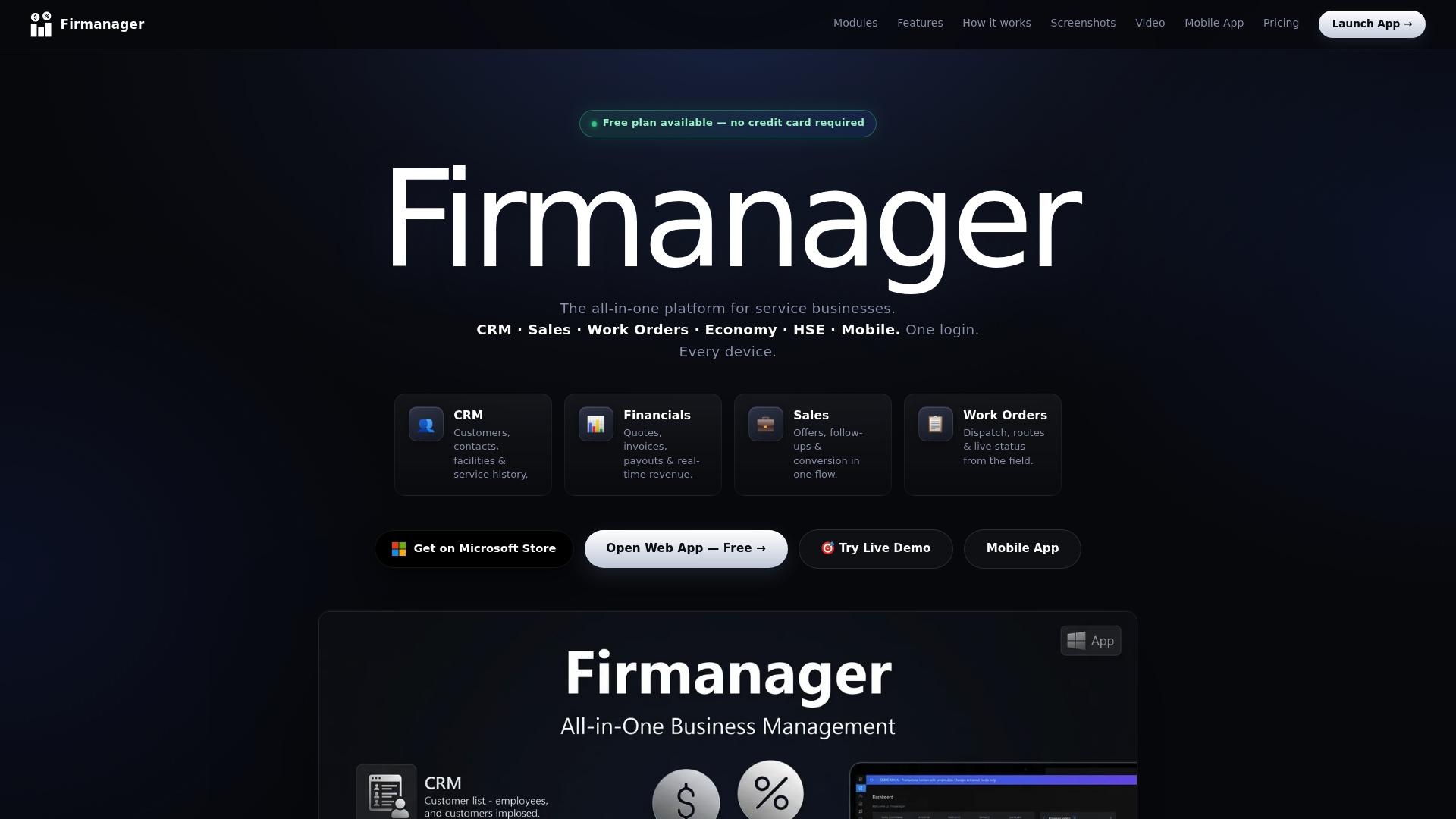
Firmanager is built specifically for service companies that need operational compliance tools alongside their day-to-day business management. It combines HSE compliance tracking, work order management, supplier management, real-time dashboards, and employee self-service into one platform, without the enterprise GRC price tag or the months-long implementation timeline. If your compliance needs live closer to the field than the boardroom, Firmanager offers a practical alternative worth evaluating alongside the platforms above. You can also explore how safety management software and facility management tools fit into a broader compliance strategy for service operations.