5 Questions Before Choosing Real Time Data Sync for Service Teams

5 Questions Before Choosing Real Time Data Sync for Service Teams
Real-time data synchronization keeps systems consistent by applying updates as they occur, typically aiming for sub-second to low-second latency. It matters most where a stale record causes a bad decision: fraud checks, dispatch, pricing, or inventory. If a few minutes of delay does not change what anyone does next, batch processing is cheaper and simpler.
TL;DR:
- Use CDC when downstream systems need every database insert, update, and delete; pub/sub suits many independent consumers, while replication best serves simple database copies.
- Choose hub and spoke when centralized conflict rules matter, but use event driven designs for active active writes only if teams can manage eventual consistency.
- Set an SLO such as under two seconds for 95% of events, then track tail latency, pipeline lag, failures, retries, and connector errors.
- Use real time only when minutes of delay change an immediate decision; otherwise, batch jobs cost less, and nightly reconciliation can catch stream misses.
Table of Contents
- Core technical methods: CDC, pub/sub, and replication
- Architectures and topologies: hub-and-spoke, event-driven, and hybrid
- Implementation checklist and operational controls
- When to pick real-time vs batch: a practical decision guide
- Common use cases and patterns
- How Firmanager applies cloud-synced data to service operations
- Security implications and data privacy considerations
- Data consistency models and their impact on system design
- Scalability challenges and strategies
- Impact of network conditions and fault tolerance
- Tools and platforms for real-time data synchronization
- Operational perspective: governance and rollout advice
- Firmanager: real-time sync built for service teams
- FAQ
- Sources
Core technical methods: CDC, pub/sub, and replication
Three approaches cover most real-time sync needs, and most production systems end up combining them rather than picking just one.
Change Data Capture (CDC) reads a database’s transaction log and emits every insert, update, and delete as a discrete event, without querying the source tables directly. Tools like Google Cloud Datastream read logs from supported databases and deliver changes downstream with minimal impact on the source system, which makes CDC efficient for high-volume operational databases feeding analytics or replicas. Because it works from the log rather than application code, CDC also captures changes that bypass your API, including manual fixes and bulk loads.
Pub/sub and event streaming distribute change events to any number of subscribers through a broker. Patterns like Ably LiveSync stream database changes to clients in order, removing the need for polling and giving each consumer control over how it processes the stream. This model fits scenarios with many independent consumers: a mobile app, a search index, and a reporting warehouse all reading the same event feed without coupling to each other.
Replication, including logical replication, copies data at the storage layer rather than emitting discrete business events. It is faster to set up for simple database-to-database copies but offers less flexibility for transforming data in flight or feeding non-database consumers.
Connector choice matters as much as the method:
- Agentless capture (log-based CDC) avoids installing software on source servers and reduces operational load, per Google Cloud’s Datastream documentation.
- Agent-based capture runs collectors on the source host, which can add overhead but sometimes supports databases without native log access.
- Connector maturity varies widely by database engine, so test failover and schema-change handling before committing to one.
Architectures and topologies: hub-and-spoke, event-driven, and hybrid
Topology decides where conflicts surface and how much operational complexity you take on.
Hub-and-spoke routes every sync through a central authority. Microsoft’s SQL Data Sync uses this model with sync groups and bi-directional sync, applying conflict policies such as “hub wins” or “member wins.” It simplifies governance because one place enforces the rules, but it introduces a single point of constraint: if the hub slows down or fails, every spoke feels it.
Event-driven streaming removes the central bottleneck by letting services publish and subscribe to a shared event bus. This supports active-active setups where multiple regions or services write simultaneously, and it scales horizontally far more easily than a hub model. The trade-off is that conflict resolution moves from one place to many, and you need strong eventual-consistency handling because no single node has the final word at write time.
Hybrid models keep one system as the authoritative writer for a given entity while publishing its changes to an event bus for everyone else to consume. This gets you a clear source of truth without forcing every consumer through a central sync service.
Topology choice drives two downstream decisions:
- Conflict resolution policy: centralized models can rely on simple rules; distributed models often need versioning or merge logic.
- Monitoring footprint: hub-and-spoke concentrates monitoring on one component, while event-driven designs require tracing across every consumer and the broker itself.
Implementation checklist and operational controls
Real-time sync is not “set and forget.” Operational guidance from Serverion stresses that silent failures in a sync pipeline create data drift that can go unnoticed for days, so monitoring and alerting deserve as much attention as the sync mechanism itself.
- Set latency SLOs before launch. Define a target (say, under two seconds for 95% of events) and measure tail latencies, not just averages, since the slowest 1% often reveals the real risk.
- Pick a conflict resolution policy up front. Last-writer-wins is simple but can silently drop updates; causal versioning (vector clocks or sequence numbers) preserves ordering; merge logic (combining fields from both versions) fits collaborative data but adds code complexity.
- Track the right metrics. Pipeline lag, sync failure rate, inflight retry counts, and error rate per connector are the core four, per Serverion’s operational practices.
- Automate remediation where possible. Auto-retry transient failures, page a human for sustained lag, and build a kill switch to pause a misbehaving connector.
- Plan the initial load separately from steady-state sync. A safe pattern: take a consistent snapshot, record its offset, start CDC capture from that offset, replay events until caught up, then cut readers over to the live stream, a sequence outlined in Tencent Cloud’s sync documentation.
Teams that track these metrics well often borrow dashboard patterns from operational analytics guides built for surfacing exceptions quickly.
Pro Tip: Alert on sync lag trend, not just threshold breaches: a connector climbing steadily toward its limit is easier to fix before it fails than after.
When to pick real-time vs batch: a practical decision guide
Real-time sync earns its complexity when a delay changes what someone does next: a dispatcher routing a technician, a shopper seeing stock that is actually available, or a fraud check running against a current balance. Batch processing remains the right default for reporting, archival, and anything reviewed on a daily or weekly cycle.
Cost and engineering effort scale with how close to instant you need to be. Running message brokers, monitoring pipelines, and on-call rotations for a connector costs more in infrastructure and people-hours than a nightly job, so the business trigger has to justify it.
A hybrid pattern often splits the difference: near-real-time pushes for the handful of fields that matter (status, availability, balance) alongside batch reconciliation overnight to catch anything the stream missed.
Ask these five questions before committing to real-time:
- Does a delay of minutes change a decision someone makes right now?
- Can the business tolerate occasional data drift between syncs?
- Do you have the operational capacity to monitor a live pipeline around the clock?
- Is the data volume and change rate high enough to justify streaming infrastructure?
- Would a scheduled job plus a nightly reconciliation meet the actual requirement?
Common use cases and patterns
Different workloads lean on different parts of the sync stack.
Operational analytics and dashboards pull from change streams rather than querying production databases directly, which keeps reporting current without adding load to transactional systems. CDC feeding a warehouse is the standard pattern here, and dashboards built on these feeds work best when they surface exceptions rather than raw totals, a design approach covered in field service dashboard guidance.
Multi-site inventory sync depends on real-time updates to avoid stockouts and overselling across locations or channels. A sale at one site needs to reduce the count everywhere else within seconds, not at the next nightly batch.
Collaborative apps use real-time sync to keep UI state consistent across multiple users editing the same document or board. Pub/sub patterns fit naturally here because every connected client needs the same event stream in the same order.
Streaming feature stores for ML inference rely on real-time sync to keep the features a model sees at prediction time aligned with the latest data, which matters for fraud detection, recommendation, and any model making decisions against live state rather than a historical snapshot.
Each of these patterns shares a common requirement: the sync layer has to be observable enough that a stalled feed gets caught before it causes a bad decision downstream, whether that decision is a dashboard number, an oversold item, or a model’s output.

How Firmanager applies cloud-synced data to service operations
Field service work depends on the same principle: a dispatcher, technician, and invoice clerk all need the same record at the same time. We designed the platform so dispatch, work orders, inventory, and invoicing stay synced across devices through one login, which matters when a technician updates a job status from a phone and the office needs to see it immediately, not after a sync window.
The platform connects these modules through a single data layer rather than bolting separate tools together, so a work order update flows into invoicing and reporting without a manual export step. For teams evaluating how this fits their own stack, our SLA tracking guidance and service contract tracking resources cover how synchronized data supports day-to-day accountability.
Security implications and data privacy considerations
Real-time sync moves data continuously, which means every connector, broker, and consumer is a point where sensitive fields can leak if access controls are loose. Encrypt data in transit between every hop, not just at the source and final destination, since a compromised intermediate consumer is a common failure point in multi-hop architectures.
Access control needs to apply at the event level, not just the database level: a pub/sub topic carrying customer records should restrict subscribers the same way a database table would, and changes to who can subscribe deserve the same review as changes to database permissions.
Providers handling customer data as part of a sync pipeline should carry independent attestations. AICPA SOC guidance outlines the controls and reporting relevant when a third party processes or stores data on your behalf, which is worth checking before routing sensitive fields through any external sync service.
Retention and deletion also get harder with real-time sync, because a record deleted at the source needs its deletion propagated everywhere it was copied, not just marked inactive in one place. Build deletion events into your pipeline design from the start rather than retrofitting them after a privacy request forces the issue.
Data consistency models and their impact on system design
Every real-time sync system makes a choice between strong consistency and eventual consistency, and that choice shapes everything downstream.
Strong consistency guarantees that once a write succeeds, every subsequent read sees it, anywhere in the system. It is simpler to reason about but harder to scale across regions, since coordinating every read and write adds latency.
Eventual consistency allows a brief window where different parts of the system disagree before converging on the same value. It scales more easily and tolerates network partitions better, but it pushes complexity onto the application layer, which has to handle the possibility that two reads a second apart return different answers.
Hub-and-spoke topologies, like Microsoft’s SQL Data Sync, lean toward stronger consistency because one hub arbitrates conflicts centrally, though the documentation notes it does not guarantee full transactional consistency even then. Event-driven architectures lean toward eventual consistency by design, trading a small window of disagreement for the ability to scale writes across many nodes at once.
The right choice depends on what a stale read costs you. A bank balance needs strong consistency. A product view count does not.
Scalability challenges and strategies
Sync pipelines that work fine at low volume often buckle under peak load, usually at one of three points: the capture layer, the broker, and the consumers.
Capture layer bottlenecks show up when a single CDC connector cannot keep up with the source database’s write rate. Partitioning the capture by table or shard spreads the load across multiple connectors instead of one.
Broker throughput limits appear when the message volume outpaces what a single broker instance can route. Horizontally scaling the broker and partitioning topics by key (customer ID, region, or entity type) lets you add capacity without a full redesign.
Consumer lag happens when a downstream system processes events slower than they arrive, and the backlog grows until something runs out of memory or disk. Autoscaling consumer instances based on queue depth, and building consumers that can catch up quickly after a pause, keeps lag from compounding during traffic spikes.
The practical strategy is to load-test each layer independently before launch, since a pipeline that handles steady traffic fine can still fail during a spike if any single layer was sized for the average case rather than the peak.

Impact of network conditions and fault tolerance
Real-time sync assumes a network connection that is available and fast, and production networks are neither all the time. A pipeline that only works under ideal conditions will fail in exactly the moments it matters most.
Retries with exponential backoff handle transient network blips without hammering a struggling connector. Idempotent event processing, where replaying the same event twice produces the same result, protects against duplicate delivery during a retry, which is common in at-least-once delivery systems.
Dead-letter queues catch events that fail processing repeatedly, so one bad record does not block the entire stream behind it. Circuit breakers that pause a connector after repeated failures, rather than retrying indefinitely, prevent a struggling downstream system from being overwhelmed by a backlog it cannot process.
For distributed deployments, regional failover matters: if a sync node in one region goes down, traffic needs a path to a healthy node without losing events in between. This is where the offset-based replay pattern, recording where a consumer left off, earns its complexity, since it lets a recovered node resume exactly where it stopped rather than reprocessing everything or skipping gaps.
Tools and platforms for real-time data synchronization
The landscape splits roughly into three categories. Managed CDC and streaming services, such as Google Cloud Datastream, read database logs and deliver changes to targets like data warehouses with minimal source-side overhead, which suits teams that want near-real-time analytics without managing connector infrastructure themselves.
Database-native sync tools, like Microsoft’s SQL Data Sync, work within a single database ecosystem and favor hub-and-spoke topology with built-in conflict policies, a good fit when every system you are syncing runs on the same database platform.
Pub/sub and realtime messaging platforms, such as Ably LiveSync, stream changes directly to client applications in order, which fits collaborative apps and live UI state more than warehouse analytics.
Choosing among them comes down to where your data lives and who the consumer is: a warehouse-bound analytics pipeline fits CDC-to-streaming tools, a same-platform database mirror fits native sync tools, and a live multi-user application fits pub/sub messaging.
Operational perspective: governance and rollout advice
The teams that run real-time sync reliably treat it as a service with an owner, not a one-time integration project. That means a runbook for common failure modes, clear on-call ownership, and a regular review of incidents against the latency SLO, patterns covered in our mean time to repair guidance.
Start with one pipeline, measure its lag and failure rate for a real operational cycle, then expand. Teams that roll out sync across every system at once rarely have the monitoring maturity to catch problems before they compound.
— KaiosMedia
Firmanager: real-time sync built for service teams
We built Firmanager around the same principle this guide covers: synchronized data only helps if it reaches the people making decisions fast enough to matter. Our platform keeps dispatch, work orders, inventory, and invoicing cloud-synced across devices through a single login, so a status change in the field shows up in the office without a manual refresh.
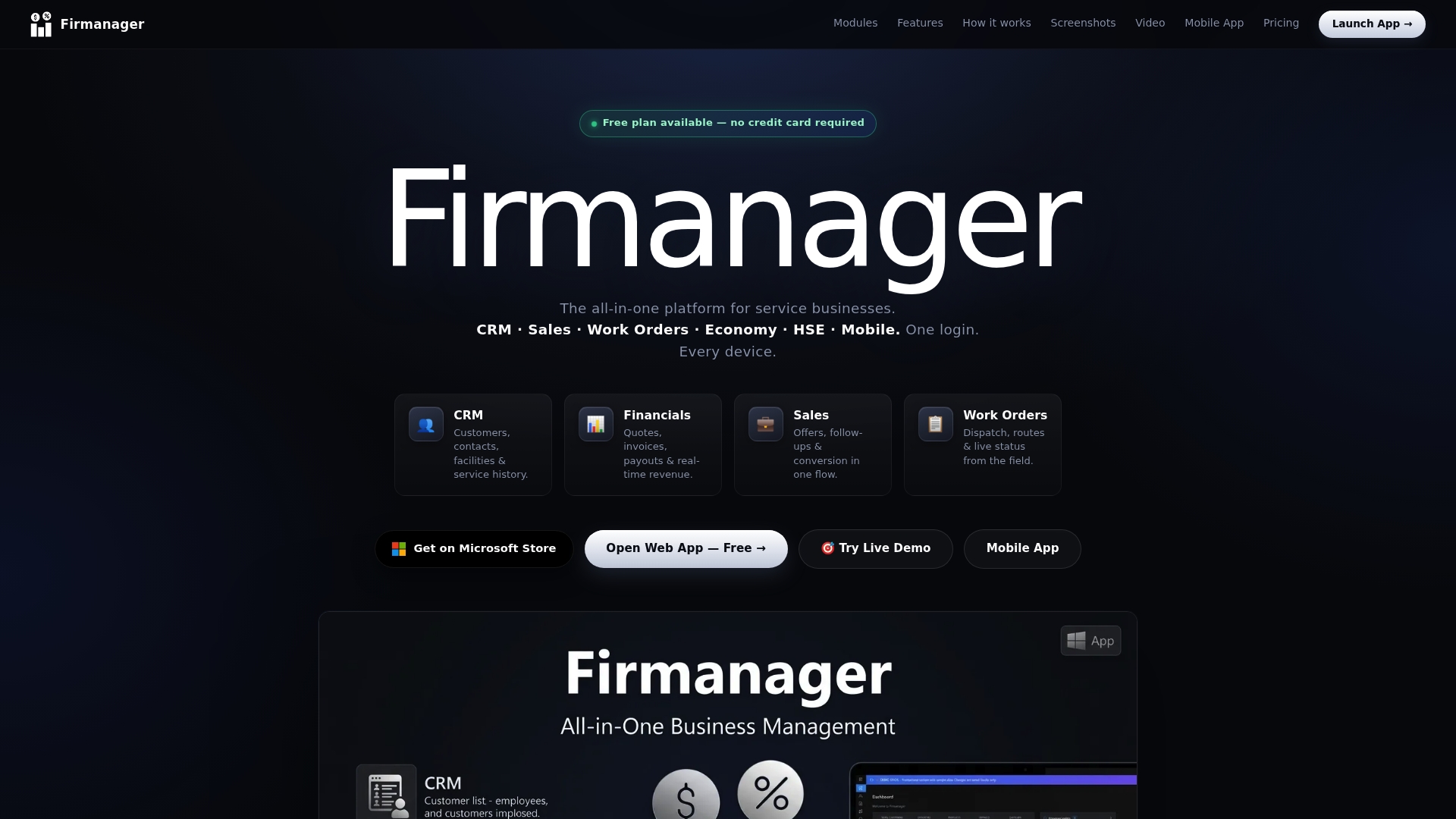
If you are evaluating a platform for this, check how it handles APIs, webhook support, and mobile offline sync, since those three determine whether real-time really means real-time once a technician loses signal mid-job. Our Free, Pro, and Business plans scale from a small team testing the fit to a full operation running every module. Start with the free tier to see how synchronized data changes your daily workflow.
FAQ
What does “real-time sync” mean?
Real-time sync means updates apply automatically the moment a change happens, typically within sub-second to low-second latency. It contrasts with batch processing, which applies changes on a fixed schedule like hourly or nightly.
Should my sync be on or off?
Turn real-time sync on when a delay would change what someone does next, like dispatch, inventory, or fraud checks. Leave it off, and use scheduled batch jobs instead, for reporting or archival data that nobody acts on within minutes.
What are examples of real-time data?
Common examples include live inventory counts across store locations, a technician’s job status updating in the field, stock prices, and fraud detection signals checked against a current account balance. Each depends on freshness measured in seconds rather than hours.
What does data sync do?
Data sync keeps two or more systems consistent by propagating changes from one to the others, whether through change data capture, pub/sub messaging, or database replication. The goal is that every system reflects the same current state instead of drifting apart over time.
Sources
- What Is Data synchronization? | IBM
- SQL Data Sync documentation | Microsoft Learn
- Datastream | Google Cloud
- Top 7 practices for real-time data synchronization | Serverion
- Ably LiveSync
Recommended
Run your whole business in one place
CRM, quotes, work orders, invoicing, expenses, HR and HSE — one login, every device. Free-forever plan.
Start free →