What is the best work order software in 2026?
The strongest work order management software options in 2026 are Fiix CMMS by Rockwell Automation, Connecteam, eMaint, and eWorkOrders, each leading in a distinct use case. Fiix stands out for asset-linked maintenance at scale, Connecteam for deskless team coordination, eMaint for analytics-driven uptime, and eWorkOrders for fast deployment with unlimited users. The right pick depends on your team size, asset complexity, and how quickly you need to go live.
| Software | Best For | Key Features | Mobile Support | Industry Specialization | Rating |
|---|---|---|---|---|---|
| Connecteam | Deskless team scheduling and communication | Scheduling, time tracking, internal comms, HR tools | iOS, Android | Construction, field services, healthcare, retail | 4.7★ (1,500+) |
| Fiix CMMS by Rockwell Automation | Scalable asset and inventory maintenance | AI-powered work orders, asset tracking, inventory, analytics | iOS, Android | Multi-industry maintenance | 4★ (29) |
| MobiWork | Field service scheduling and dispatch | Work order management, scheduling, dispatching | iOS, Android | Field services | 5★ (16) |
| eMaint | Cloud-connected uptime and reporting | Asset management, work orders, spare parts, analytics | iOS, Android | CMMS, EAM, IIoT | 4.7★ (10) |
| Service Pro® by MSI Data, LLC | Heavy equipment and industrial field service | Asset-centric scheduling, dispatch, analytics | iOS, Android | Heavy equipment, HVAC, energy, construction | 3.5★ (6) |
| eWorkOrders | Fast deployment with unlimited users | Cloud work orders, preventive maintenance, asset tracking, KPI dashboards | iOS, Android | Manufacturing, healthcare, facilities | 5★ (5) |
| PRO Software Solutions | Customizable multi-industry maintenance | Work order and maintenance management, support services | iOS, Android | Diverse industries | 5★ (5) |
| FMX | Facility maintenance scheduling | Scheduling, reporting, communication tools | iOS, Android | Facilities management | 5★ (5) |
Trust signals matter here. Fiix CMMS is trusted by over 4,500 maintenance teams and holds SOC 2 Type 2 compliance with an "A" security rating. Connecteam carries a 4.7-star rating on Capterra across more than 1,500 reviews, plus 4.8 stars on the App Store from over 41,000 ratings. eWorkOrders earned over 120 industry recognitions in 2025 and is a 2026 Category Leader in Maintenance Management per G2, Capterra, and Software Advice.

How to choose the best work order software for your team
Your team's current maturity level is the first filter. Simpler mobile-first tools outperform complex enterprise systems for teams still dealing with missed requests or low adoption. If your crew is already tracking assets and running preventive maintenance schedules, a full CMMS with inventory and analytics integration will serve you better long-term.
Key factors to evaluate before you commit:
- Team size and user model. Some platforms charge per technician seat; others offer unlimited requester seats so anyone in the organization can submit a request without adding cost.
- Asset integration. Work order tools that connect directly to asset records give technicians repair history, warranty status, and parts data at the point of work.
- Mobile accessibility. Field teams need offline capability, push notifications, and the ability to close out a job from their phone without returning to a desk.
- Scalability. Choosing a scalable CMMS over a standalone work order tool prevents costly data migration later and supports future needs like predictive maintenance and inventory control.
- Implementation timeline. Single-site teams typically go live in under 30 days with mobile-first platforms; multi-site enterprise deployments with integrations can take 60–90 days.
- Vendor support and training. Ask vendors specifically about data import assistance, onboarding support, and whether training is included or billed separately.
- Pricing model. Confirm whether pricing is per user, per site, or a flat subscription, and whether requester or guest seats carry an additional charge.
Pro Tip: Before you demo any platform, write down your three most common work order failure points, whether that is lost tickets, slow dispatch, or missing asset history. Use those as your test scenarios during the vendor call.
In-depth profiles of the best work order software solutions
Connecteam
Connecteam targets operations with large deskless workforces spread across multiple locations. Its strength is combining scheduling, time tracking, internal communication, and HR tools in a single app, which reduces the number of separate platforms a manager has to maintain. It covers industries from construction and field services to healthcare and retail, making it one of the most versatile options on this list. A 14-day free trial is available; specific plan pricing is not publicly listed.
Fiix CMMS by Rockwell Automation
Fiix is purpose-built for maintenance teams that need asset and inventory data tied directly to every work order. Its AI-powered management capabilities help prioritize jobs and surface patterns across large asset fleets. The SOC 2 Type 2 compliance and "A" security rating make it a credible choice for organizations in regulated industries where data security is non-negotiable. Pricing details are available through their site.

MobiWork
MobiWork focuses tightly on field service operations: work order creation, technician scheduling, and dispatch. Its "Proven & Top Rated" recognition reflects a track record in field service environments where speed of dispatch and job completion accuracy drive customer satisfaction. It suits mid-size field service companies that need reliable scheduling without the overhead of a full enterprise CMMS.
eMaint
eMaint has earned a Gartner Peer Insights Award and consistently ranks highly on Capterra, Software Advice, and G2. Its cloud ecosystem connects asset management, work orders, spare parts inventory, and analytics in one platform, with a focus on maximizing equipment uptime. Teams that need detailed reporting to justify maintenance spend will find eMaint's analytics layer particularly useful.
Pro Tip: When evaluating eMaint or any analytics-heavy platform, ask the vendor to show you a sample uptime or mean-time-to-repair report using data from a comparable industry. Generic demos rarely reveal how the reporting performs on your actual asset types.
Service Pro® by MSI Data, LLC
Service Pro® is the clearest specialist on this list. It targets heavy equipment, HVAC, energy and utilities, construction, and industrial sectors with an asset-centric approach that ties scheduling, dispatch, and analytics to specific equipment records. Organizations in those verticals with complex asset portfolios will get more relevant functionality here than from a general-purpose work order tool.
eWorkOrders
eWorkOrders deploys fast, often within 24–48 hours, and charges a flat subscription with unlimited users rather than per-seat pricing. That model works well for facilities and manufacturing teams where many staff members need to submit requests but only a smaller group actively manages and closes work orders. Its cloud platform covers preventive maintenance triggers, asset lifecycle tracking, KPI dashboards, and AI-assisted maintenance tools.
PRO Software Solutions
PRO Software Solutions offers broad maintenance and work order management capability designed to adapt across industries. Its positioning centers on customization and support services, making it a reasonable fit for organizations with non-standard workflows that need a vendor willing to configure the platform to their process rather than the other way around.
FMX
FMX prioritizes ease of use and is built specifically for facilities management teams. Its scheduling and real-time reporting features are accessible to non-technical staff, and its communication tools keep requesters and technicians aligned without requiring training. For school districts, municipal facilities, or property management teams that need a low-friction solution, FMX is worth a close look.
Why asset management integration determines long-term value
Work order tools that operate independently from asset records create information gaps that reduce repair effectiveness. When work orders are disconnected from asset data, technicians arrive at a job without warranty status, maintenance history, or related fault patterns, which forces guesswork and increases the chance of a repeat failure. The integration between work orders and asset management is what separates a ticketing system from a genuine maintenance platform.
Digital records improve customer trust and service revenue by creating professional, verifiable documentation that prevents loss and errors. Teams that move from paper or email-based work orders to a connected digital system gain audit trails, compliance records, and performance data that support both internal decisions and external accountability.
The most common adoption failure is skipping asset preparation. Digitizing asset data before migration with QR codes and clean asset lists avoids the chaos of retroactive tagging, which is far more time-consuming and error-prone once the system is live.
Pro Tip: Run a physical asset audit and assign QR codes or barcodes to every piece of equipment before you import anything into your new platform. Teams that do this go live faster and get accurate reporting from day one.
Firmanager covers the full service operation, not just work orders
If the platforms above solve one piece of the puzzle, Firmanager is built to manage the whole picture. Service businesses that need CRM, field service dispatch, work order tracking, invoicing, and compliance management in one place spend less time switching between tools and more time delivering work.
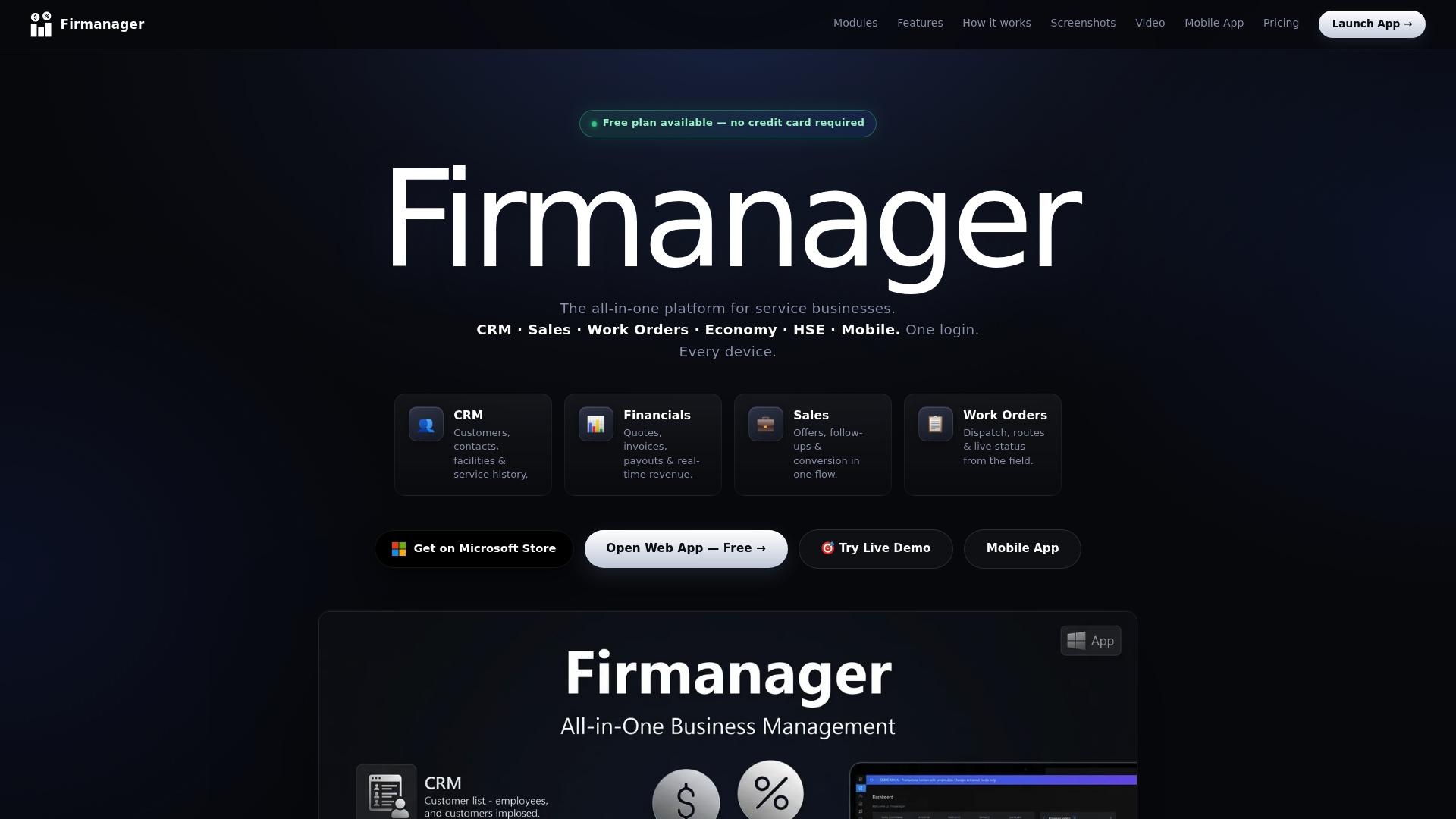
Firmanager includes real-time dashboards, an employee self-service mobile portal, HSE compliance tracking, route and dispatch management, and Stripe-integrated invoicing. Every module connects, so a work order links to the customer record, the assigned technician, the invoice, and the compliance log without manual data entry. For service businesses managing field teams, customer relationships, and financial reporting together, Firmanager's all-in-one platform removes the friction that standalone work order tools leave behind. You can also explore how it compares to leading field service alternatives for a broader view of the market.
Key Takeaways
The best work order software in 2026 connects work orders to asset data, supports mobile execution, and scales with your team's growing maintenance needs.
| Point | Details |
|---|---|
| Match software to team maturity | Simpler mobile-first tools outperform complex systems for teams with low adoption or missed requests. |
| Asset integration drives repair quality | Work orders linked to asset history, warranty status, and parts data reduce repeat failures and guesswork. |
| Deployment speed varies significantly | Single-site teams can go live in under 30 days; multi-site enterprise deployments typically take 60–90 days. |
| User pricing model affects total cost | Flat-subscription platforms with unlimited users often cost less than per-seat models for large request volumes. |
| Firmanager for full-service operations | Firmanager combines work order management with CRM, invoicing, dispatch, and compliance in one connected platform. |