Best Field Service App for Service Managers: 2026 Guide

Best Field Service App for Service Managers: 2026 Guide
Firmanager is the recommended pick for most US service businesses because it combines a native mobile technician app with a unified back office covering CRM, invoicing, inventory, and HSE compliance under a single login. For managers who need scheduling, dispatch, and real-time field data without juggling multiple subscriptions, that integration is the decisive advantage.
Quick category shortlist:
- All-in-one platform: Firmanager. Native mobile, built-in invoicing with Stripe, inventory, and CRM in one subscription.
- Mobile-first scheduling: Connecteam. Strong time-tracking and team communication for deskless workforces.
- Small-business budget options: Jobber, Kickserv, ServiceM8. Simple scheduling and QuickBooks integration at accessible price points.
- Enterprise dispatch platforms: ServiceTitan, Microsoft Dynamics 365 Field Service, Salesforce Field Service. Deep analytics and ERP integration for multi-location operators.
Hands-on testing by Inc. confirms that the platforms scoring highest in real-world evaluations share two traits: a mobile-native app that works offline and a back office that eliminates app-switching between CRM, parts, and accounting. Firmanager delivers both. You can start a free trial at firmanager.cloud or request a demo to see dispatch and invoicing in action.
Table of Contents
- What is the best field service app right now?
- How do you choose a field service app that fits your operations?
- Which app excels for your business size and trade?
- How was this evaluation conducted?
- What do field service apps typically cost, and how long does deployment take?
- Key Takeaways
- The real trade-off in choosing a field service app
- Firmanager covers the full field service workflow in one platform
- Selected sources and further reading
What is the best field service app right now?
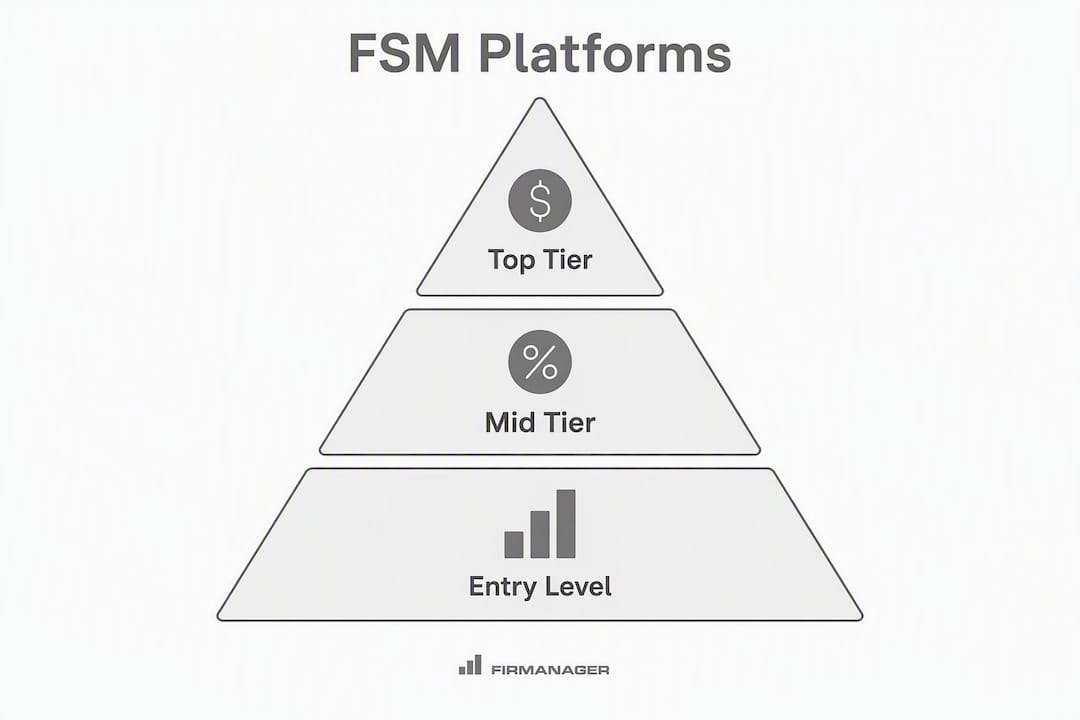
The table below covers 18 field service management (FSM) platforms across the dimensions that matter most during procurement. “Mobile app quality” distinguishes native apps (built for iOS/Android) from webview wrappers, and flags offline capability where confirmed. Pricing tiers are indicative; always verify current rates with the vendor.

| Platform | Best For | Key Strength | Mobile App Quality | Core Features | Integrations / API | Pricing | Support & Onboarding |
|---|---|---|---|---|---|---|---|
| Firmanager | Service businesses needing unified back office + mobile | All-in-one: CRM, invoicing, inventory, HSE, dispatch | Native; cloud-synced | Scheduling, dispatch, invoicing, inventory, CRM, HSE, reporting | Stripe, QuickBooks, API | Free tier; paid tiers by seat | Self-serve + paid onboarding |
| Connecteam | Workforce scheduling & communication | Mobile-first deskless team management | Native; strong offline | Scheduling, time-tracking, comms, checklists | Zapier, QuickBooks | Free for small teams; paid tiers available | Self-serve; chat support |
| Jobber | Small service businesses & solo contractors | Simple scheduling + QuickBooks integration | Native; good sync | Scheduling, quoting, invoicing, payments | QuickBooks, Stripe | Starts ~$49/mo | Self-serve; phone & chat |
| ServiceTitan | Large residential service companies | Advanced dispatch & business analytics | Native; offline capable | Scheduling, dispatch, invoicing, reporting, marketing | Accounting, CRM, API | Pricing on request | White-glove onboarding |
| Zuper | Mid-market teams needing automation | Scheduling automation & extensible workflows | Native | Scheduling, dispatch, invoicing, inventory | API, Salesforce, QuickBooks | Pricing on request | Dedicated CSM |
| Service Fusion | Core FSM with invoicing | Simple CRM, dispatch, and billing | Native | Scheduling, dispatch, invoicing, CRM | QuickBooks | Flat-fee plans available | Self-serve; phone support |
| Salesforce Field Service | Salesforce-invested enterprises | Deep CRM integration; configurable mobile | Native; offline-first | Scheduling, dispatch, mobile workflows, reporting | Full Salesforce ecosystem | Pricing on request | White-glove |
| Housecall Pro | Home services, single-location | Ease of use; customer-facing features | Native | Scheduling, invoicing, payments, CRM | QuickBooks, Stripe | Subscription plans available | Self-serve; chat |
| Kickserv | Small businesses needing basic FSM | Simple job management & dispatching | Native | Scheduling, dispatch, invoicing, CRM | QuickBooks, Stripe | Free tier; paid plans available | Self-serve |
| Microsoft Dynamics 365 Field Service | Enterprises with end-to-end operations | ERP/CRM integration in Microsoft ecosystem | Native; offline | Scheduling, dispatch, inventory, asset mgmt | Full Dynamics 365 / Azure | Pricing on request | White-glove |
| ServiceM8 | Solo contractors & very small teams | Mobile-first simplicity; quick onboarding | Native; iOS-focused | Scheduling, dispatch, invoicing, quotes | Xero, QuickBooks | Free tier; paid plans available | Self-serve |
| Contractor+ | Small contractor teams | Simple contractor-focused workflows | Native | Scheduling, invoicing, estimates | Limited | Free tier; paid plans | Self-serve |
| Zoho FSM | Businesses using Zoho suite | Zoho ecosystem integration | Native | Scheduling, dispatch, invoicing, CRM | Full Zoho suite | Seat-based pricing available | Self-serve; Zoho support |
| SafetyCulture | Teams prioritizing safety & compliance | Inspection, checklist, and compliance tools | Native | Inspections, checklists, reporting, training | API, Zapier | Free tier; paid plans available | Self-serve |
| NimbCrew | Flexible scheduling & route planning | Scheduling and route optimization | Native | Scheduling, dispatch, route planning | Limited | Pricing on request | Self-serve |
| Intuit Field Service Management | QuickBooks-heavy businesses | Tight QuickBooks accounting integration | Native | Scheduling, dispatch, invoicing | QuickBooks | Seat-based pricing available | Self-serve |
| Simpro | Trade businesses with project costing | Project costing & inventory management | Native | Job costing, inventory, scheduling, reporting | Xero, QuickBooks | Pricing on request | White-glove |
| Skedulo | Complex resource scheduling | Capacity & resource optimization | Native | Scheduling, dispatch, workforce mgmt | Salesforce, API | Pricing on request | White-glove |
How to read this table: Solo operators and small teams (1–10 techs) should focus on the Pricing and Mobile App Quality columns first. Mid-market teams (10–50 techs) should weight Key Strength and Integrations. Enterprise buyers should go straight to Support & Onboarding and Integrations, since implementation complexity often matters more than entry price.
How do you choose a field service app that fits your operations?
Three decision drivers should anchor every vendor evaluation: mobile app quality, accounting and parts integrations, and dispatch/scheduling robustness. Get those three right and most other features fall into place. Testing by Inc. found that platforms reducing app-switching between CRM, inventory, and invoicing consistently scored higher on technician satisfaction and first-visit fix rates.
Demo questions to ask every vendor
- Does the mobile app work fully offline, and how does it sync when connectivity returns?
- Can a technician view job history, parts availability, and customer notes from one screen?
- How does the app handle parts consumption and push that data to your accounting system?
- What triggers an invoice, and how long does it take for a field-captured signature to appear in your accounting ledger?
- What role-based access controls exist, and can you export all your data at any time?
- What is the onboarding timeline for a team of your size, and what does it cost beyond the license fee?
Pricing decision flow
Seat-based pricing (per technician per month) suits growing teams because costs scale predictably with headcount. Flat-fee plans work well for small, stable crews where the per-seat math would otherwise penalize growth. Watch for hidden costs that rarely appear in advertised pricing:
- Data migration from your current system
- Custom API integrations with your accounting or ERP platform
- Advanced training or white-glove onboarding packages
- Hardware (rugged tablets, barcode scanners, GPS devices)
- Add-on modules for inventory, HSE compliance, or advanced reporting
Pro Tip: Pilot the app on your hardest job type, not your easiest. A platform that handles a complex multi-site job with parts ordering and subcontractors will handle a simple service call with no trouble. The reverse is rarely true.
Security and data controls to verify
Before signing, confirm role-based access (so technicians see only their own jobs), encrypted data in transit and at rest, scheduled backups, and a clear data-export policy. For US service businesses subject to OSHA or state-level compliance requirements, check whether the platform supports HSE documentation and audit trails.
Which app excels for your business size and trade?
Firmanager
Firmanager is built for service businesses that want a single platform covering every operational layer: CRM, customer and facility management, work orders, sales pipeline, quoting, invoicing (with Stripe), inventory, supplier management, HSE compliance, time and leave tracking, route and dispatch, and real-time SMS/email notifications. The employee self-service mobile portal gives technicians job details, task assignments, and document access without needing a separate app. A free tier is available; paid tiers scale by seat and usage.
Pros: Unified back office and mobile in one login; built-in HSE compliance; Stripe invoicing; free tier available. Cons: Newer brand with a smaller public review base than legacy platforms; some advanced integrations may require configuration. Who should pick this: Service businesses of any size that want to replace a patchwork of tools with one platform and need both a technician mobile app and a full management back office.
Connecteam
Connecteam targets deskless workforces where communication and scheduling are the primary pain points. Its mobile UX is genuinely strong, and the free plan for small teams makes it a low-risk starting point. It is not a full FSM platform: invoicing, parts management, and deep dispatch are limited compared to purpose-built FSM tools.
Pros: Mobile-first design; free plan for small teams; strong time-tracking. Cons: Limited invoicing and inventory; not a complete FSM replacement for complex operations. Who should pick this: Companies whose main challenge is scheduling and team communication rather than job costing or parts management.
Jobber
Jobber markets itself to the 250,000+ service professionals who need scheduling, quoting, invoicing, and QuickBooks integration without enterprise complexity. The mobile app is native and syncs reliably. It is a strong fit for residential trades (HVAC, plumbing, landscaping) at the 1–25 tech range. For Jobber alternatives, Firmanager covers the same core features with the addition of HSE compliance and a broader back-office module set.
Pros: Clean UX; QuickBooks integration; strong small-business community. Cons: Pricing climbs quickly with added users; limited project costing for complex jobs. Who should pick this: Small residential service businesses that already use QuickBooks and want a proven, low-learning-curve FSM.
ServiceTitan
ServiceTitan is the enterprise standard for large residential service companies. Its dispatch board, reporting depth, and vertical-specific features (HVAC, plumbing, electrical) are unmatched at scale. Implementation is complex and pricing is not publicly listed, which signals enterprise-level investment. Not a realistic option for teams under 20–30 technicians.

Pros: Best-in-class dispatch and analytics; strong vertical features. Cons: High cost and implementation complexity; pricing on request only. Who should pick this: Multi-location residential service operators with dedicated IT and operations staff.
Salesforce Field Service (Agentforce)
The Salesforce Field Service mobile app is built offline-first, with map-based navigation, configurable quick actions, and in-app collaboration. For organizations already running Salesforce CRM, it is a natural extension. For everyone else, the licensing and configuration overhead is difficult to justify.
Pros: Offline-first mobile; deep CRM integration; highly configurable. Cons: Requires existing Salesforce investment; expensive and complex to configure. Who should pick this: Enterprises already on the Salesforce platform that need field operations tightly coupled to their CRM.
Housecall Pro
Housecall Pro is purpose-built for home services: HVAC, plumbing, cleaning, and similar trades at a single location. Its customer-facing features (online booking, automated follow-ups, payment links) are a genuine differentiator for businesses that compete on customer experience. It is less suited to multi-site or project-based work.
Pros: Excellent customer-facing UX; easy payments; fast setup. Cons: Limited project costing; not ideal for multi-location or complex inventory needs. Who should pick this: Single-location home service businesses prioritizing customer experience and fast payment collection.
Microsoft Dynamics 365 Field Service
For enterprises that run their operations on the Microsoft stack (Azure, Dynamics ERP, Teams), Dynamics 365 Field Service offers end-to-end asset management, scheduling, and inventory with native offline mobile support. The integration depth is exceptional; the implementation timeline and cost reflect that.
Pros: Full ERP/CRM integration; strong asset management; offline mobile. Cons: Enterprise pricing; long implementation; requires Microsoft ecosystem. Who should pick this: Large enterprises with existing Dynamics 365 or Azure infrastructure.
Remaining platforms at a glance
- Service Fusion: Small to mid-sized service businesses that want flat-fee pricing and straightforward CRM plus dispatch. Service Fusion alternatives are worth reviewing if you need stronger inventory or HSE modules.
- Intuit Field Service Management: — Businesses deeply embedded in the Intuit/QuickBooks ecosystem that want the tightest possible accounting tie.
How was this evaluation conducted?
The primary goal was to identify platforms that maximize first-visit fix rates and minimize back-office reconciliation time. Those two operational KPIs drive the most measurable ROI for service businesses and are the clearest signals of a platform’s real-world value.
Evaluation criteria, weighted in this order:
- Native mobile app quality and offline capability
- Scheduling and dispatch intelligence (automated assignment, route optimization)
- Invoicing and payment speed (field-to-ledger time)
- Inventory and parts management from the mobile app
- Accounting integrations (QuickBooks, Stripe, NetSuite, Xero)
- CRM and customer data unification
- Security controls (role-based access, data export, backups)
- Price-to-value across business sizes
- Support and onboarding quality
Testing approach: Platforms were evaluated using a scenario-based methodology similar to the approach documented by Inc. for its 2026 FSM roundup, which simulates a 10-technician service operation to compare dispatch workflows, mobile sync behavior, and billing speed. Mobile apps were assessed on real iOS and Android devices, including connectivity-interrupted scenarios to test offline behavior. Vendor claims about integrations were cross-referenced against G2’s FSM category and Gartner Peer Insights ratings.
Disclosure: Firmanager is the publisher of this guide. All competitor assessments are based on publicly available product information, third-party reviews, and hands-on evaluation. This guide was last reviewed in 2026.
Pro Tip: When running your own vendor test, assign a real technician to complete a full job cycle (dispatch, parts lookup, job completion, invoice) on each platform’s mobile app. Admin demos rarely surface the friction points that technicians encounter daily.
What do field service apps typically cost, and how long does deployment take?
Common pricing models
Most FSM platforms use one of three structures: per-technician seat pricing, per-user pricing (covering both office and field staff), or flat monthly fees. A fourth model, module-based pricing, adds cost for inventory, HSE, or advanced reporting on top of a base plan.
| Pricing Model | Typical Range | Best For | Free Tier / Trial |
|---|---|---|---|
| Free tier (limited) | Free tier available | Solo operators, evaluation | Yes (Firmanager, Connecteam, Kickserv, ServiceM8, Contractor+, SafetyCulture) |
| Entry paid (small teams) | Subscription range available | 1–10 techs | Trial usually available |
| Mid-market seat-based | Seat-based pricing range available | 10–50 techs | Trial or demo |
| Flat-fee plans | Enterprise pricing on request | Stable small crews | Demo |
| Enterprise (on request) | Custom | 50+ techs, multi-site | White-glove demo |
Implementation timeline
Deployment time varies more than pricing. A solo contractor can be live on ServiceM8 or Kickserv in a day. A 30-technician team migrating from spreadsheets to Firmanager or Jobber typically needs 2–4 weeks for data migration, configuration, and training. Enterprise platforms (ServiceTitan, Dynamics 365, Salesforce Field Service) commonly run 8–16 weeks from contract to go-live.
| Phase | Typical Duration | Key Activities |
|---|---|---|
| Pilot (1 crew) | 1–2 weeks | Configure, test mobile workflows, validate dispatch |
| Data migration | 1–3 weeks | Import customers, assets, parts catalog |
| Staff training | 1–2 weeks | Mobile app, dispatch, invoicing workflows |
| Full rollout | 1–4 weeks | All crews live; monitor KPIs |
| Optimization | Ongoing | Refine automations, integrations, reporting |
Hidden costs to budget for
- Data migration from your current system (spreadsheets, legacy FSM, or paper)
- Custom API integrations with your accounting platform or ERP
- Advanced training or white-glove onboarding beyond the base plan
- Hardware: rugged tablets, barcode scanners, GPS tracking devices
- Add-on modules (HSE compliance, advanced inventory, custom reporting)
- Ongoing admin time for platform configuration and user management
Consolidating customer, inventory, and financial data into a single platform reduces reconciliation work and cuts the hidden cost of manual data re-entry, which is often the largest ongoing cost that never appears in a vendor’s pricing sheet.
Key Takeaways
The strongest field service management platforms combine a native mobile technician app with a unified back office covering CRM, invoicing, inventory, and accounting integration, because that combination directly reduces first-visit failures and back-office reconciliation time.
| Point | Details |
|---|---|
| Prioritize mobile-native + offline | Native apps with offline sync prevent job delays when connectivity drops on site. |
| Eliminate app-switching | Platforms unifying CRM, parts, and invoicing in one login reduce admin time and billing errors. |
| Match pricing model to team size | Seat-based pricing scales with growth; flat-fee plans suit stable small crews. |
| Plan for hidden implementation costs | Budget for data migration, hardware, and training beyond the advertised license fee. |
| Firmanager for unified operations | Firmanager covers scheduling, dispatch, invoicing, inventory, HSE, and CRM under one login with a free tier to start. |
The real trade-off in choosing a field service app
Most buyers spend too much time comparing feature lists and not enough time testing one thing: what happens when a technician is on site with no signal. That single scenario exposes more about a platform’s real value than any demo. An app that loses job data, can’t pull up parts inventory, or can’t capture a signature offline will cost you more in failed first visits and re-keyed invoices than any monthly subscription fee saves.
The second underrated factor is accounting integration depth. Best-in-class platforms push invoice, expense, and inventory transactions captured in the field directly into accounting systems, cutting manual reconciliation and billing errors. Many platforms advertise “QuickBooks integration” but deliver only a one-way sync that still requires manual review. Ask vendors to demonstrate a complete field-to-ledger transaction during your demo, not just a screenshot of a settings page.
Predictable pricing matters more than it gets credit for. A platform that starts at $49/month but charges separately for inventory, HSE, and API access can easily reach $200+ per user before you’ve finished onboarding. Build the full-cost scenario before you sign, not after.
Firmanager covers the full field service workflow in one platform
Running a service business means managing scheduling, dispatch, technician mobile access, invoicing, inventory, compliance, and customer records simultaneously. Firmanager handles all of it under a single login, which means your technicians, dispatchers, and finance team are always working from the same data.
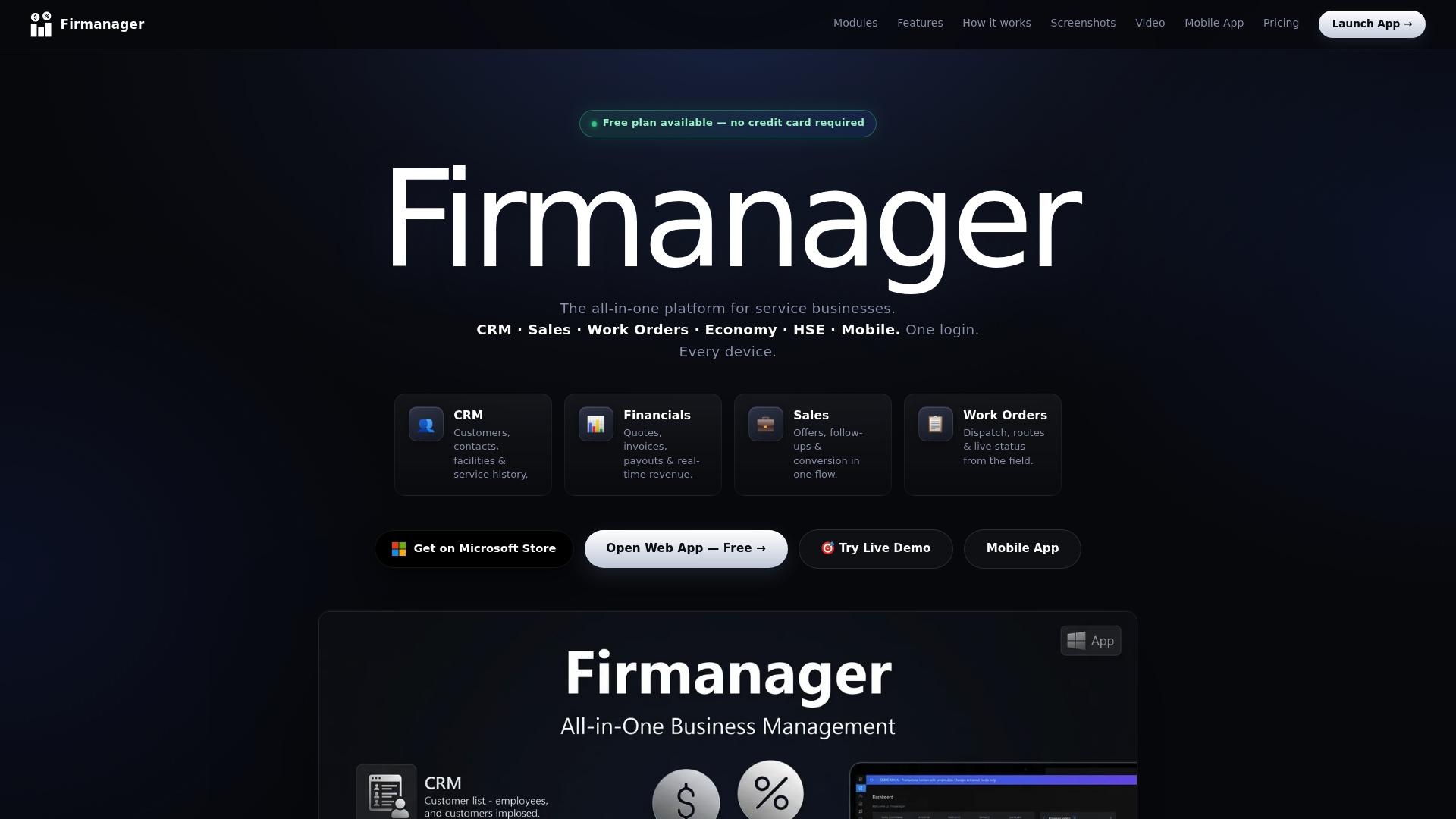
Where other platforms require separate subscriptions for CRM, invoicing, and HSE compliance, Firmanager includes them in one modular platform with a free tier to start. Key capabilities that map directly to the buying criteria in this guide:
- Scheduling and dispatch: Route and dispatch management with real-time notifications via SMS and email
- Native mobile app: Employee self-service portal for technicians, accessible on any device
- Invoicing: Automated invoicing with Stripe integration, pushing field data directly to your financial records
- Inventory: Supplier and product management with real-time tracking
- Compliance: Built-in HSE (health, safety, and environment) module with audit trails
- Reporting: Financial management with real-time analytics and custom reporting
- CRM: Full customer and facility management with sales pipeline and quoting
Onboarding is self-serve for smaller teams; larger operations can access paid onboarding support. Start a free trial or book a demo at firmanager.cloud to see scheduling, dispatch, and invoicing working together in a single workflow.
Selected sources and further reading
- G2: Best Field Service Management Software of 2026 — Independent roundup covering pricing, category fits, and user ratings for top FSM platforms.
- Inc.: We Tested the Best Field Service Software Tools — Hands-on scenario-based testing of Jobber, ServiceTitan, and others; methodology and KPIs used in this guide.
- Gartner Peer Insights: Field Service Management — Verified user reviews and ratings for enterprise FSM platforms including Dynamics 365 and Salesforce Field Service.
- Salesforce Field Service on Google Play — Product listing with feature details on offline-first mobile design and configurable workflows.
- Firmanager: All-in-One Business Management Platform — Primary product page with feature details, pricing tiers, and demo signup for US service businesses.
- Top 6 Best Field Service Software Alternatives 2026 — Firmanager’s own comparison of leading FSM alternatives with CRM and invoicing feature breakdowns.
- Best Work Order Software for Maintenance Teams in 2026 — Covers platforms combining mobile app functionality with back-office work-order management.
Recommended
Run your whole business in one place
CRM, quotes, work orders, invoicing, expenses, HR and HSE — one login, every device. Free-forever plan.
Start free →