Best Supplier Management Software for Service Businesses
Best Supplier Management Software for Service Businesses
What makes the best supplier management software?
The best supplier management software is a centralized Vendor Management System (VMS) that governs the full supplier lifecycle: onboarding, compliance, performance tracking, risk management, and offboarding. For service businesses, the right platform replaces disconnected spreadsheets and email chains with a single, auditable system your entire team can actually use.
Top-tier vendor management software delivers four core outcomes:
- Automated onboarding workflows that route supplier applications to the right reviewers without manual coordination
- Compliance tracking with proactive alerts before documents or certifications expire
- Real-time performance scorecards tied to configurable KPIs, not manual data entry
- Integration with ERP, finance, and procurement systems for continuous data accuracy
The platform model matters as much as the feature list. Leading solutions segment by enterprise procurement breadth, supplier collaboration depth, and spend integration, meaning the right fit depends on your operational priorities, not the longest feature checklist.
Table of Contents
- What supplier management software actually replaces
- Key features to look for in supplier management software
- How to choose the right supplier management software for your service business
- How Firmanager handles supplier management for service businesses
- Why a unified platform outperforms point solutions
- What to expect from pricing and total cost of ownership
- Scalability and customization in supplier management platforms
- Firmanager gives your service business one place to manage it all
- Key Takeaways
What supplier management software actually replaces
Most service businesses manage suppliers across a mix of shared drives, inboxes, and spreadsheets. The problem is not just inefficiency. It is institutional knowledge loss: when a team member leaves, the contract history, risk flags, and negotiation context go with them.
A unified supplier management platform creates what practitioners call the “golden record,” a single living supplier record containing contracts, risk flags, payment histories, and communication logs, current for everyone who opens it. This shift from reactive to proactive management is where the real operational gain lives.
Core functions a solid platform covers:
- Centralized supplier records with contact hierarchy and business classification
- Self-service supplier portals for document submission and profile updates
- Automated compliance alerts and document renewal tracking
- Configurable approval workflows with full audit trails
- Real-time scorecards updated from operational and ERP data
Pro Tip: Avoid treating supplier management software as a procurement-only tool. Integrating Legal, Finance, and Procurement into continuous unified workflows is the single factor most cited by industry experts as the difference between a tool that gets used and one that gets abandoned.
Key features to look for in supplier management software
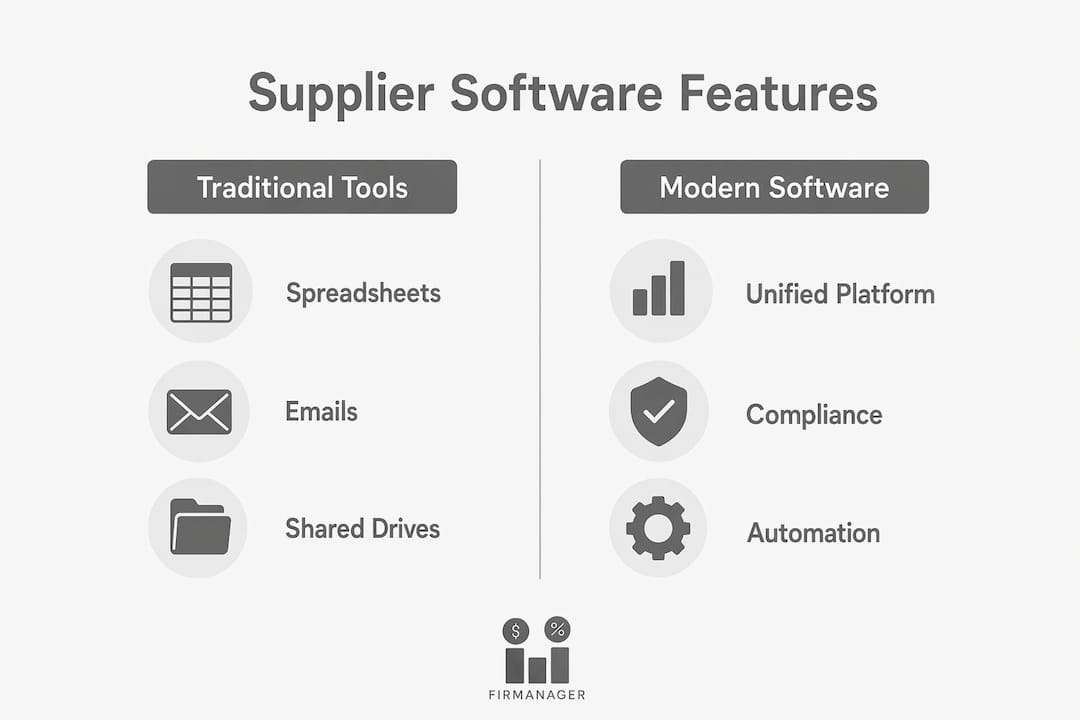
Not every platform covers the same ground. When evaluating supplier management tools, prioritize features that match your governance model and operational scale.
Supplier lifecycle management:
- Automated onboarding with multi-step approval routing by category, spend tier, or geography
- Self-service vendor portals where suppliers upload certifications and respond to compliance requests
- Full audit trail from first contact through offboarding
Compliance and risk:
- Proactive expiration alerts for insurance certificates, licenses, and compliance documents
- Risk scoring with configurable tolerance levels, not gut-feel assessments
- Continuous monitoring rather than point-in-time reviews
Collaboration and performance:
- Supplier portals with communication logs and negotiation history
- Scorecards with custom KPIs reflecting your actual business priorities
- Structured review workflows with clear ownership and follow-up tracking
Integration and data:
- ERP sync for master vendor data and invoice processing
- Role-based access controls so each team sees what it needs
- Configurable segmentation by spend tier, risk level, or strategic importance
The best choice is problem-driven, not feature-count driven. Identify your most urgent pain point first, then match the platform model to it.
How to choose the right supplier management software for your service business
Start with the problem you need to solve today. If inconsistent supplier reviews are costing you, focus on governance workflows and review cadence. If onboarding is the bottleneck, prioritize automated approval routing and self-service portals. If spend visibility is the gap, look for platforms with deep ERP integration and spend analytics.
A practical selection checklist:
- Fit with your workflows: Does the platform model (procurement-centric, collaboration-centric, or spend-integrated) match how your team actually operates?
- Ease of implementation: Most mid-market platforms target a go-live window of four to eight weeks. Confirm what implementation support is included.
- Pricing transparency: Look for published pricing tiers or a clear pricing discussion process. Hidden costs in implementation or per-module licensing add up fast.
- Security and data privacy: Role-based access, audit trails, and data encryption are baseline requirements, not premium add-ons.
- Scalability: Multi-entity and multi-business-unit configurations matter if you plan to grow or already manage multiple locations.
Aligning the platform model with your organizational workflows is what industry experts consistently identify as the primary driver of successful implementation. Choosing software based on brand recognition alone is how teams end up with a tool nobody uses.
For service businesses also managing scheduling and field operations, the same logic applies: software that fits your existing operational workflows outperforms a feature-rich platform that requires you to rebuild your processes around it.

How Firmanager handles supplier management for service businesses
Firmanager is built specifically for service businesses, and supplier management is one module inside a fully integrated operational platform, not a bolt-on. That distinction matters when your team is already managing work orders, field dispatch, invoicing, and compliance from the same system.
Key capabilities Firmanager delivers for supplier and product management:
- Centralized supplier and product records accessible across your entire operation
- Work order integration so supplier-sourced materials and services connect directly to job tracking
- Financial management with real-time analytics including spend visibility by supplier
- HSE compliance tracking with alerts and documentation built into the same platform
- Live dashboards giving you a current view of supplier status, costs, and operational data
- Employee self-service portal reducing manual coordination across procurement and field teams
- Real-time notifications via SMS and email for approvals, compliance alerts, and workflow updates
Firmanager addresses the fragmented data problem directly. Instead of pulling supplier records from one system, invoices from another, and compliance documents from a shared drive, your team works from one interface. That consolidation reduces errors, speeds up approvals, and keeps your supplier data continuously accurate.
The subscription model includes a free tier and paid plans scaled by seats and usage, making it accessible for growing service businesses without the enterprise licensing costs associated with large procurement platforms.
Why a unified platform outperforms point solutions
Running supplier management in a standalone tool while your financials, work orders, and compliance live elsewhere creates exactly the data silos that unified platforms are designed to eliminate. Every time data moves between systems manually, there is a lag, an error risk, and a gap in your audit trail.
A unified platform approach delivers three concrete advantages. First, your supplier data stays continuously validated because it feeds directly into financial and operational decisions rather than sitting in a separate database. Second, compliance monitoring becomes proactive: the system alerts you before a certificate expires, not after an incident. Third, your team spends less time chasing information across tools and more time acting on it.
For service businesses managing field service operations alongside supplier relationships, the integration benefit compounds. Supplier costs, job costs, and compliance status all live in the same record.
What to expect from pricing and total cost of ownership
Supplier management software pricing varies widely by platform type and scale. Entry-level platforms targeting small and mid-market businesses typically offer tiered subscription pricing based on vendor count or user seats, with implementation included. Enterprise platforms often carry separate implementation fees, per-module licensing, and multi-year contracts.
Total cost of ownership goes beyond the subscription fee. Factor in implementation time, training, integration work with your existing ERP or accounting system, and ongoing support costs. A platform with transparent pricing and included implementation often delivers lower total cost than a cheaper subscription with expensive professional services attached.
Firmanager’s tiered SaaS model, including a free option, keeps entry costs low while giving service businesses room to scale without renegotiating contracts.
Scalability and customization in supplier management platforms
Your supplier base grows as your business does. The platform you choose today needs to handle that growth without requiring a full migration in two years. Look for multi-entity support, configurable workflows, and the ability to add governance tiers as your supplier count increases.
Customization matters at the workflow level: approval routing by category, custom KPIs on scorecards, and configurable compliance document types. Platforms that lock you into fixed workflows create friction as your operational model evolves. Role-based access controls are equally important, ensuring each team member sees the data relevant to their function without exposing sensitive financial or risk data across the organization.
Compliance tracking automation and configurable risk alerts are the features that scale best, because they reduce manual oversight as your supplier base grows rather than adding to it.
Firmanager gives your service business one place to manage it all
Service businesses running supplier management in a separate tool from their CRM, invoicing, and work orders are paying a hidden tax in manual coordination every single day.
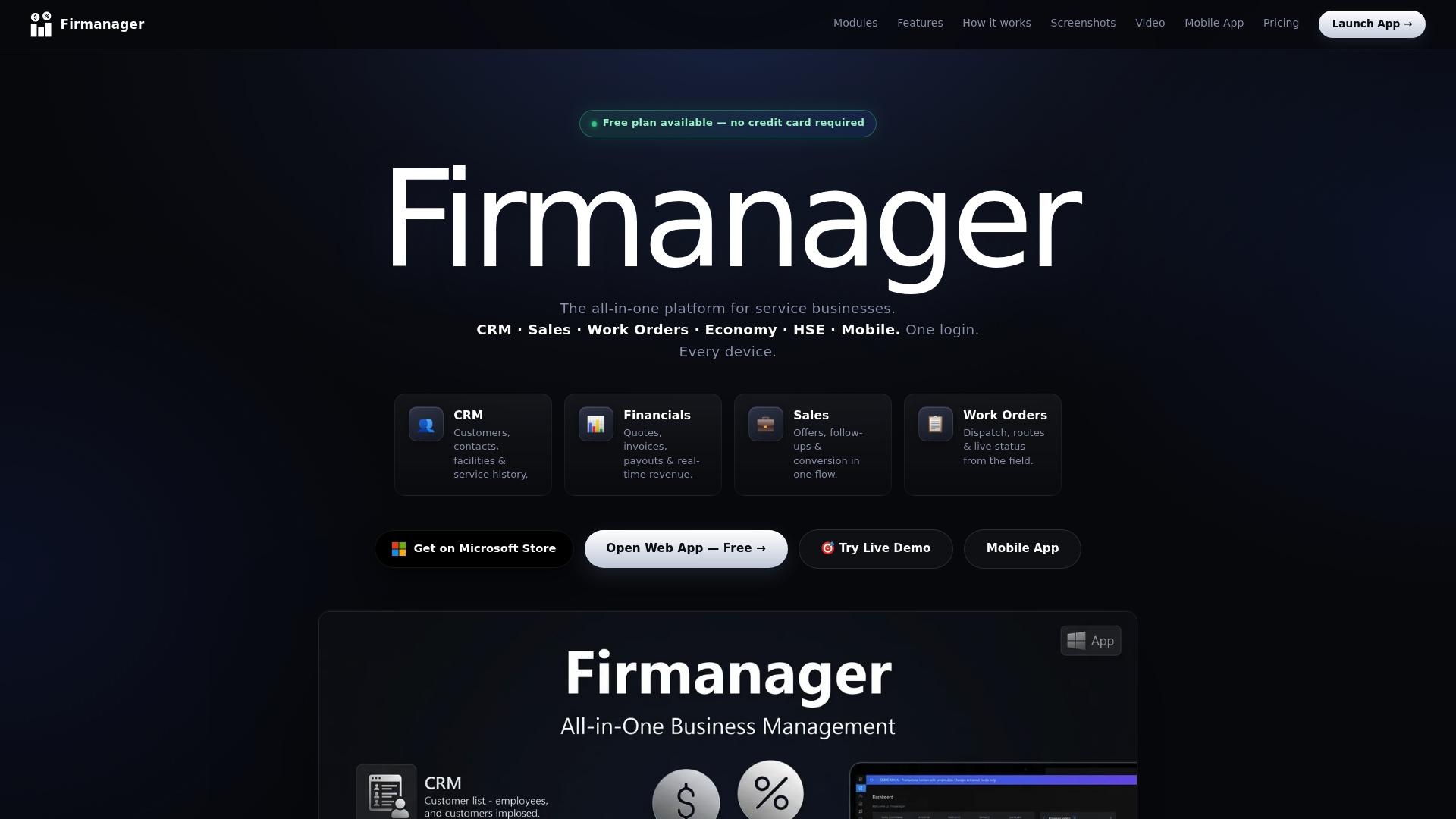
Firmanager consolidates supplier and product management, financial reporting, compliance tracking, work order management, and real-time analytics into one platform built for service operators. You track supplier costs against job budgets, manage compliance documents alongside HSE requirements, and approve supplier onboarding from the same interface your field team uses for dispatch. No separate logins, no manual data transfers, no gaps in your audit trail.
The tiered subscription model means you can start with what you need now and scale as your operation grows. Explore Firmanager and see how it fits your supplier and operational workflows.
Key Takeaways
The best supplier management software for service businesses is a unified platform that connects supplier lifecycle management directly to financial, compliance, and operational workflows.
| Point | Details |
|---|---|
| Start with your pain point | Choose software based on your most urgent need: governance, onboarding speed, compliance, or spend visibility. |
| Unified platforms outperform point solutions | Connecting supplier data to finance and operations eliminates manual transfers and keeps records continuously accurate. |
| Compliance must be proactive | The best platforms alert you before documents expire, not after an incident creates liability. |
| Pricing transparency matters | Factor in implementation, integration, and support costs, not just the subscription fee, when comparing total cost of ownership. |
| Firmanager for service businesses | Firmanager integrates supplier and product management with CRM, work orders, HSE compliance, and financial analytics in one platform. |
Recommended
Run your whole business in one place
CRM, quotes, work orders, invoicing, expenses, HR and HSE — one login, every device. Free-forever plan.
Start free →