What are the best route optimization software options for US logistics managers?
The best route optimization software for US logistics managers in 2026 are Routific, Onfleet, and OptimoRoute for core delivery operations. Badger Maps and SPOTIO lead for field sales teams. Each platform addresses a distinct operational need, from last mile delivery automation to granular constraint management.
Choosing the wrong tool costs more than just money. Poor route planning inflates fuel costs, strains drivers, and erodes customer trust. The platforms below are evaluated on algorithmic strength, integration depth, ease of use, and fit for US-based logistics operations.
| Software | Best For | Pricing Model | Core Features | Integrations | Ease of Use | Rating |
|---|---|---|---|---|---|---|
| Routific | Delivery route optimization | SaaS, free trial available | AI routing, live tracking, driver app, ETAs | Routing engine API | Moderate | 5★ (2) |
| Onfleet | Last mile delivery | SaaS, tiered plans | Real-time GPS, proof of delivery, auto notifications | Food, retail, healthcare systems | High | 4.3★ (10) |
| OptimoRoute | Complex constraint management | SaaS, tiered plans | Constraint-based planning, workload balancing, driver app | Excel import, API | High | — |
| Badger Maps | Field sales routing + CRM | SaaS, tiered plans | CRM sync, territory mapping, Voice-to-CRM, lead routing | Salesforce, HubSpot, Dynamics, Zoho, 10+ more | High | 4.8★ (87) |
| SPOTIO | AI-driven field sales | SaaS, tiered plans | Next Best Action AI, voice capture, pipeline management | CRM sync, territory management | Moderate | 3.8★ (65) |
| FarEye | Enterprise delivery orchestration | Enterprise pricing | Fleet visibility, driver dispatch, delivery monitoring | Enterprise ERP/WMS | Moderate | 3.4★ (17) |
| SpeedRoute | Flexible delivery scheduling | Not publicly listed | Custom routing, scheduling flexibility | — | Moderate | 5★ (3) |
| Route Optimization Consultants | Municipal and waste collection routing | Consulting + software | Route audits, KPI analysis, waste routing software | Municipal systems | Specialized | 5★ (1) |
| RouteSolutions | Route planning with support focus | Not publicly listed | Route planning, tracking, navigation | — | Moderate | — |
| Roadwarrior | Mobile daily route management | Not publicly listed | Mobile route planning, on-the-go optimization | — | High | — |

How do these platforms compare on features, pricing, and real-world performance?
Routific is built around a smart routing algorithm that factors in live traffic, driver preferences, and business priorities simultaneously. Its dispatcher dashboard and driver app work together cleanly, making it a practical fit for small to mid-size delivery fleets that need professional-grade optimization without a steep learning curve. A free trial is available.
Onfleet targets last mile delivery specifically, with AI-powered automation covering proof of delivery capture, automated customer notifications, and delay alerts. It holds recognition as a Route Planning and Fleet Management Leader on G2 and a Top 20 Fleet Management Software on Capterra. Retail, food, beverage, and healthcare delivery teams are its strongest use case.

OptimoRoute earns its reputation through constraint handling. Logistics managers dealing with time windows, driver licensing requirements, and mixed vehicle fleets report that OptimoRoute accommodates those variables without manual workarounds. One verified user noted it handles "time, date and licensing constraints which was critical for our business needs" while managing high order volumes. Its Excel import and API make onboarding straightforward.
Badger Maps takes a different angle entirely. It is a field sales routing tool that connects directly to CRM platforms including Salesforce, HubSpot, Microsoft Dynamics, Zoho, Oracle NetSuite, Veeva, Pipedrive, and more. Its Voice-to-CRM feature lets sales reps log call notes hands-free while driving, which is a genuine time saver for teams covering large territories.
SPOTIO pairs route optimization with an AI co-pilot called DASH, which delivers Next Best Action recommendations to field reps before each visit. It also captures voice data and scans business cards, reducing manual data entry. For sales-focused teams, it goes beyond routing into full sales execution support.
FarEye is built for enterprise scale, covering driver dispatch, fleet monitoring, and delivery orchestration across large networks. Its integration depth with enterprise ERP and WMS systems suits organizations running complex, multi-leg supply chains.
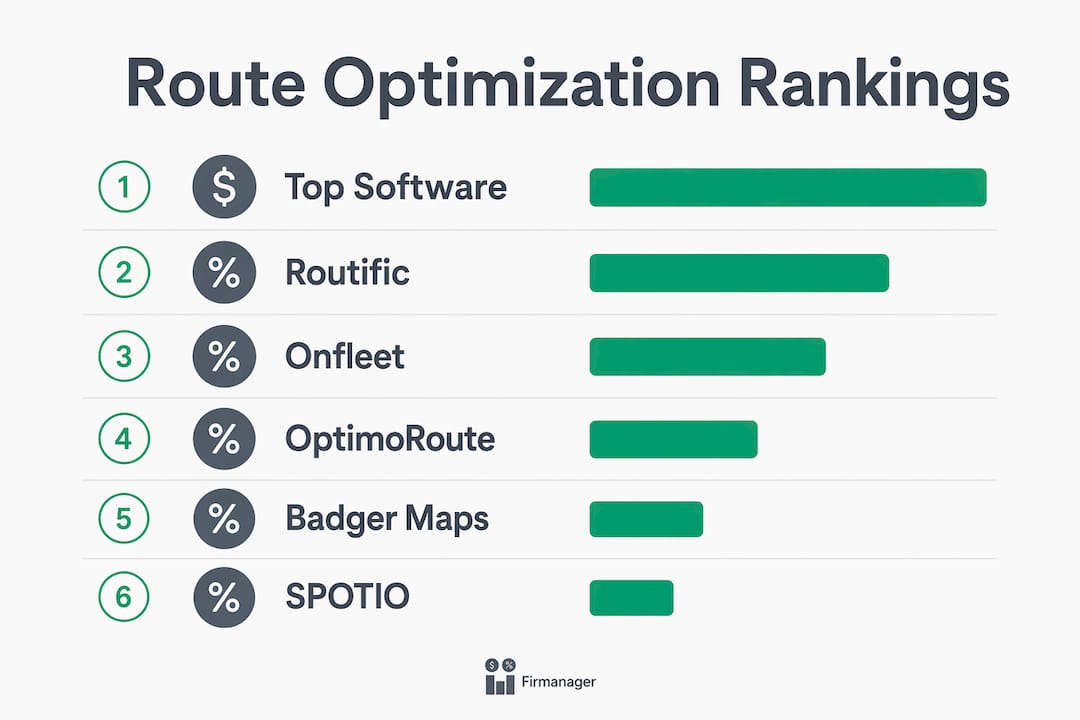
SpeedRoute focuses on scheduling flexibility for delivery businesses that need custom routing configurations. RouteSolutions positions itself around dedicated customer support alongside core route planning and tracking. Roadwarrior is a mobile-first app suited to owner-operators or small teams managing daily stops on the go. Route Optimization Consultants is a US-based firm specializing in waste collection and municipal routing, offering consulting, route audits, and KPI analysis for high-density and specialized scenarios.
Pro Tip: Before committing to any platform, test it against your actual constraint set: time windows, vehicle types, and driver certifications. A tool that handles your real-world rules beats a faster algorithm that ignores them.
How do you choose the right route planning software for your business?
Selecting route optimization software requires balancing algorithmic power with day-to-day usability. A system that produces theoretically optimal routes but confuses drivers creates its own inefficiencies. Here are the criteria that matter most:
- Business size and delivery volume. Small fleets under 10 drivers benefit from tools like Routific or Roadwarrior. Mid-market operations with complex constraints fit OptimoRoute. Enterprise networks need FarEye or a comparable platform with deep ERP integration.
- Constraint complexity. If your routes involve delivery time windows, vehicle weight limits, or driver certifications, prioritize granular rule-setting over basic mapping. Software that cannot encode your constraints will require manual corrections that erase any efficiency gain.
- Integration with your existing tech stack. Real-time connection with your CRM, ERP, or WMS is often more critical than the routing algorithm itself. Platforms that require manual data imports create bottlenecks at scale. Badger Maps and SPOTIO excel here for sales-driven teams; OptimoRoute and FarEye serve operations-heavy environments.
- Driver experience. Algorithmically efficient routes can produce overlapping, confusing paths that frustrate drivers and hurt retention. Look for platforms that offer territorial consistency settings alongside pure distance minimization.
- Scalability and customization. Your software should handle twice your current order volume without a platform change. Confirm API availability and whether the vendor supports custom rule configurations as your operation grows.
- Trial periods and demos. Routific offers a free trial. OptimoRoute provides a demo. Never commit to an annual contract without testing the tool against a real week of your routes.
Pro Tip: Map your current tech stack before evaluating any tool. If your CRM is Salesforce and your ERP is NetSuite, shortlist only platforms with native connectors to both. Manual imports at scale are a hidden cost that compounds weekly.
How was this software evaluated?
Every platform in this comparison was assessed against a consistent set of criteria drawn from real logistics operations, not just vendor marketing.
| Evaluation Dimension | What Was Assessed |
|---|---|
| Route efficiency | Algorithm quality, constraint handling, traffic integration |
| Ease of use | Driver app clarity, dispatcher interface, onboarding time |
| Integration flexibility | Native connectors to CRM, ERP, WMS, and API availability |
| Customer support | Response quality, documentation depth, support tier availability |
| Cost-effectiveness | Pricing transparency, free trial availability, value per seat |
The core distinction tested was transitioning from basic trip planning to true route optimization with capacity constraints, delivery windows, and real-time traffic. Tools that only sequence stops without encoding real-world rules were rated lower, regardless of interface quality. Driver-friendly settings that reduce "spaghetti routes" were weighted alongside pure algorithmic efficiency, because retention and adoption determine whether any software delivers its promised savings.
What makes US-focused route optimization different in 2026?
The US logistics market has specific characteristics that shape which tools perform best here. Urban density in metros like Chicago, Los Angeles, and New York creates routing challenges that differ sharply from rural or suburban delivery patterns. Several providers address this directly.
- Route Optimization Consultants is one of the few US-based firms offering waste collection routing consulting alongside software, covering municipal solid waste, postal, and para-transit routing for high-density environments.
- Badger Maps and SPOTIO are built for the US field sales model, where reps cover large geographic territories and need CRM data synced in real time from the road.
- AI-driven features are accelerating fast. Voice-to-CRM, real-time traffic adjustment, and Next Best Action recommendations are now standard in leading field sales tools, not premium add-ons.
- A common implementation pitfall in US operations: teams adopt route optimization software but fail to integrate it with existing enterprise platforms like CRM or ERP, then wonder why efficiency gains stall. The software is only as useful as the data flowing into it.
- Driver retention is an underappreciated factor. Routes that prioritize territorial consistency over pure distance minimization tend to reduce driver turnover, which is a real cost in a tight US labor market.
For logistics managers evaluating field service software alternatives, the 2026 market rewards platforms that combine algorithmic depth with practical usability and tight integration, not just the fastest solver.
Firmanager gives logistics businesses one platform for routes, CRM, and operations
If you manage field service or delivery operations and find yourself juggling separate tools for routing, customer management, invoicing, and compliance, Firmanager offers a different approach.
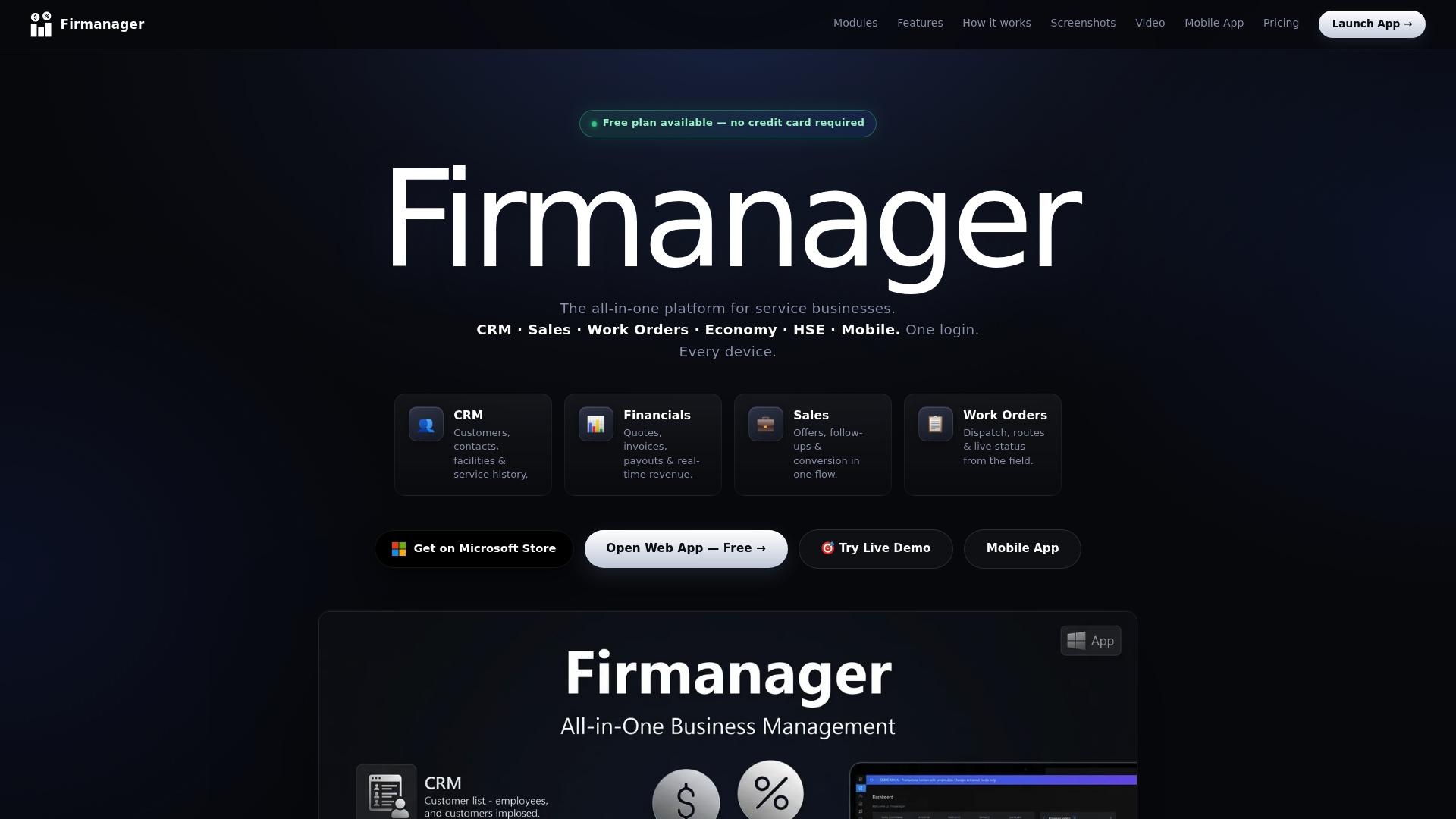
Firmanager is an all-in-one business management platform built for service businesses, providing tailored make-ready operations for multifamily property teams. It includes route and dispatch management alongside CRM, work order tracking, financial reporting, invoicing with Stripe integration, and HSE compliance, all in a single interface. You get live dashboards, real-time SMS and email notifications, and an employee self-service mobile portal without stitching together five separate subscriptions.
Key advantages for logistics and field service managers:
- Route and dispatch management integrated with customer and facility data
- Real-time financial analytics and invoicing in the same platform
- Tiered SaaS pricing with a free plan available
- No manual data imports between disconnected tools
Explore Firmanager's platform to see how it fits your operation.
Key Takeaways
The best route optimization software matches your constraint complexity, integration needs, and driver experience requirements, not just your stop count.
| Point | Details |
|---|---|
| Match tool to constraint complexity | OptimoRoute and FarEye handle time windows and licensing rules; simpler tools suit smaller fleets. |
| Integration drives real-world gains | Connecting routing software to your CRM or ERP prevents data silos that erase efficiency gains. |
| Driver-friendly routing improves retention | Territorial consistency settings reduce confusing paths and lower driver turnover in tight labor markets. |
| US niche providers fill specific gaps | Route Optimization Consultants serves municipal and waste collection needs that general platforms skip. |
| Firmanager consolidates route and ops management | Firmanager combines dispatch, CRM, invoicing, and compliance in one platform for service businesses. |